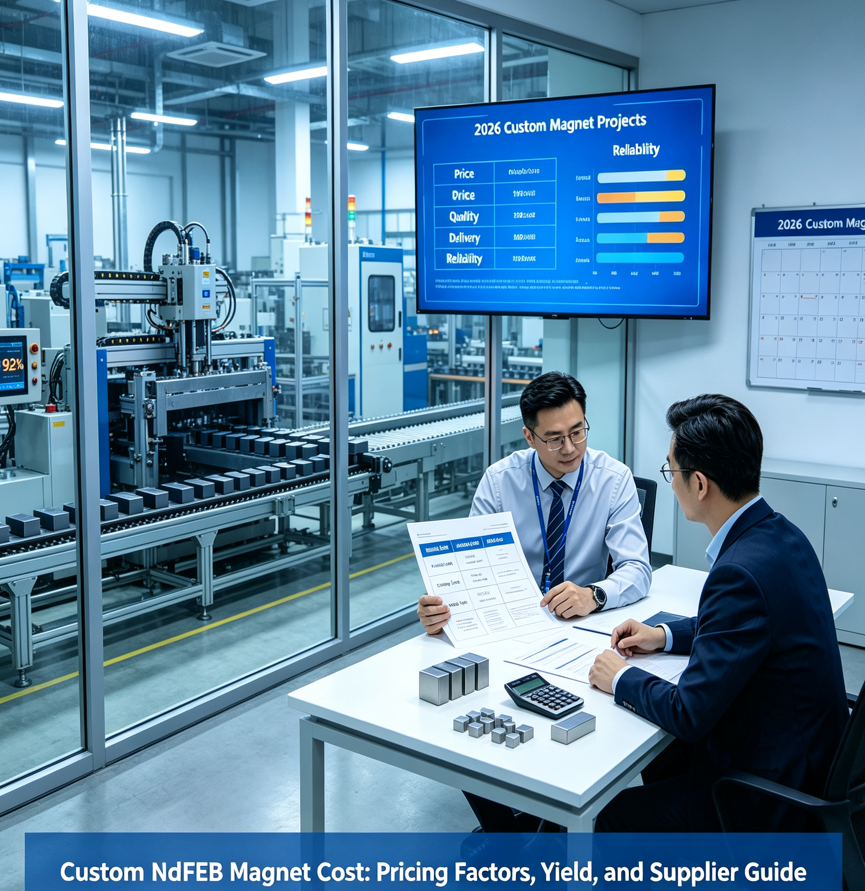
Custom NdFeB Magnet Cost: Pricing Factors, Yield, and Supplier Guide
Most procurement teams have had this conversation. Two suppliers quote the same N42 magnet, with the same dimensions and coating—and the prices can differ significantly. One quote looks competitive. The other looks inflated. But the cheaper option is not always the better one.
Custom NdFeB magnet pricing is not arbitrary. It reflects raw material costs, machining yield, tolerance requirements, coating choices, magnetization complexity, and order volume. Understanding how these factors interact helps buyers evaluate quotations more accurately and avoid decisions that create problems later in production.
This guide breaks down the real cost drivers behind custom NdFeB magnets and explains what procurement and engineering teams should look for when comparing supplier quotes.
What Actually Drives the Price of a Custom NdFeB Magnet
Raw Material: The Largest Cost Component
Rare earth materials are among the primary cost drivers of NdFeB magnets, although the exact percentage varies by grade, geometry, yield, and market conditions. Neodymium, praseodymium, and the heavy rare earths (dysprosium, terbium) used in high-temperature grades are the primary material inputs—making rare earth market prices a direct influence on magnet quotations.
This creates a direct link between rare earth market prices and your magnet costs. When NdPr metal prices rise, magnet quotations follow—sometimes within weeks, sometimes with a delay depending on the supplier’s inventory position and purchasing strategy.
Grade selection is the first cost lever. A higher grade (N52 vs. N42) means more magnetic strength in the same volume, but it also means higher material cost. For high-temperature grades (SH, UH, EH), the addition of dysprosium or terbium significantly increases raw material cost.
Machining: Where the Hidden Costs Live
Sintered NdFeB is difficult to machine. The material is hard but brittle—prone to chipping, cracking, or edge breakage during cutting and grinding.
Common machining defects include edge chipping, delamination, and micro-cracks. These defects are not always visible, but they reduce performance and may cause field failures later.
To avoid these defects, manufacturers use diamond abrasive tools with coolant flood to keep the cutting zone below the temperature where thermal demagnetization and cracking become likely. Feed rates are slow compared to machining steel.
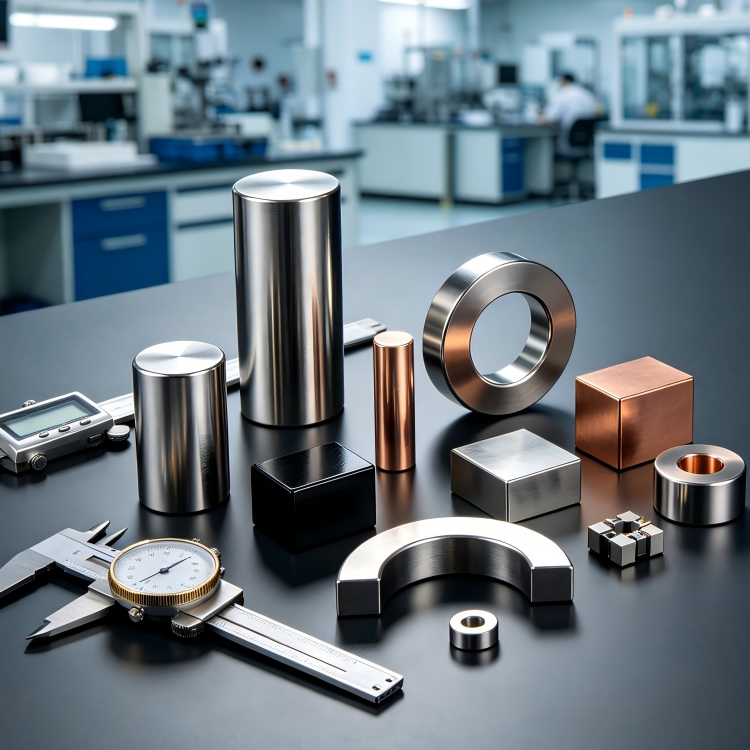
This is why machining cost varies so much between parts. A simple disc or block that can be sliced and ground efficiently has much lower machining cost than a complex arc segment or a thin-walled ring that requires wire EDM.
The Yield Problem: Why Your Unit Price Is Higher Than the Material Cost
Here is where many procurement teams get surprised. The material cost of a 1 kg NdFeB block is not the same as the material cost of the finished magnets you receive. The difference is yield—the percentage of raw material that becomes usable finished parts.
For sintered NdFeB machining, typical yield rates vary significantly depending on magnet geometry, machining allowance, equipment, and quality requirements. Common ranges include:
-
Slicing yield (block to plates): 70–85%
-
Grinding yield (to final dimensions): 85–95%
-
Overall yield: 60–80% depending on part complexity
This means that for every 1 kg of raw NdFeB block purchased, only a portion becomes finished magnets. The rest is lost as kerf (cutting waste), grinding swarf, and rejected parts.
The cost impact is direct. If a raw block costs $40/kg and overall yield is 72%, the effective material cost per finished kilogram is $40 ÷ 0.72 = $55.60/kg.
For complex shapes—arc segments, thin rings, multi-pole configurations—yield can drop further. Material utilization for irregular shapes is sometimes significantly lower than for simple discs. This is why a custom-shaped magnet often costs more than a simple disc of the same weight.
Tolerance: Each Decimal Place Has a Cost
Tolerance requirements directly affect yield and machining time. Tighter tolerances require additional grinding passes, more frequent inspection, and higher scrap rates.
| Tolerance Level | Typical Application |
|---|---|
| ±0.10–0.20 mm | General-purpose, non-critical fit |
| ±0.05 mm | Standard precision, most industrial applications |
| ±0.03 mm | Servo motors, precision sensors |
| ±0.02 mm | High-precision motors, encoder rings |
| ±0.01 mm | Wire EDM shapes, ultra-precision applications |
The cost increase is not linear. Tighter tolerances may require additional machining passes, specialized tooling, more frequent inspection, and higher scrap rates. The actual impact depends heavily on part geometry and production volume.
Coating: Cost vs. Environment
Coating cost is driven by the coating type and the required corrosion performance.
| Coating | Relative Cost | Typical Application |
|---|---|---|
| Zinc | Low | Dry indoor environments |
| Ni-Cu-Ni | Low–Medium | General industrial applications |
| Epoxy | Medium | High humidity / corrosion-prone environments |
| Parylene | High | Specialized / demanding environments |
Actual salt spray performance should be confirmed through supplier test data under the specified ASTM B117 test conditions. Coating performance depends on thickness, pretreatment, substrate condition, sealing, and sample geometry—not just the coating type.
Important: A coating does not increase the intrinsic temperature rating of the NdFeB material. Maximum operating temperature is primarily determined by the magnet grade and its magnetic properties, while the coating protects the magnet from environmental corrosion.
Magnetization: Complexity Adds Cost
Simple axial or diametric magnetization is relatively low cost. Multi-pole magnetization—where the magnet is magnetized with alternating poles around a circumference—requires custom fixtures and more time.
Multi-pole configurations with different pole counts can be produced on suitable ring or arc geometries, depending on the magnet design and magnetization fixture. The cost increases with pole count and complexity. For high-volume production, the magnetization fixture cost is amortized across the order. For small batches, the fixture cost may be a significant portion of the total.
Order Volume: Tooling and Setup Distribution
Tooling and setup costs are distributed across the batch size. A small order may carry a per-unit cost that is significantly higher than a large order, even if the magnet specifications are identical. This is not a markup—it is the reality of manufacturing. Grinding fixtures, magnetization fixtures, and inspection setup are the same whether you order 500 pieces or 50,000. The difference is how many pieces share that cost.
How Machining Method Affects Cost and Yield
The two primary methods for cutting large NdFeB blocks into thinner plates are diamond wire slicing and multi-blade cutting. Each has different cost, yield, and quality implications.
| Parameter | Diamond Wire Slicing | Multi-Blade (Gang) Cutting |
|---|---|---|
| Kerf width | Narrower | Wider |
| Material loss per plate | Lower | Higher |
| Surface roughness | Smoother | Rougher |
| Cutting speed | Slower | Faster |
| Suitable volume | Prototypes, small batches | High-volume production |
| Per-part cost | Higher | Lower |
Diamond wire slicing produces a smoother surface with less material loss, but it is slow and has a higher consumable cost than conventional multi-blade cutting. Multi-blade cutting is faster and more cost-effective for high volumes, but the wider kerf means more material waste and a rougher surface that requires additional grinding allowance.
For procurement teams, this means that a quotation based on diamond wire slicing will be higher per unit than one based on multi-blade cutting—but the diamond wire option may reduce total cost by lowering grinding requirements and improving yield. The right choice depends on the part geometry, tolerance requirements, and order volume.
What to Ask a Supplier About Pricing
When comparing quotations from different NdFeB magnet suppliers, here are the questions that reveal whether a price is realistic or hiding a quality risk:
1. What yield rate is assumed in the quotation?
A supplier who quotes a price based on high yield but delivers lower yield will either lose money on the order or cut corners. Ask what yield rate is assumed and what happens if actual yield is lower.
2. Is the quotation based on a specific machining method?
Diamond wire slicing and multi-blade cutting have different cost structures. A quotation that does not specify the machining method may be based on assumptions that do not match your part requirements.
3. What is the assumed order volume for the quoted price?
Many quotations include a volume assumption. If your actual order volume is lower, the price may change.
4. How is the raw material cost calculated?
Is the quotation based on current NdPr prices? Is there a price adjustment mechanism if raw material costs change during production?
5. What inspection and documentation is included?
Is dimensional inspection included, or is it an add-on? Are test reports provided? What inspection frequency is assumed?
6. What happens if the first production run yields lower than expected?
A supplier who has not considered yield variability may surprise you with a price increase after the first run. Ask how they handle yield shortfalls.
These questions help separate suppliers who understand their own cost structure from those who are simply guessing.
Why In-House Manufacturing Can Improve Cost Control
For buyers, the supplier’s manufacturing model affects both price stability and quality consistency. A supplier with in-house production has several structural advantages:
| In-House Capability | Cost Impact |
|---|---|
| Own sintering | Direct control over material quality and production scheduling |
| Engineering review | Reduces unnecessary machining by evaluating geometry before production |
| Yield analysis | Improves material utilization by identifying features that reduce yield |
| In-house process control | Reduces coordination costs and quality handoff risks |
This is not about marketing claims. It is about where the cost actually comes from. When a supplier outsources critical processes such as sintering or coating, additional coordination may be required, and visibility into process control can be more limited. A supplier who controls these processes internally can identify cost drivers earlier and respond to problems before they affect delivery.
Each production stage directly affects a specific performance characteristic:
| Process Stage | What It Controls |
|---|---|
| Raw material control | Magnetic consistency across batches |
| Sintering and heat treatment | Br, Hcj, and temperature stability |
| Machining | Dimensional tolerance |
| Coating | Corrosion resistance |
| Magnetization | Final magnetic output |
This is why buyers should ask whether a supplier performs these steps internally. A supplier who outsources sintering or coating has less visibility into the variables that determine whether the magnet performs as specified.
How DAWA Handles Cost and Yield Management
DAWA has been manufacturing NdFeB magnets for 35 years. Production covers sintering, machining, coating, magnetization, and final inspection within our own production system.
Sintering
DAWA operates its own sintering production, which provides visibility into material quality and yield from the earliest stage. Raw material purchasing is managed internally, allowing better control over material cost and availability.
Machining
For qualified geometries, DAWA supports dimensional tolerances down to ±0.02 mm. Machining methods are selected based on part geometry, tolerance requirements, and order volume—balancing yield, surface finish, and cost.
Yield Management
Custom shapes—arc segments, rings, and complex geometries—are evaluated for manufacturability before production. The engineering team reviews the drawing to identify features that may reduce yield or require special fixturing, and provides feedback before tooling is committed. This reduces the risk of unexpected cost increases after production begins.
Coating
Multi-layer nickel-copper-nickel is standard. Epoxy, gold, and other coatings are available based on application requirements. Coating processes are controlled internally to maintain consistent adhesion and corrosion performance.
Inspection
Dimensional inspection is performed on critical features. Magnetic performance is verified before shipment. Test data can be provided upon request.
DAWA has experience supplying NdFeB magnet solutions for applications including TWS earbuds, servo motors, and other high-precision assemblies. This experience is particularly useful when a project moves from prototype samples to volume production, where yield stability and process control directly affect cost and delivery.
Why do two suppliers quote different prices for the same N42 magnet?
Price differences usually come from raw material sourcing, machining yield assumptions, tolerance requirements, coating specifications, and order volume. A lower quote may assume higher yield or a less precise machining method.
What is machining yield and why does it matter?
Yield is the percentage of raw NdFeB material that becomes usable finished parts. For custom shapes, overall yield can be significantly lower than for simple discs. Lower yield means higher effective material cost per finished part.
How does tolerance affect price?
Tighter tolerances may require additional grinding passes, more inspection, and higher scrap rates. The cost increase is not linear—the actual impact depends on part geometry and production volume.
Why is a complex shape more expensive than a simple disc?
Complex shapes have lower material utilization and require more machining time. Material utilization for irregular shapes is often significantly lower than for simple discs.
Does coating affect the price significantly?
Yes. Zinc is the lowest cost, Ni-Cu-Ni is mid-range, and epoxy and parylene are higher cost. The right choice depends on the operating environment and required corrosion performance.
How does order volume affect unit price?
Tooling and setup costs are distributed across the batch. A small order may have a per-unit cost significantly higher than a large order with identical specifications.
Why is a custom magnet more expensive than a standard magnet?
Custom magnets may require dedicated tooling, special machining, lower material utilization, additional inspection, and customized magnetization fixtures. These costs are distributed over a smaller production volume, increasing the unit price.
Can I reduce NdFeB magnet cost without changing performance?
Yes. Cost can sometimes be reduced through geometry optimization, tolerance review, machining method selection, coating selection, order consolidation, and material utilization improvements. The goal is not simply to choose a lower grade, but to optimize the complete magnet specification around the actual application requirements.
What should I ask a supplier before accepting a quote?
Ask about yield assumptions, machining method, order volume assumptions, raw material pricing basis, inspection scope, and how yield shortfalls are handled.
Does DAWA offer custom shapes with tight tolerances?
Yes. DAWA supports custom shapes including arc segments, rings, and wire EDM profiles. Qualified geometries can be manufactured to tolerances down to ±0.02 mm.
Dawa Jiahao, facilitate innovation and mass production