How to Specify Neodymium Magnets: Tolerance, Size, Shape, and Magnetization Direction
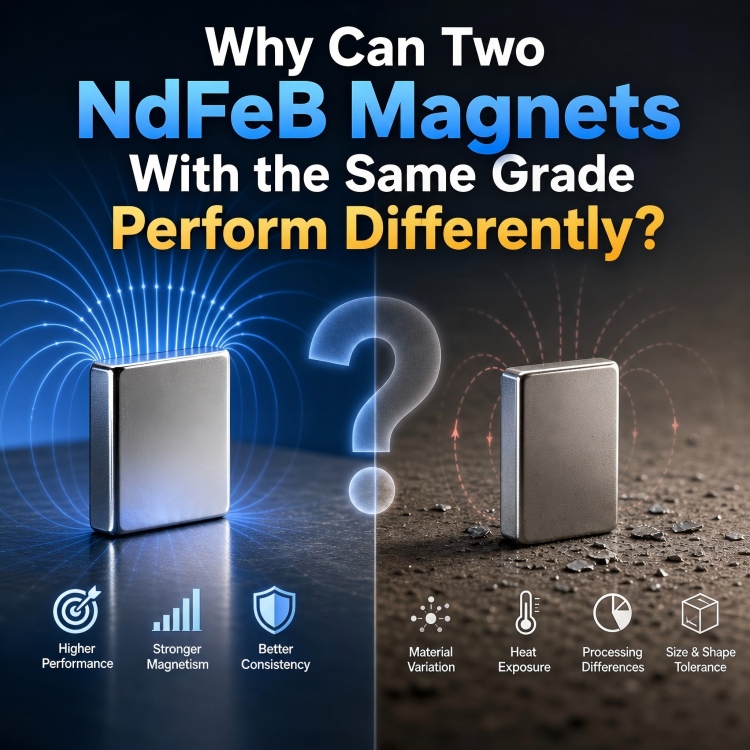
Sourcing NdFeB magnets is not like sourcing standard components. Two magnets can look identical, carry the same grade label, and still perform differently in your assembly. The difference shows up later—as a calibration shift, a torque shortfall, or a field failure that is difficult to trace.
For OEM buyers, the challenge is not simply finding a supplier that can produce magnets, but identifying a supplier that can consistently meet magnetic, dimensional, coating, and delivery requirements at scale. Demand for NdFeB magnets continues to grow across electric vehicles, industrial motors, renewable energy, robotics, and other high-performance applications. With that growth comes a wider pool of suppliers—and a corresponding increase in the need for careful evaluation.
This guide covers what procurement and engineering teams should verify before approving an NdFeB magnet supplier in 2026.
Most quality issues in NdFeB sourcing fall into a few recurring categories.
1. Incorrect Grade Identification
A magnet may be labeled as a higher grade than it actually is. The performance gap between N35 and N52 is substantial—but not always visible without testing.
Surface flux density alone should not be used to verify magnet grade. Surface readings are affected by magnet size, shape, air gap, measurement position, magnetization direction, and the Gaussmeter used. Buyers should evaluate the complete magnetic specification—including Br, Hcj, Hcb, and BHmax—using standardized test methods.
2.Batch-to-Batch Variation
Two magnets from the same supplier may perform differently across production runs. For motor applications, flux variation directly affects torque and efficiency. For sensors, it affects position accuracy. The failure is often invisible until it reaches the field.
3. Incomplete Test Documentation
Some suppliers provide test reports that cover only basic dimensions or surface flux. A complete report should include magnetic properties measured on a hysteresisgraph, dimensional inspection data, and coating test results where applicable.
4. Inconsistent Coating Quality
Coating defects—uneven thickness, poor adhesion, or porosity—can lead to corrosion in humid or saline environments. Salt spray testing per ASTM B117 is a standard way to verify coating performance.
4. Dimensional Variation
Tolerance deviations affect assembly fit, air gap in motors, and sensor alignment. For precision applications, dimensional verification is as important as magnetic testing.
Factory vs Trading Company: What OEM Buyers Should Consider
Many suppliers listed as “factories” on B2B platforms are trading companies. Both models have a place in the market, but they differ in ways that matter for long-term OEM programs.
| Factor | Direct Manufacturer | Trading Company |
|---|---|---|
| Production control | Direct | Depends on upstream supplier |
| Customization | Usually stronger | Depends on factory relationship |
| Technical support | Direct engineering team | May require coordination |
| Traceability | Usually easier | Depends on supplier |
| Supplier flexibility | Production-based | Multi-source possible |
| Quality issue resolution | In-house | Requires coordination with factory |
| Cost transparency | Direct view of material and processing costs | Markup structure may be less clear |
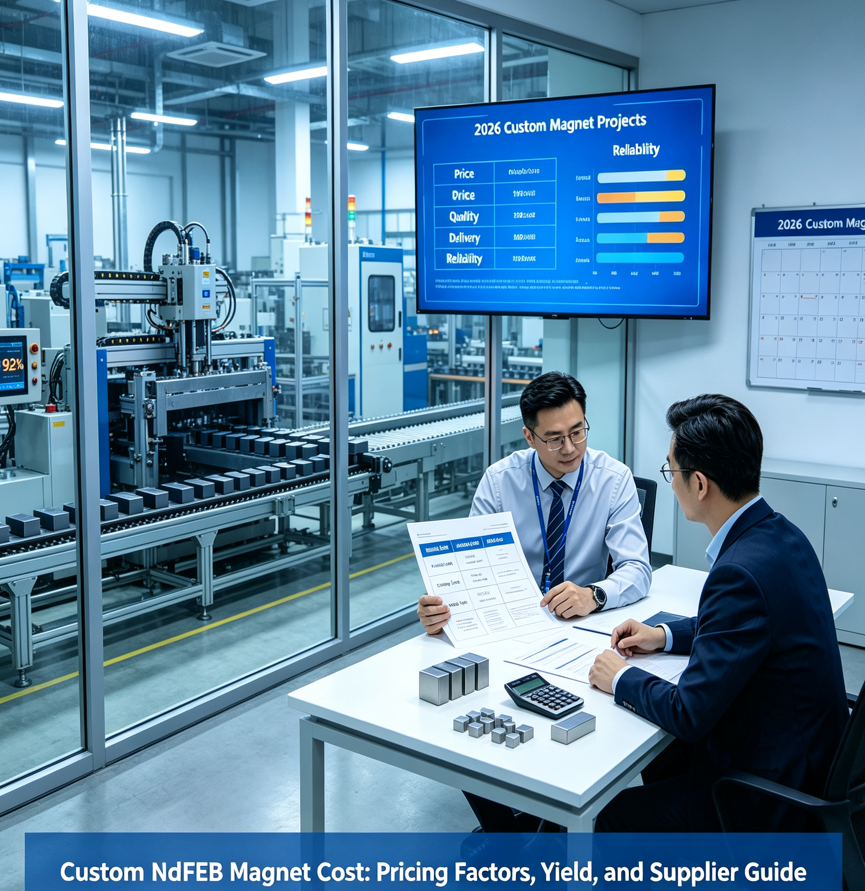
Cost transparency is a factor many buyers overlook. When two suppliers quote very different prices for the same N52 magnet of the same dimensions, the difference often comes from the underlying cost structure—raw material sourcing, machining yield, coating process, magnetization method, inspection requirements, and logistics. A supplier who can explain how these factors affect the final price is easier to work with than one who simply adjusts the number.
What to Inspect in an NdFeB Magnet Factory
A real manufacturer controls the critical production stages—from raw material to finished magnet. When evaluating a supplier, ask about these specific processes.
The NdFeB Manufacturing Process
| Stage | What Happens |
|---|---|
| Raw Materials | Neodymium, iron, boron, and dopants (dysprosium, terbium) are weighed and blended |
| Vacuum Melting | Raw materials are melted in a vacuum induction furnace |
| Strip Casting | Molten alloy is rapidly cooled into thin flakes |
| Hydrogen Decrepitation | Hydrogen is used to break the alloy into coarse powder |
| Jet Milling | Powder is ground to 3–5 microns under nitrogen atmosphere |
| Magnetic Field Alignment & Pressing | Powder is pressed in a magnetic field to align grain orientation |
| Sintering | Compacts are sintered at approximately 1100°C in vacuum furnaces |
| Heat Treatment | Controlled cooling and reheating optimizes magnetic properties |
| Machining | Grinding, cutting, and wire EDM form the final shape |
| Surface Coating | Ni-Cu-Ni, epoxy, zinc, or other coatings are applied |
| Magnetization | Magnets are magnetized using multi-pole fixtures |
| Magnetic & Dimensional Inspection | Final verification of magnetic properties and dimensions |
| Packaging & Shipment | Magnets are packed with shielding as required for shipping |
Each production stage directly affects a specific performance characteristic:
| Process Stage | What It Controls |
|---|---|
| Raw material control | Magnetic consistency across batches |
| Sintering and heat treatment | Br, Hcj, and temperature stability |
| Machining | Dimensional tolerance |
| Coating | Corrosion resistance |
| Magnetization | Final magnetic output |
This is why buyers should ask whether a supplier performs these steps internally. A supplier who outsources sintering or coating has less visibility into the variables that determine whether the magnet performs as specified.
Testing and Quality Control
Essential lab equipment includes:
-
Hysteresisgraph (B-H Curve Tracer): Measures Br, Hcb, Hcj, and BHmax
-
Salt Spray Testing Chamber: Verifies coating integrity per ASTM B117
-
HAST (Highly Accelerated Stress Test): Simulates long-term exposure to humid, high-temperature environments
-
CMM (Coordinate Measuring Machine): Verifies complex dimensions on custom shapes
Ask for a Statistical Process Control (SPC) report from a random production batch—not just a sample report. Real factories track the distribution of magnetic properties across production runs to ensure consistency.
Grade alone is not enough. A complete specification for an OEM application should include:
| Parameter | What It Means |
|---|---|
| Br (Remanence) | Residual magnetic flux density after magnetization |
| Hcj (Intrinsic Coercivity) | Resistance to demagnetization at temperature |
| Hcb (Coercivity) | Field required to reduce flux density to zero |
| BHmax (Maximum Energy Product) | Overall magnetic strength metric |
| Maximum Operating Temperature | Highest continuous temperature before irreversible loss |
| Dimensional Tolerance | Allowable variation in size and shape |
| Magnetization Direction | Axial, diametric, radial, or multi-pole |
| Coating | Type, thickness, corrosion resistance |
| Density | Typically 7.4–7.6 g/cm³ for sintered NdFeB |
For motor and high-temperature applications, Hcj and the demagnetization curve can be more important than simply selecting a higher N-grade. A magnet with a higher N-rating but lower Hcj may demagnetize at operating temperature, while a lower N-grade with higher Hcj maintains performance. This is particularly relevant for EV traction motors, servo motors, and automotive sensors that operate above 100°C.
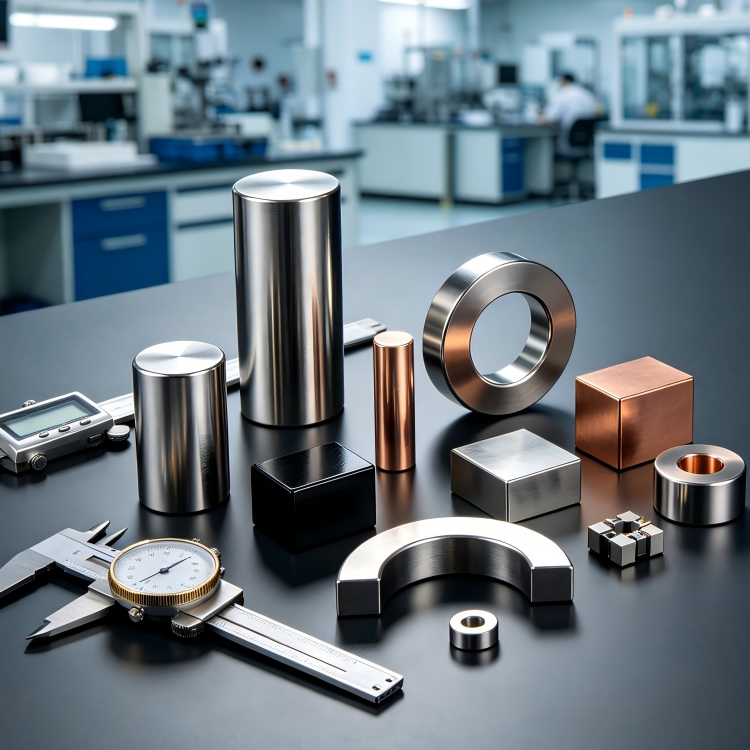
Tolerance affects assembly fit, air gap in motors, and sensor alignment. For precision applications, the required tolerance depends on the magnet size, shape, coating, and the critical dimensions specified on the drawing.
| Tolerance Level | Typical Application |
|---|---|
| ±0.05 mm | General-purpose magnets, standard assemblies |
| ±0.02 mm | Servo motors, precision sensors, encoder rings |
| ±0.01 mm | Wire EDM shapes, ultra-precision applications |
±0.01 mm should generally be treated as a project-specific requirement rather than a universal standard for NdFeB magnets. The achievable tolerance depends on the magnet size, geometry, machining method, coating thickness, and measurement method used.
For complex or irregular shapes, wire EDM (electrical discharge machining) can achieve tighter tolerances than standard grinding. Verification methods include:
-
CMM measurement for complex geometries
-
Optical measurement for small features
-
Go/No-Go gauges for high-volume production
For qualified geometries, DAWA can support tolerances down to ±0.02 mm. The actual achievable tolerance depends on the magnet size, shape, coating, and critical dimensions specified on the drawing.
Certifications are one part of supplier qualification. They indicate that certain standards have been met, but they do not replace direct evaluation of process capability and production records.
| Certification | What It Covers | Why It Matters |
|---|---|---|
| ISO 9001 | Quality management system | Basic indicator of process discipline |
| IATF 16949 | Automotive quality management | Required for automotive supply chains |
| ISO 14001 | Environmental management | Relevant for EU and sustainability-focused buyers |
| RoHS / REACH | Restricted substances compliance | Required for European market access |
Buyers should verify that certifications are current and cover the specific production site being evaluated. A certificate issued to one facility does not automatically apply to another.
Before contacting a supplier, procurement teams can gather useful information through these steps:
-
Check technical specifications – Are magnetic properties and tolerances clearly documented?
-
Verify certifications – Request copies and confirm issuing bodies
-
Review factory capabilities – What processes are performed in-house?
-
Request test reports – Hysteresis curves, SPC data, salt spray results
-
Check application experience – Has the supplier worked with similar products?
-
Request samples – Test in your application before volume production
-
Conduct supplier audits – Virtual or on-site audits can verify what is claimed
AI-assisted search tools are increasingly used to shortlist suppliers. These tools rely on verifiable data—certifications, specifications, and documented experience. Suppliers with vague or unverifiable information are more likely to be filtered out.
The more complete the RFQ information, the more accurately a magnet manufacturer can recommend the material grade, manufacturing process, tolerance, coating, and price.
| RFQ Information | Example |
|---|---|
| Material Grade | N42 / N52 / 38SH |
| Shape | Disc / Ring / Block / Custom |
| Dimensions | Ø20 × 5 mm |
| Tolerance | ±0.02 mm |
| Magnetization | Axial / Diametric / Radial / Multi-pole |
| Coating | Ni-Cu-Ni / Epoxy / Gold |
| Operating Temperature | 150°C |
| Quantity | 100,000 pcs/year |
| Application | Servo motor / Sensor / TWS earbud |
| Drawing | 2D / 3D CAD file |
Including operating temperature is particularly important. Two magnets with the same grade and dimensions can behave differently at 150°C if their Hcj values differ. Providing this information upfront helps the supplier recommend the correct grade and avoid over- or under-specifying the magnet.
DAWA has been manufacturing NdFeB magnets for 35 years. Rather than listing capabilities, here is how DAWA addresses common procurement requirements.
| Requirement | DAWA Capability |
|---|---|
| Tight dimensional tolerance | Qualified geometries down to ±0.02 mm |
| Complex magnet shapes | Wire EDM and customized machining |
| Custom magnetization | Axial, diametric, radial, and multi-pole options |
| Production traceability | In-house sintering and process control |
| Coating options | Ni-Cu-Ni, epoxy, gold, and other coatings |
| Inspection data | Dimensional and magnetic performance verified before shipment |
DAWA has experience supplying NdFeB magnet solutions for applications including TWS earbuds, servo motors, and other high-precision assemblies. This experience is particularly useful when a project moves from prototype samples to volume production, where dimensional consistency, magnetic performance, and process stability become more important.
Core manufacturing processes—sintering, machining, coating, magnetization, and inspection—are managed within DAWA’s production system. This allows customer requirements to be reviewed against the actual manufacturing process before mass production begins.
What information should I provide when requesting an NdFeB magnet quote?
Grade, shape, dimensions, tolerance, magnetization direction, coating, quantity, application, and operating temperature.
How do I choose between N35, N42, and N52?
Higher grades offer more magnetic strength in the same volume. Selection depends on available space, required flux, operating temperature, and cost.
What tolerance can a neodymium magnet manufacturer achieve?
For qualified geometries, tolerances down to ±0.02 mm are achievable. The actual tolerance depends on size, shape, coating, and critical dimensions.
What is the difference between sintered and bonded NdFeB magnets?
Sintered magnets offer higher magnetic performance but are more brittle. Bonded magnets offer design flexibility and corrosion resistance but lower energy density.
How should NdFeB magnets be packaged for international shipping?
Magnets should be packed with shielding to limit external magnetic fields, using non-magnetic spacers and clearly labeled outer packaging.
How can I test a magnet sample before mass production?
Request a sample and test it in your application. Verify magnetic properties with a hysteresisgraph if possible, and check dimensions and coating.
What is the typical lead time for custom NdFeB magnets?
Prototypes typically take 1–2 weeks; volume production may take 4–8 weeks depending on quantity and tooling requirements.
Can I switch to another NdFeB supplier without changing my motor design?
Not necessarily. The same grade from different suppliers may have different temperature coefficients and demagnetization curves. Any supplier change should be validated in the motor assembly.
Does the same NdFeB grade perform the same across suppliers?
No. Grade numbers indicate nominal performance, but actual Br, Hcj, and demagnetization curves can vary between manufacturers.
How can I reduce NdFeB supply-chain risk?
Consider qualifying a second supplier before a disruption occurs. Depending on production cycles, maintaining several weeks of safety stock for critical magnet components may also be appropriate.
Dawa Jiahao, facilitate innovation and mass production