Why Are Neodymium Magnets Widely Used in Modern Industrial Products?
Neodymium magnets have become a common choice in many industrial products, especially where strong magnetic performance is needed in a relatively small space. They are used in motors, sensors, magnetic assemblies, automation equipment, speakers, pumps, and many other products that rely on controlled magnetic force.
The reason is fairly straightforward. A Neodymium Magnet can provide a high level of magnetic strength without taking up as much space as some other permanent magnet materials. For product designers, that can make a real difference when every millimeter matters.
But magnetic strength is only part of the story. The shape, size, grade, magnetization direction, working environment, and final assembly all have to work together. That is why choosing the right magnet often starts with understanding the product rather than simply looking for the strongest option.
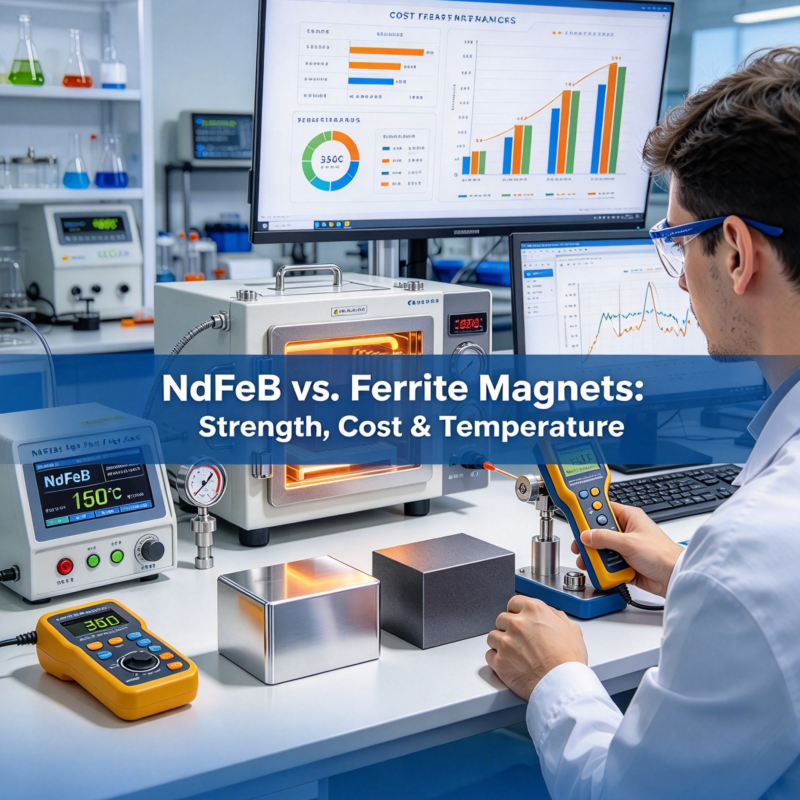
One of the main reasons Neodymium Magnets are widely used is their high magnetic energy. Compared with many traditional permanent magnets, NdFeB magnets can achieve strong magnetic force from a relatively compact size.
That is useful in modern equipment, where designers are often trying to reduce the size of a product without giving up performance. A smaller magnetic component can leave more room for other parts and may also make the overall assembly easier to integrate.
This does not mean that a smaller magnet is always better. The magnet still needs to provide enough force for the application, and engineers have to consider how it will interact with surrounding components. In practice, the goal is usually to find the right balance between magnetic performance, size, cost, and service conditions.
The applications for NdFeB Magnets are quite broad because magnetic force can be used in many different ways. A magnet might drive movement inside a motor, trigger a sensor, hold two components together, assist positioning, or become part of a larger magnetic assembly.
Motors are a good example. A permanent magnet is an important part of many motor designs, and the strong magnetic properties of NdFeB material allow manufacturers to develop compact motor systems with the required magnetic performance.
The same basic principle applies to other equipment, although the design requirements can be very different. A magnet used in a sensor may need a very different shape and specification from one used in an industrial motor. This is one reason standardizing every application around one magnet size rarely makes sense.
When people talk about magnets, they often focus first on the material grade. In an actual product design, however, the physical shape can be just as important.
A disc magnet, for example, may work well in a compact holding or sensing application, while a ring magnet can be useful when a central opening is required. Block magnets are another common option when the available installation space has a more rectangular shape.
For industrial products, manufacturers may also require unusual dimensions or specific magnetization directions. Custom Neodymium Magnets give engineers more freedom to work around the structure of the finished product instead of redesigning the product around an off-the-shelf magnet.
Industrial components are rarely designed in isolation. A magnet has to fit inside an assembly, work with other components, and meet the requirements of the final product. Even a small change in dimensions can sometimes affect the way an assembly works.
This is where custom production becomes useful. Depending on the project, buyers may require a particular length, diameter, thickness, shape, magnetic grade, or magnetization direction. The requirements can also change from one application to another.
A good Neodymium Magnet Supplier should therefore be able to discuss the application with the buyer instead of treating every order as a standard product purchase. For OEM projects in particular, getting the magnetic component right at the development stage can save time and reduce problems during later production.
There is no single specification that works for every industrial application. A magnet used inside an electronic product may have very different requirements from one installed in production equipment or a motor.
Temperature is one factor that needs attention. The surrounding environment, available installation space, mechanical structure, and required magnetic performance also influence material and specification choices.
This is why experienced engineers normally look at the complete application before selecting a magnet. The strongest available Rare Earth Magnet is not automatically the best choice. A suitable magnet is one that delivers the required performance under the actual working conditions and fits the design without creating unnecessary cost.
Consistency Matters When Magnets Are Ordered in Volume
A sample may look perfect during product development, but industrial buyers need more than a good sample. When hundreds, thousands, or more components are produced, consistency between batches becomes important.
Dimensions, magnetic properties, surface condition, and other specifications need to remain within the agreed requirements. Otherwise, even a small variation can create problems when the magnets are installed into an automated production line or assembled into a finished product.
This is an area where the capabilities of a Neodymium Magnet Manufacturer become important. Manufacturing experience, quality control, production equipment, and inspection processes all contribute to the reliability of the final magnet.
DAWA works with customers looking for magnet solutions for different industrial and commercial applications. Rather than relying only on standard sizes, the company can work around the requirements of individual projects where customized magnet specifications are needed.
For OEM customers, this can be particularly useful during the product development process. The required magnet may depend on the available space, intended function, assembly method, and magnetic performance, so discussing these details early can help determine a more suitable solution.
The objective is not simply to supply a strong magnet. It is to provide a magnetic component that fits the product and can be manufactured consistently for the intended application.
| Item | What to Check |
|---|---|
| Material | NdPr / heavy rare earth availability, sourcing strategy |
| Sintering | In-house or outsourced |
| Machining | Tolerance capability, grinding capacity |
| Magnetization | Direction / pole configuration capability |
| Coating | Type, thickness, corrosion testing |
| Quality | Batch inspection, test data provided |
| Capacity | Monthly production capacity, scalability |
| Lead Time | Sample vs mass production timelines |
| Price | Quotation validity period, pricing structure |
| Backup | Contingency plan for supply disruptions |
This checklist can be used when comparing multiple suppliers or when evaluating a new potential source.
The popularity of neodymium magnets in modern industrial products comes down to a combination of performance and practicality. They can provide strong magnetic force in compact designs, while their flexibility in shape and size makes them suitable for a wide range of applications.
Still, selecting a magnet is not simply about choosing the highest magnetic strength. The right Neodymium Magnet needs to match the product’s dimensions, operating conditions, assembly requirements, and expected performance.
For businesses sourcing magnets for industrial products, working with an experienced manufacturer such as DAWA can make the process more straightforward. With the right specifications and a clear understanding of the application, a magnet can become a well-integrated part of the product rather than just another component added at the end of the design process.
Dawa Jiahao, facilitate innovation and mass production