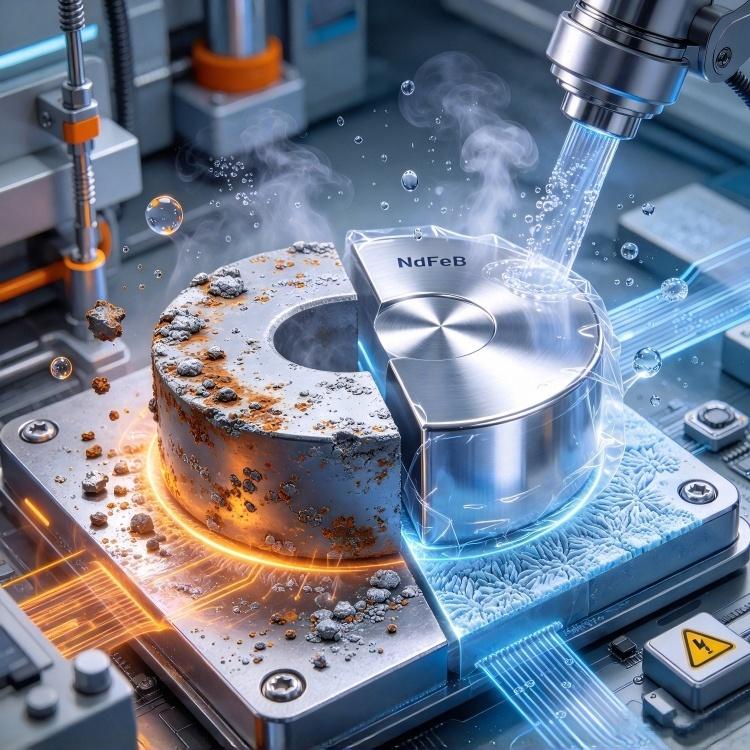
If you have ever used a neodymium magnet, you already know it behaves very differently from traditional ceramic magnets. Often referred to in engineering environments as an NdFeB magnet, it is made from a combination of neodymium, iron, and boron.
These rare earth magnets power many modern technologies, including electric motors, wind turbines, and data storage systems. However, not all neodymium magnets deliver the same performance. Two magnets of the same size can show very different holding power. The reason lies in material science, design, and manufacturing precision.
At DAWA, we specialize in producing industrial-grade neodymium magnets and understand the key factors that determine magnetic strength in real applications.

1. Grade Selection Determines Core Strength
Neodymium magnets are classified by grades such as N35, N42, and N52.
These numbers represent the energy level of the magnet, which directly affects its strength.
In simple terms:
- Higher grade means stronger magnetic performance
- Lower grade offers more cost efficiency but reduced force
For example, an N52 magnet will generate significantly stronger magnetic force than an N35 magnet of the same size.
Selecting the correct grade is essential when designing industrial systems where space and performance must be balanced.
2. Temperature Has a Direct Impact on Performance
Heat is one of the most important factors affecting neodymium magnet strength.
When exposed to high temperatures, a magnet may temporarily lose strength or, in extreme cases, suffer permanent reduction in performance.
Different grades are designed for different temperature ranges, often indicated by suffixes such as SH or UH. For demanding environments such as automotive or industrial motors, high-temperature grades are essential to maintain stability.
3. Shape and Geometry Influence Magnetic Efficiency
The physical shape of a neodymium magnet plays a major role in how effectively it performs.
Key principles include:
- Thick magnets maintain strength more efficiently than thin ones
- Disc-shaped magnets may experience weaker field distribution
- Cylindrical or block designs often provide better stability
This is related to how magnetic fields distribute internally. Poor geometry can lead to self-interference, reducing usable magnetic force.
In many cases, optimizing shape is more effective than simply increasing magnet size.
4. Surface Protection Prevents Long-Term Degradation
Because neodymium magnets contain iron, they are vulnerable to corrosion when exposed to moisture or air.
Without protection, oxidation can gradually weaken the structure and reduce magnetic performance.
To prevent this, industrial magnets are usually coated with materials such as:
- Nickel
- Zinc
- Epoxy
Proper coating significantly extends the lifespan of the magnet, especially in humid or industrial environments.

5. Manufacturing Precision Determines Final Performance
Even with the same material and grade, production quality can vary significantly between manufacturers.
Key manufacturing factors include:
- Powder particle consistency
- Pressing alignment
- Sintering temperature control
- Magnetic field orientation accuracy
As a professional neodymium magnet manufacturer, DAWA focuses on precision control throughout the entire production process to ensure stable performance across batches.

DAWA Industrial Magnet Solutions
DAWA is a professional supplier of rare earth magnet solutions, specializing in high-performance NdFeB magnet production for industrial applications.
We provide:
- Custom neodymium magnet design
- OEM and ODM manufacturing support
- Bulk industrial supply
- Engineering optimization for performance and cost balance
Our goal is to help global customers achieve reliable and scalable magnetic solutions for complex applications.
Conclusion:
The strength of a neodymium magnet depends on multiple interconnected factors, including grade selection, temperature resistance, shape design, coating protection, and manufacturing precision. Understanding these variables allows engineers and buyers to choose the right strong neodymium magnet for their application, ensuring both performance and long-term reliability. DAWA continues to support global industries with stable, high-quality rare earth magnet and NdFeB magnet solutions.