SmCo vs NdFeB Magnets: Which High Temperature Magnet Is Better?
Choosing the right permanent magnet is about much more than finding the strongest magnetic force. Working temperature, corrosion resistance, application environment, and budget all play important roles in long-term performance.
Among rare earth permanent magnets, Samarium Cobalt (SmCo) and Neodymium Iron Boron (NdFeB) are two of the most widely used materials. Both deliver exceptional magnetic performance, but they are designed for different operating conditions.
So, which one is the better choice?
The answer depends entirely on your application. In this guide, DAWA compares SmCo and NdFeB magnets to help engineers, manufacturers, and buyers select the right material for their projects.
What Are SmCo and NdFeB Magnets?
Both SmCo and NdFeB belong to the rare earth magnet family, meaning they offer significantly stronger magnetic performance than traditional ferrite or AlNiCo magnets.
SmCo magnets are made from samarium and cobalt. They are known for excellent thermal stability, high coercivity, and outstanding corrosion resistance. Because of these characteristics, SmCo magnets are often selected for demanding industrial environments.
NdFeB magnets, on the other hand, are manufactured from neodymium, iron, and boron. They provide the highest magnetic strength available among commercially produced permanent magnets, making them the preferred choice for applications where maximum magnetic force is required in a compact size. Although both materials are high-performance magnets, they excel in different areas.
Magnetic Performance Comparison
Magnetic performance is usually evaluated by several key parameters, including remanence (Br), coercivity (Hcj), and maximum energy product (BHmax).
In general, NdFeB magnets deliver stronger magnetic output than SmCo magnets. Their higher energy product allows engineers to design smaller and lighter magnetic assemblies without sacrificing performance.
SmCo magnets also offer strong magnetic properties, but their greatest advantage is not maximum magnetic strength. Instead, they maintain stable magnetic performance under challenging operating conditions where other magnets may gradually lose strength.
For applications requiring the highest magnetic force within limited installation space, NdFeB is often the preferred solution. However, when stability is more important than absolute strength, SmCo becomes a competitive option.
Temperature Resistance: Where SmCo Stands Out
Temperature is often the deciding factor when selecting a permanent magnet.
As operating temperatures increase, all permanent magnets experience some reduction in magnetic performance. The key difference lies in how well each material resists that loss.
SmCo magnets are specifically designed for high-temperature environments. Depending on the grade, they can typically operate at temperatures up to 250°C to 350°C, while maintaining excellent magnetic stability.
Standard NdFeB magnets usually operate below 80°C, although high-temperature grades can withstand temperatures of 150°C to 200°C. Even then, their magnetic properties decline more noticeably than those of SmCo under prolonged heat exposure.
For equipment exposed to continuous high temperatures—such as aerospace systems, downhole oil tools, or industrial sensors—SmCo is generally the safer long-term choice.
Environmental conditions can significantly affect magnet lifespan.
One of SmCo’s major advantages is its natural corrosion resistance. The material performs well even in humid, chemically aggressive, or vacuum environments without requiring additional surface coatings.
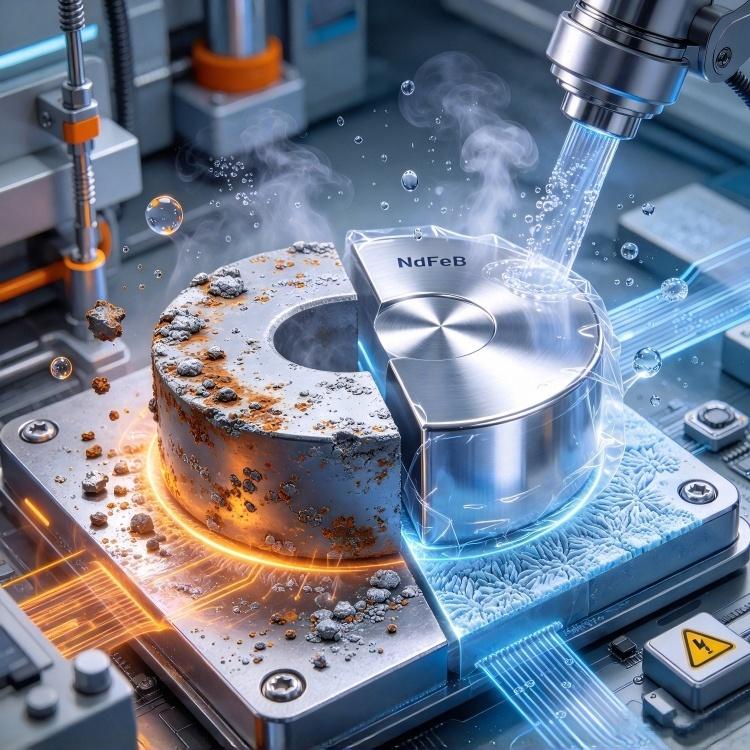
NdFeB magnets are much more vulnerable to oxidation because of their iron content. Without proper protection, they can corrode relatively quickly.
For this reason, NdFeB magnets are commonly finished with coatings such as:
- Nickel (Ni-Cu-Ni)
- Epoxy
- Zinc
- Phosphate
These coatings effectively improve corrosion resistance, but they also introduce additional manufacturing steps and potential wear over time if the coating becomes damaged.
When long-term reliability in harsh environments is critical, SmCo often offers a maintenance advantage.
Which Magnet Should You Choose?
There is no universal answer because every application has different priorities.
Choose SmCo magnets if your project requires:
- Continuous high-temperature operation
- Excellent corrosion resistance
- Stable magnetic performance over time
- Reliable operation in demanding industrial environments
Choose NdFeB magnets if your priority is:
- Maximum magnetic strength
- Compact product design
- Cost-effective production
- General industrial or commercial applications
Rather than asking which material is “better,” the more practical question is which material best matches your working conditions.
At DAWA, we work closely with customers to evaluate operating temperature, magnetic requirements, environmental conditions, and production costs before recommending the most suitable magnet solution.
Conclusion:
Both SmCo and NdFeB are excellent rare earth permanent magnets, but they are designed to solve different engineering challenges.
NdFeB offers exceptional magnetic strength and outstanding value, making it the preferred solution for many commercial and industrial products. SmCo, on the other hand, excels in environments where high temperatures, corrosion resistance, and long-term stability are critical.
Instead of looking for the “best” magnet, focus on selecting the material that best fits your application’s operating conditions.
With years of experience in manufacturing high-performance permanent magnets, DAWA provides customized SmCo and NdFeB solutions for customers across industries. Whether you need guidance on material selection or support for a custom project, our engineering team is ready to help you find the right magnetic solution.
Dawa Jiahao, facilitate innovation and mass production