A practical buyer’s guide from an engineering perspective (DAWA insights)
Most buyers don’t realize one thing at the beginning:
When you are sourcing a neodymium magnet manufacturer, you are not just buying a product.
You are choosing a performance risk partner.Because a NdFeB magnet is not a simple component—it is a controlled energy system.
And small differences in production can completely change how a magnet behaves in real applications.

🧠 First question buyers should ask (not “price”)
Before comparing suppliers, engineers usually ask a more technical question:
Can this manufacturer consistently reproduce magnetic performance across batches?
Because in real-world systems, a super strong permanent magnet is only useful if it is stable—not just strong once.
This is where most low-tier suppliers fail.
⚙️ The hidden divide between magnet manufacturers
In the industry, neodymium magnet manufacturers are usually split into three categories:
1. Trading-based suppliers
- Buy and resell magnets
- Limited control over NdFeB magnet quality
- High variability between batches
2. Semi-integrated factories
- Some in-house production
- Partial control over coating and shaping
- Medium stability
3. Fully integrated manufacturers (like DAWA)
- Full control from raw alloy → sintering → machining → coating
- Tight control of magnetic consistency
- Engineered for industrial reliability
This difference is usually invisible on a product listing—but very visible in real performance.
🔬 What actually defines a “strong” magnet?
Most people think “strong neodymium magnet” simply means a higher grade like N52.
In reality, strength is influenced by four interacting systems:
- Material purity (rare earth composition stability)
- Grain alignment during magnetization
- Density control during pressing
- Thermal resistance behavior in real environments
If any one of these is unstable, even a powerful rare earth permanent magnet will underperform.

🌡️ The factor most buyers underestimate: environment
A magnet is not tested in a catalog. It is tested in heat, vibration, and time.
A good neodymium magnet manufacturer should already design for:
- temperature cycling stability
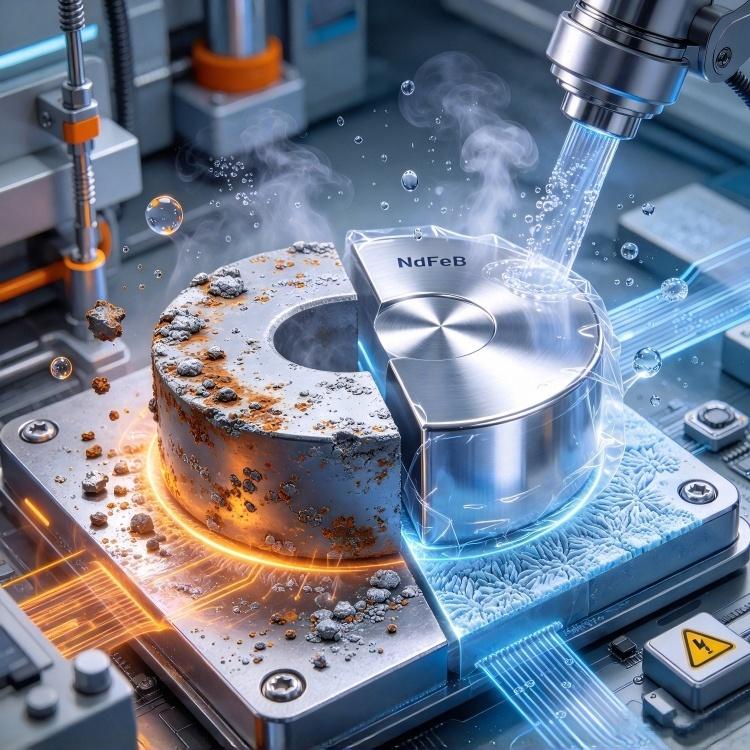
- corrosion resistance behavior
- demagnetization safety margin
Without this, performance loss is just a matter of time.
🏗️ Manufacturing capability is more important than specifications
Here is a simple truth experienced engineers rely on:
Specification tells you what a magnet should be.
Manufacturing tells you what it actually becomes.
Key indicators of a capable NdFeB magnet producer include:
- repeatable batch performance
- controlled sintering environment
- magnetization direction accuracy
- coating durability under stress
This is where DAWA positions itself—not as a seller, but as a controlled production system.
🧩 What DAWA focuses on in real production
Instead of “selling magnets,” DAWA focuses on engineering stability:
- stabilizing magnetic output across large batches
- optimizing geometry for real-world force efficiency
- improving long-term resistance performance
- supporting OEM design adjustments
Because in industrial use cases, a super strong permanent magnet that varies in performance is not “strong”—it is unpredictable.
🧲 Closing insight
The best neodymium magnet manufacturer is not the one offering the strongest sample.It is the one that can guarantee the same performance in the 10,000th unit as in the first. That is the real definition of industrial reliability.And that is the direction DAWA builds its manufacturing system around.