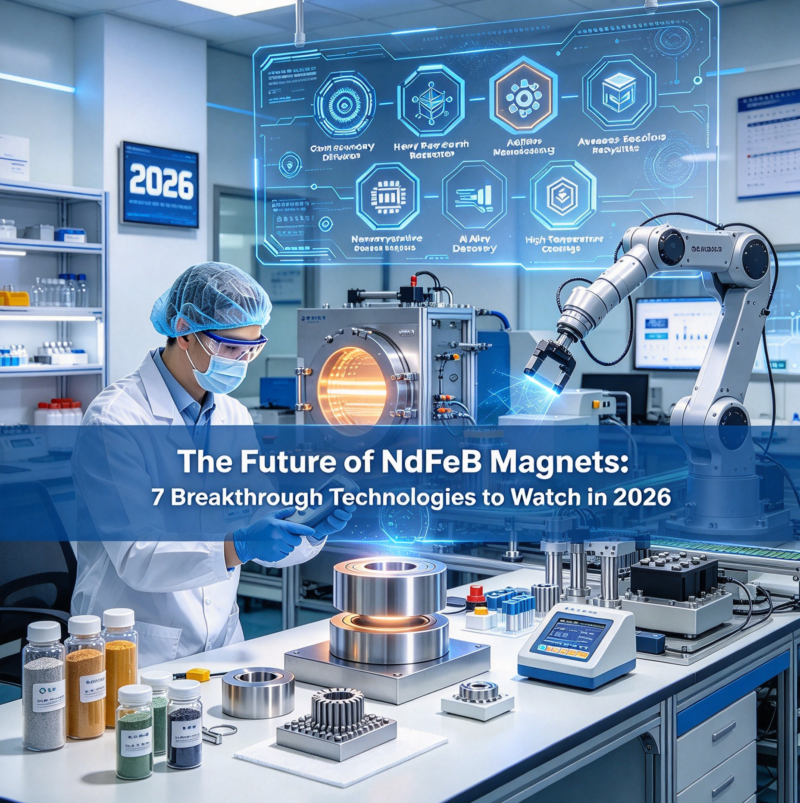
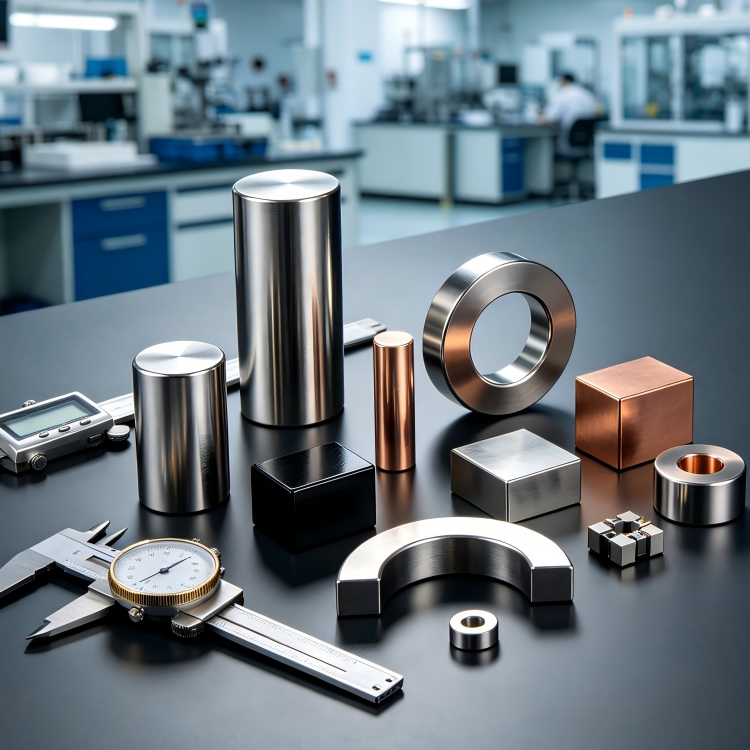
The Future of NdFeB Magnets: 7 Breakthrough Technologies to Watch in 2026
Most articles about neodymium magnets explain what they are and how they work. This one looks at where the technology is heading—the research breakthroughs, manufacturing innovations, and new applications that are changing what NdFeB magnets can do.
For engineers and procurement teams, understanding these trends helps with long-term planning. The magnet you specify today may be produced by a very different process in three years. The grades available, the cost structure, and the performance limits are all shifting.
The developments below are at different stages of research, pilot development, and commercialization. Some remain laboratory-scale technologies and should not be treated as qualified production alternatives without further validation.
Here are seven developments worth watching in 2026.
Grain boundary diffusion (GBD) has been the primary method for improving coercivity without sacrificing remanence. The technique enriches the grain boundaries—the regions between magnetic grains—with heavy rare earth elements like dysprosium and terbium.
A 2026 study published in the Journal of Materials Science & Technology demonstrated a coercivity gain exceeding 10 kOe using a two-step Dy/Tb competitive lattice diffusion process, with only 0.18 wt% Tb. This is far below the 0.65 wt% Tb required by conventional single-step Tb diffusion processes.
The mechanism is worth noting. During the first-step Dy diffusion, a Dy-enriched shell forms on the magnet surface. This shell effectively prevents Tb from diffusing into the lattice during the second step, instead promoting Tb migration along grain boundaries. The result is deeper penetration of Tb into the magnet and the formation of a multi-layered gradient core-shell structure—which is what drives the coercivity improvement.
Why it matters: This approach could help reduce the heavy rare earth content required to achieve high coercivity, potentially lowering material cost and supply chain exposure for high-temperature grades (SH, UH, EH).
The magnetic performance of sintered NdFeB depends heavily on how well the crystal grains are aligned during pressing. Better alignment means higher remanence (Br)—the magnetic output of the magnet.
In laboratory-scale experiments, a 2026 study published in Materials Today Physics introduced a vibration-assisted pulsed magnetic field orientation process. The novel molding process integrates a pulsed magnetic field (maximum orientation field: 4.5 T) with high-frequency vibration during the orientation stage while eliminating the application of pressure.
The results were notable. The new process achieved an orientation degree of 2.19 and remanence of 15.19 kG, outperforming conventional transverse magnetic field pressing (TMP), which achieved 1.36 and 14.99 kG. When combined with grain boundary diffusion, the researchers successfully developed a magnet with high remanence (15 kG) and coercivity of 17.42 kOe.
Why it matters: Higher remanence can help increase the magnetic performance available from a given magnet volume, depending on the magnetic circuit and application requirements. For applications where space is constrained—TWS earbuds, miniature sensors, compact motors—this could allow designers to achieve the required performance with smaller magnets, or to use lower grades where higher grades were previously necessary.
Magnet development has traditionally been a slow, iterative process. Researchers formulate a composition, process it, measure the properties, and adjust. Each cycle takes weeks or months.
Machine learning is changing that. A 2026 study published in the Journal of Materials Chemistry A demonstrated a large language model-enabled machine learning approach for NdFeB magnet design. The researchers developed a multimodal deep learning framework that integrates structured compositional data with textual embeddings extracted from scientific publications using large language models. A dual-tower neural network architecture was developed to independently encode elemental compositions and experimental descriptions.
The gated-fusion model achieved prediction accuracies exceeding 98% for remanence—surpassing conventional methods including XGBoost and random forest. Using Pareto frontier analysis of virtual compositions, the researchers identified niobium (Nb) as a critical performance-enhancing element. Guided by model predictions, they successfully fabricated magnets with optimized Nb content that surpassed the predicted Pareto frontier for heavy rare-earth-free magnets.
Why it matters: Faster design cycles could shorten the early stages of magnet development and help researchers identify promising compositions more efficiently. For OEM buyers, this could eventually result in magnets that better match specific application requirements—rather than forcing a choice among existing standard grades.
Researchers at Ames National Laboratory reported a significant milestone in 2026: a hot-roll-processed nanograin NdFeB magnet achieving 44.2 MGOe (BH)max—a 10% increase beyond the previous record for this processing route.
The significance is not just the energy product. This was achieved using an M-grade composition—a standard grade that does not require heavy rare earth additions. The nanograin structure, produced through a novel hot-roll fabrication process, provides the coercivity needed for M-grade temperature performance without Dy or Tb.
The process uses mechanically milled NdFeB melt-spun flakes as feedstock, which are packed into a metal vessel and hot-rolled to form a fully dense and highly textured strip magnet. The research demonstrates a potential route toward high-temperature, heavy-rare-earth-free NdFeB magnets. A patent for the technology was granted in 2026.
The result is still at the research stage, but it demonstrates a promising route toward reducing reliance on heavy rare earth elements in high-performance NdFeB magnets.
Why it matters: Dy and Tb are among the most supply-constrained and expensive elements in the NdFeB supply chain. A processing route that achieves competitive performance without them would reduce cost and supply chain exposure.
The search for rare-earth-free permanent magnets has been ongoing for decades. Most candidates have fallen short of NdFeB performance. But 2026 brought several developments worth noting.
MnBi and Fe₁₆N₂ are among the rare-earth-free permanent magnet systems receiving significant research attention in 2026. Their potential appeal comes from the use of more abundant elements and the possibility of reducing dependence on rare-earth materials. MnBi exhibits a positive temperature coefficient of coercivity—a property that makes it of interest for high-temperature motor applications where conventional NdFeB magnets lose performance. Fe₁₆N₂ (iron nitride) is another candidate, valued for its potential to deliver competitive magnetic performance using abundant, geopolitically stable elements.
High-entropy borides: A Georgetown University team led by professors Kai Liu and Gen Yin identified a new class of strong magnets based on C16 high-entropy borides using earth-abundant transition metals and boron. These materials exhibit strong magnetic anisotropy approaching that of some rare-earth magnetic materials, but their overall permanent-magnet performance is not yet comparable with commercial NdFeB. The findings were published in Advanced Materials.
Fe₁₆N₂ development: Niron Magnetics is collaborating with Aspina to develop motors using iron nitride permanent magnets, aiming to reduce rare earth dependence while maintaining high performance.
These technologies are promising, but they remain at different stages of laboratory and early-stage development and are not direct replacements for NdFeB in most high-performance applications. The key challenge is not only magnetic performance, but also scalability, cost, processing consistency, and long-term reliability. For applications where NdFeB performance is not required—fans, pumps, less critical motors—rare-earth-free options could become viable alternatives over time.
Why it matters: These alternatives could free NdFeB capacity for the applications that truly need it, while providing procurement teams with additional options for less demanding applications.
One of the most striking new applications for NdFeB magnets is in medical microrobotics. Researchers are embedding NdFeB microparticles into soft polymer matrices (PDMS) to create tiny robots that can be steered through blood vessels using external magnetic fields.
Earlier research demonstrated a magnetically driven soft continuum microrobot made from NdFeB particles and polydimethylsiloxane (PDMS), with a diameter as small as 200 μm. A hydrogel layer on the surface overcomes adhesion forces and reduces friction. The experimental results demonstrate that the soft continuum microrobot can travel through microfluidic channels by its own vibration and flexibly steer in a bifurcation environment, showing potential for intravascular manipulation.
Additional research directions include sub-millimeter squeezing soft robots for targeted drug release, also fabricated from PDMS infused with NdFeB microparticles, and femtosecond laser-assisted printing of hard magnetic microrobots capable of swimming upstream in blood flow.
NdFeB is particularly attractive for these applications because of its high magnetic energy density and strong magnetic response at small scales. These applications require strong magnetic response within extremely small volumes. As medical microrobotics moves from research toward practical applications, demand for specialized magnetic materials and micro-scale magnetic components could increase.
Why it matters: These applications require strong magnetic response within extremely small volumes. As medical microrobotics continues to develop, these systems may create new demand for ultra-fine magnetic powders and precision-manufactured micro-magnetic components.
Recycling NdFeB magnets has always been technically possible but economically challenging. The magnets contain valuable rare earths—neodymium, praseodymium, dysprosium, terbium—but recovering them from end-of-life products is complex.
Recent research is exploring several different recycling routes, including selective oxidation, hydrometallurgical recovery, and electrochemical processing.
Selective oxidation route: A 2026 study published in the Journal of Cleaner Production demonstrated a one-step selective oxidation process for recovering rare earth elements from end-of-life sintered NdFeB magnets using a CaO-Al₂O₃-REE₂O₃ slag system. The pyrometallurgical treatment at 1700°C achieved over 98% REE extraction when using Fe₂O₃ or Al₂O₃ as oxidants. The process was scaled from 50 g to 1.35 kg of magnet feed. Subsequent hydrometallurgical processing achieved up to 97% REE recovery. The integrated process achieved an overall REE recovery of approximately 85%.
Other routes: Electrochemical and molten-salt routes are also being investigated for selective REE recovery. Grain-boundary engineering of recycled NdFeB magnets from single-phase RE₂Fe₁₄B powder is being studied as an approach to produce recycled magnets with competitive performance.
Why it matters: Recycled magnets reduce dependence on primary rare earth mining and provide an alternative source for OEMs concerned about supply chain concentration. The technology is not yet at commercial scale for most routes, but continued research is improving recovery efficiency and process understanding.
For OEM buyers and motor designers, these developments point to several long-term implications.
Heavy rare earth requirements could decrease for some high-temperature grades. If GBD efficiency continues to improve and heavy rare earth content decreases, the cost premium for SH, UH, and EH grades could narrow. The two-step Dy/Tb competitive lattice diffusion process already demonstrates that coercivity gains above 10 kOe can be achieved with less than 0.2 wt% Tb—far below conventional single-step diffusion requirements.
Smaller magnets may deliver the same performance. Improved orientation processes and higher energy products allow designers to reduce magnet volume without sacrificing magnetic output. The vibration-assisted orientation process achieved remanence of 15.19 kG in laboratory experiments, which could translate to smaller magnet designs for space-constrained applications.
Supply chain diversification may become more feasible. Rare-earth-free alternatives and recycled magnets provide options—not replacements for NdFeB in demanding applications, but alternatives for less critical uses. The selective oxidation recycling route has been scaled to 1.35 kg magnet feed, though commercial-scale adoption is still developing.
Supplier capability will become more important. As advanced magnet technologies move toward commercial production, buyers may need suppliers with stronger materials expertise, process control, and engineering support—not just the ability to manufacture standard grades. A supplier who understands how grain boundary diffusion affects coercivity, or how hot-roll processing differs from sintering, can help buyers evaluate whether a new technology is relevant to their application—and whether it is ready for volume production.
DAWA has been manufacturing NdFeB magnets for 35 years. Production covers sintering, machining, coating, magnetization, and final inspection within our own production system.
Sintering. DAWA operates its own sintering production, which provides visibility into material quality and magnetic consistency from the earliest stage of manufacturing. The engineering team follows developments in GBD and heat treatment processes to evaluate how new techniques may improve coercivity and temperature stability.
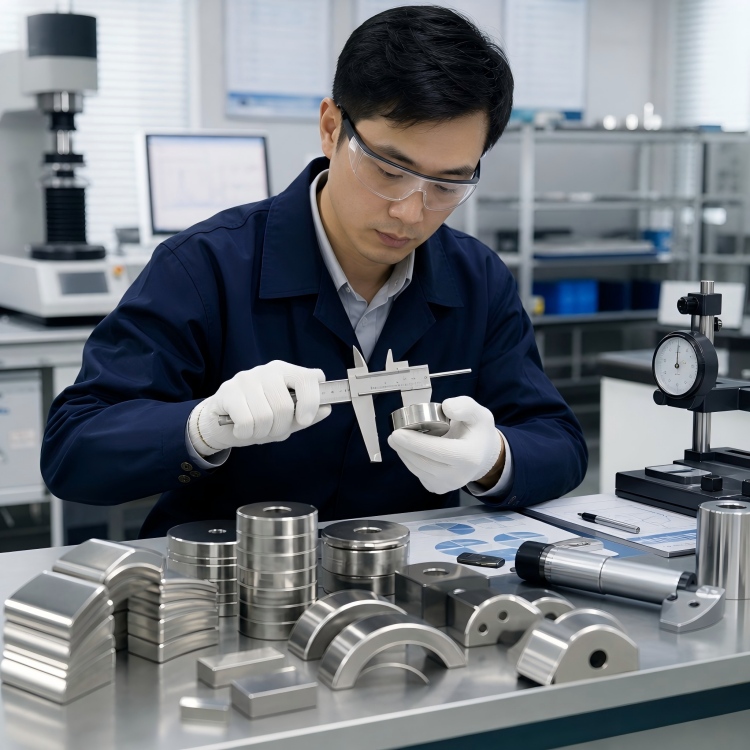
Machining. For qualified geometries, dimensional tolerances down to ±0.02 mm can be supported. Wire EDM is available for complex shapes requiring ultra-tight tolerances.
Magnetization. Axial, diametric, radial, and multi-pole magnetization are available based on application requirements.
Coating. Multi-layer nickel-copper-nickel is standard. Epoxy, gold, and other coatings are available depending on the operating environment.
Inspection. Dimensional inspection is performed on critical features. Magnetic performance is verified before shipment.
DAWA has experience supplying NdFeB magnet solutions for applications including TWS earbuds, servo motors, and other high-precision assemblies. As new magnet technologies move from research to production, DAWA evaluates where these developments can benefit customer applications—and where they are not yet ready for volume manufacturing.
What is grain boundary diffusion?
A process that enriches the grain boundaries of NdFeB magnets with heavy rare earth elements (Dy, Tb) to increase coercivity without significantly reducing remanence. Recent research has demonstrated that a two-step Dy/Tb competitive lattice diffusion process can achieve coercivity gains exceeding 10 kOe with very low Tb content.
Why is reducing dysprosium and terbium important?
Dy and Tb are among the most supply-constrained and expensive elements in the NdFeB supply chain. Reducing their content lowers cost and supply chain risk. A 2026 study showed that 0.18 wt% Tb can achieve coercivity gains that previously required 0.65 wt% Tb.
What is the current status of rare-earth-free magnets?
Several materials show promise—MnBi, Fe₁₆N₂, high-entropy borides—but none yet match NdFeB for demanding applications. They may become viable for lower-performance uses over time. Georgetown University researchers have identified high-entropy borides with magnetic anisotropy approaching that of some rare-earth magnetic materials, but their overall permanent-magnet performance is not yet comparable with commercial NdFeB.
Can recycled magnets match virgin material performance?
Recent research suggests recycled NdFeB can achieve competitive magnetic properties with appropriate processing. A 2026 study demonstrated over 98% REE extraction from end-of-life magnets using a selective oxidation process, with an overall recovery of approximately 85%. Commercial-scale adoption is still developing.
What magnet specifications are needed for medical microrobots?
Ultra-fine NdFeB powder, precise particle size control, and the ability to fabricate micro-scale magnets with consistent magnetic properties. Research has demonstrated NdFeB/PDMS microrobots as small as 200 μm in diameter.
Will rare-earth-free magnets replace NdFeB magnets?
Not in the near term for most high-performance applications. Rare-earth-free technologies are progressing, but NdFeB still offers a combination of magnetic performance, energy density, and commercial maturity that is difficult to match.
When will new NdFeB technologies become commercially available?
Commercial adoption depends on more than laboratory performance. Cost, production scalability, process consistency, raw material availability, and qualification requirements all influence how quickly a new technology moves from research to volume manufacturing.
How does DAWA evaluate new magnet technologies?
DAWA monitors research and industry developments, evaluates where new processes or materials may benefit customer applications, and integrates them into production when they are mature enough for volume manufacturing.
Research Sources
This article references the following peer-reviewed studies and institutional sources:
Dawa Jiahao, facilitate innovation and mass production