How Does Magnet Shape Affect Magnetic Field Distribution?
When selecting a permanent magnet for an industrial or electronic application, buyers often focus on material grade, dimensions, and magnetic strength. However, one important design factor can easily be overlooked: magnet shape.
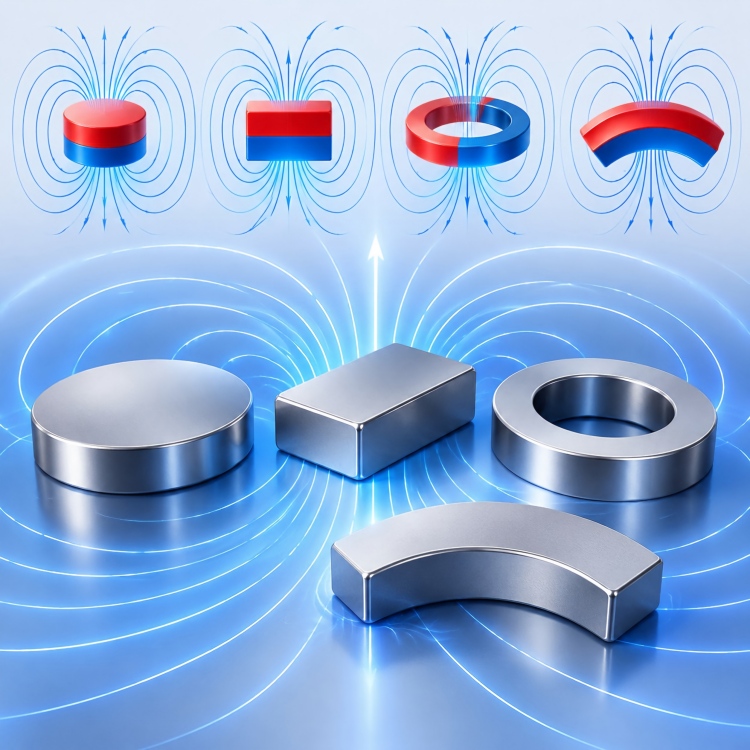
A disc magnet, rectangular block, ring magnet, and arc segment may be made from the same magnetic material, but they do not necessarily produce the same magnetic field distribution. Their geometry affects how magnetic flux travels through the surrounding space, where the field is concentrated, and how the magnet interacts with nearby components.
For engineers developing motors, sensors, electronic devices, and custom magnetic assemblies, understanding this relationship is essential. The right magnet shape is not simply a matter of fitting a component into a housing. It is part of the overall magnetic circuit design.
A permanent magnet generates a magnetic field through its north and south poles. The field extends outside the magnet and forms a continuous path, with magnetic flux traveling from one pole to the other through the surrounding environment.
The geometry of the magnet influences the available paths for this magnetic flux. Its length, thickness, width, curvature, and pole surface area all affect the way the external field develops.
For example, a rectangular magnet has relatively flat pole surfaces and straight edges. A disc magnet has circular pole surfaces, while a ring magnet introduces an opening through its center. These differences change the spatial distribution of the magnetic field.
It is important to understand that a larger magnet does not automatically produce a stronger field at every point. Material properties, magnetization direction, dimensions, surrounding components, and the distance from the magnet all contribute to the final result.
Different geometries are selected because they support different magnetic circuit requirements. Understanding their characteristics helps engineers narrow down suitable options.
Disc and Cylindrical Magnets
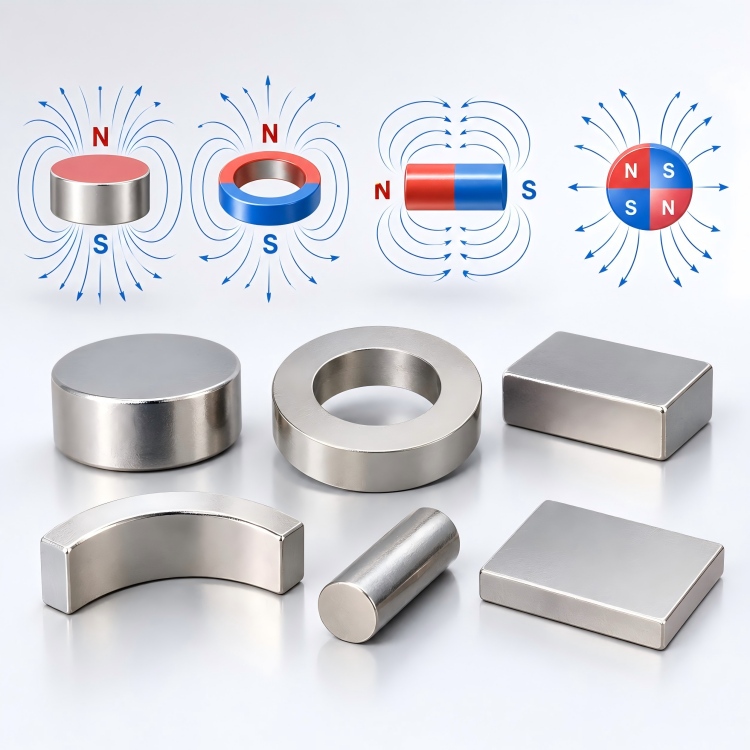
Disc and cylindrical magnets are widely used in compact electronic products, sensors, speakers, and holding applications. Their circular geometry provides a relatively symmetrical field pattern when magnetized axially.
However, the field is not uniform everywhere. It changes with distance from the pole surface, and the edges can influence the local field distribution. If the magnet is relatively thin compared with its diameter, its field characteristics will differ from those of a longer cylindrical magnet.
Block and Rectangular Magnets
Rectangular magnets are useful when a design requires a flat contact surface or a specific installation area. They are commonly considered for industrial equipment, magnetic fixtures, and electronic components.
Their field distribution is influenced by the relationship between length, width, and thickness. Edge effects and the dimensions of the pole faces can create variations in the field near different regions of the magnet.
For applications requiring controlled magnetic performance, these details should be evaluated as part of the complete design rather than selected based on external dimensions alone.
Ring Magnets
Ring magnets are frequently used in motors, sensors, encoders, and rotating magnetic components. Their central opening provides space for shafts or other mechanical structures, while their circular geometry supports rotational applications.
The resulting field depends strongly on the magnetization configuration. Axially magnetized rings and radially magnetized rings produce different field orientations. Multi-pole magnetization can create alternating magnetic poles around the ring, making it suitable for specific sensing and motor requirements.
Arc Segment Magnets
Arc magnets are often used in motor assemblies where the magnetic components follow the curvature of a rotor or stator. Their geometry helps match the structure of the motor rather than relying on separate rectangular magnets.
The arc angle, inner radius, outer radius, thickness, and magnetization direction all influence the magnetic field within the assembly. Dimensional consistency is also important because uneven gaps between adjacent segments can affect field uniformity and overall motor performance.
The most reliable way to select a coating is to evaluate the conditions the magnet will actually experience. The following factors can help narrow the options.
1. Match the Coating to the Operating Environment
Start by identifying the main exposure risks.
For a dry indoor environment, a standard Ni-Cu-Ni coating may be sufficient. In humid environments or applications involving salt exposure, epoxy or another validated protective system may be more appropriate.
If the magnet will encounter chemicals, condensation, or continuous moisture, obtain compatibility data for the specific coating and operating conditions.
Do not assume that a coating suitable for occasional humidity will also withstand continuous immersion or concentrated salt exposure.
2. Consider Operating Temperature
Coating performance and magnet performance are related but separate considerations.
The magnet’s maximum usable temperature depends on its magnetic grade, coercivity, geometry, magnetic circuit, and actual operating conditions. The coating also has its own temperature limitations, particularly for organic coatings.
For example, an epoxy system that provides good corrosion resistance at moderate temperatures may not be appropriate for a high-temperature motor application.
When selecting a high-temperature NdFeB magnet coating, check both the coating’s temperature rating and the magnet’s resistance to irreversible demagnetization. These limits should be verified independently.
3. Check Coating Thickness and Dimensional Tolerances
Coating thickness can affect the final dimensions of a magnet. This matters when magnets must fit into precision slots, rotor assemblies, sensor housings, or other components with limited clearance.
A thicker coating may improve protection in some designs, but it can also interfere with assembly if the dimensional allowance is insufficient.
Before production, confirm the permitted coating thickness, finished dimensions, and tolerance requirements with the manufacturer. For complex geometries, sample inspection can help verify that the selected coating works with the intended assembly process.
4. Evaluate Wear, Impact, and Assembly Conditions
Magnets may be exposed to mechanical stress during installation or normal operation. Coatings can crack, chip, or wear through if the surface is subjected to excessive impact or friction.
If the magnet will be pressed into a housing, bonded to another component, or installed near moving parts, consider how the coating will interact with the assembly method.
For applications with repeated contact or vibration, testing the complete magnet assembly is more meaningful than evaluating an isolated coating sample.
5. Review the Required Service Life
The best coating is not necessarily the least expensive option or the one with the highest reported corrosion resistance. It is the coating that meets the application’s reliability requirements at an acceptable total cost.
A low-cost coating may be suitable for a short-life indoor product. Equipment expected to operate for years in a humid industrial environment may justify a more thoroughly validated protection system. Consider maintenance access, replacement costs, downtime, and the consequences of coating failure when comparing options.
A magnet rarely operates in isolation. In most products, it works alongside steel parts, metal housings, shafts, rotor structures, or other magnetic components.
The distance between the magnet and the target component is known as the air gap. Even a relatively small change in this distance can affect the magnetic flux density available at the working position.
The surrounding materials also influence the magnetic circuit. Ferromagnetic materials such as suitable grades of steel can provide a lower-reluctance path for magnetic flux, changing the field distribution compared with an open-air configuration.
This is why a magnet that performs well during an individual component test may behave differently after installation. Engineers should evaluate the magnet together with its housing, mounting structure, and operating environment.
Selecting a suitable magnet shape requires more than comparing product dimensions. The decision should begin with the intended magnetic function.
For example, a motor design may require arc segments with controlled field distribution, while a sensor application may need a ring magnet with a defined pole arrangement. A compact electronic product may prioritize installation space and a specific magnetic response.
Several factors should be reviewed during the design process:
- Application requirements: Define whether the magnet is used for attraction, positioning, rotation, sensing, or another function.
- Magnet geometry: Confirm the required shape, dimensions, thickness, and critical tolerances.
- Material selection: Consider NdFeB, ferrite, SmCo, AlNiCo, or bonded NdFeB according to the required magnetic and operating characteristics.
- Magnetization direction: Specify axial, diametric, radial, or multi-pole magnetization where applicable.
- Assembly conditions: Evaluate air gaps, nearby metal parts, mounting structures, and surrounding components.
- Field verification: Use magnetic field measurements or simulation to check whether the design meets the required performance.
For more complex applications, finite element analysis (FEA) can help engineers visualize magnetic flux distribution, identify leakage paths, and evaluate different geometries before producing physical prototypes.
How DAWA Supports Custom Magnet Design
Choosing the right geometry is an important part of developing a reliable magnetic component. For projects with specific space limitations or field distribution requirements, standard magnet dimensions may not provide the most suitable solution.
DAWA offers permanent magnet products including sintered NdFeB, ferrite, rubber magnets, SmCo, AlNiCo, and bonded NdFeB. Its product range also covers different geometries, including discs, blocks, rings, and arc-shaped magnets.
For custom magnet projects, DAWA supports manufacturing processes such as precision machining, surface treatment, and magnetization. The company also provides magnetic assembly solutions that combine magnets with metal or plastic components.
This combination is relevant for customers developing motors, sensors, consumer electronics, automotive components, and other products that require magnets to work within a larger mechanical structure.
When discussing a custom magnet project, buyers can provide technical drawings, application details, required dimensions, magnetization direction, and target magnetic performance. These details help establish a practical starting point for evaluating material selection, geometry, and manufacturing requirements.
Magnet shape plays a direct role in how magnetic flux is distributed around a permanent magnet. Disc, block, ring, and arc geometries each offer different design possibilities, but none should be selected without considering magnetization direction, air gap, surrounding materials, and the intended application.
For engineers and product manufacturers, the most effective approach is to evaluate the magnet as part of the complete magnetic circuit. By considering geometry and magnetic performance together, it becomes easier to develop custom magnets that fit both the mechanical structure and functional requirements of the final product.
Dawa Jiahao, facilitate innovation and mass production