How Will New Technologies Shape the Future of NdFeB Magnets?
Neodymium iron boron (NdFeB) magnets have become essential components in modern industry, powering everything from electric vehicle motors and wind turbines to industrial automation and consumer electronics. Their high magnetic energy product allows engineers to develop smaller, lighter, and more efficient systems without compromising performance.
However, as applications become more demanding, traditional manufacturing methods face new challenges. Manufacturers must improve coercivity, maintain magnetic stability at elevated temperatures, reduce reliance on critical rare earth elements, and deliver more consistent product quality. At the same time, sustainability and material costs are becoming increasingly important in magnet production and procurement.
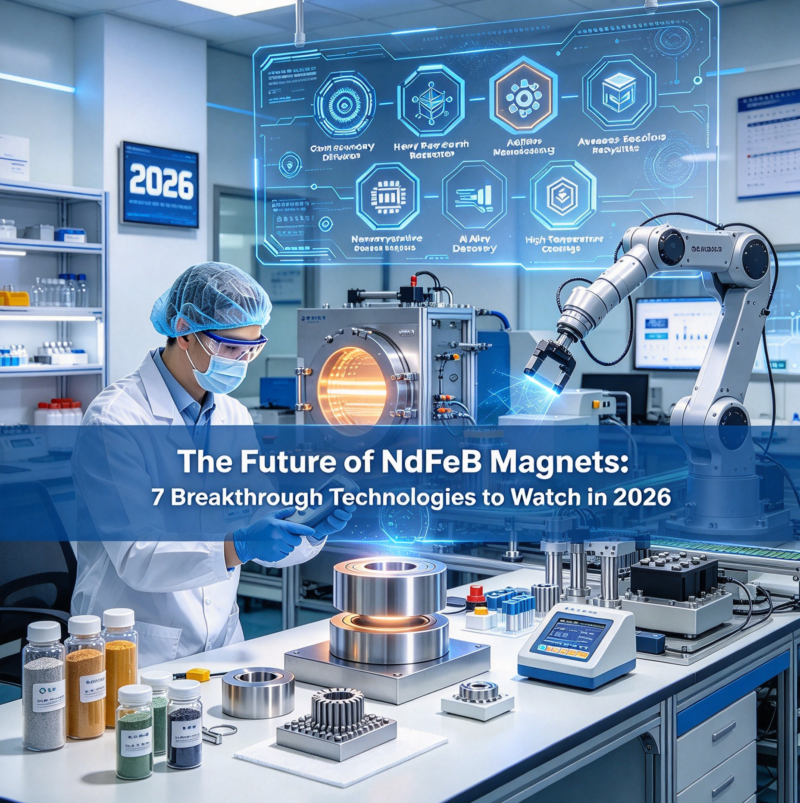
New technologies are helping address these challenges. From grain boundary diffusion and advanced microstructure control to automated manufacturing and magnet recycling, ongoing innovations are expanding the capabilities of NdFeB magnets.
For manufacturers and industrial buyers, understanding these developments is essential to selecting suitable magnetic materials and preparing for future application requirements. Dawa explores the key technologies that are likely to shape the future of NdFeB magnets and their role in next-generation industrial systems.
Grain boundary diffusion (GBD) is one of the most significant advances in the development of high-performance sintered NdFeB magnets. The process introduces selected elements, such as dysprosium or terbium, into the grain boundaries and near-surface regions of a magnet to improve its resistance to demagnetization.
This property, known as coercivity, is particularly important in applications where magnets operate under elevated temperatures or strong opposing magnetic fields. Electric vehicle traction motors and high-performance industrial motors are two examples in which insufficient coercivity can compromise long-term performance.
In conventional approaches, heavy rare earth elements may be added throughout the magnet to improve coercivity. Although effective, this can increase material costs and affect remanence, which contributes to the magnetic flux density a magnet can provide.
Grain boundary diffusion offers a more targeted alternative. By concentrating heavy rare earth elements in strategically important regions, manufacturers can improve coercivity while potentially reducing overall heavy rare earth consumption.
The effectiveness of this process depends on several factors, including magnet thickness, composition, diffusion conditions, and the required magnetic grade. It is not a universal solution for every NdFeB magnet, but it provides manufacturers with another way to balance magnetic performance and material efficiency.
As this technology develops, it will remain important for applications that demand high coercivity without unnecessary increases in rare earth content.
The performance of an NdFeB magnet depends on more than its chemical composition. Its internal structure also plays a major role in determining magnetic strength, coercivity, and consistency.
In sintered NdFeB magnets, the size and distribution of magnetic grains, the properties of grain boundaries, and the distribution of rare earth elements all influence the final performance. Small variations during manufacturing can affect how reliably a magnet performs under demanding conditions.
Advanced microstructure engineering aims to control these characteristics more precisely.
Grain refinement, for example, can help improve coercivity when combined with appropriate control of grain structure and boundaries. Grain boundary optimization can also reduce unwanted magnetic interactions between adjacent grains, helping the material resist demagnetization.
Meanwhile, improvements in powder preparation, magnetic field orientation, sintering, and heat treatment can contribute to more consistent magnetic properties across production batches.
These developments are particularly relevant to high-performance NdFeB magnets used in precision motors, robotics, generators, and other equipment where magnetic consistency affects overall system performance.
Rather than relying exclusively on changes in alloy composition, manufacturers can increasingly optimize the relationship between material chemistry and internal structure. This approach creates opportunities to improve performance while making more efficient use of valuable raw materials.
Rare earth elements are fundamental to conventional NdFeB magnets, but their cost and availability can create challenges for manufacturers and industrial buyers. Heavy rare earth elements, particularly dysprosium and terbium, are especially important in certain applications requiring high coercivity at elevated temperatures.
Reducing dependence on these elements without compromising essential magnetic properties has therefore become a major research and development objective.
Several technologies are contributing to this effort.
First, grain boundary diffusion can improve coercivity through more localized use of heavy rare earth elements. Second, improved microstructure control can help manufacturers achieve better magnetic performance with more efficient material utilization. Third, ongoing research into alloy design and alternative diffusion materials may create additional options for reducing heavy rare earth requirements.
However, reducing heavy rare earth consumption does not mean eliminating rare earth elements from NdFeB magnets. Neodymium remains central to their magnetic performance, and some demanding applications will continue to require carefully engineered compositions.
The most appropriate approach depends on the intended operating temperature, demagnetization risk, target magnetic properties, and production cost.
For industrial buyers, these developments are relevant not only to material pricing but also to supply-chain planning. Working with a supplier that understands the relationship between magnetic grade, operating conditions, and material selection can help avoid unnecessary specifications and improve purchasing efficiency.
Even a well-designed magnetic material cannot deliver consistent results without reliable manufacturing processes. For NdFeB magnet manufacturers, controlling production variation is essential to meeting customer specifications and maintaining product quality.
Smart manufacturing technologies are creating new opportunities to improve process control throughout the production cycle.
Automated handling systems can reduce manual variation, while digital monitoring can help track critical parameters during powder processing, pressing, sintering, machining, and inspection. Data-driven quality management can also make it easier to identify recurring defects and trace products back to specific production conditions.
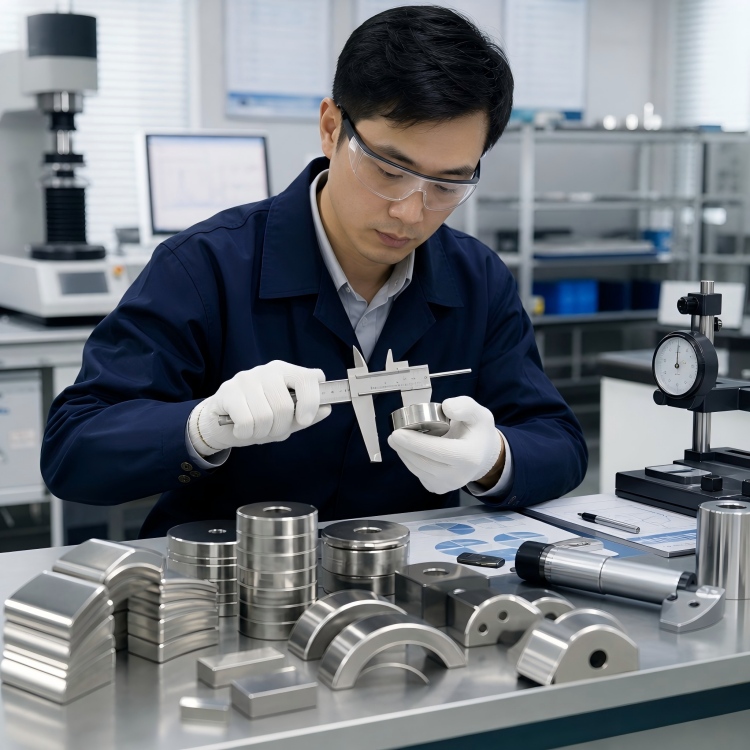
Precision inspection remains equally important. Magnetic properties, dimensions, surface conditions, and coating quality must all be verified according to the requirements of the intended application.
For example, a magnet used in a compact motor may require tight dimensional tolerances to fit correctly within the assembly. A magnet intended for a demanding industrial environment may need additional verification of its magnetic stability and protective coating.
The value of smart manufacturing lies in making production more repeatable and traceable. It does not automatically improve every magnetic property, but it helps manufacturers maintain tighter control over the factors that influence finished-product quality.
For buyers sourcing custom NdFeB magnets, consistent quality control can reduce assembly problems, improve product reliability, and simplify supplier qualification.
Sustainability is becoming an increasingly important consideration across the permanent magnet supply chain. NdFeB magnets contain valuable rare earth materials, and recovering these materials from production waste and end-of-life products can help reduce dependence on newly extracted resources.
However, recycling NdFeB magnets is technically challenging. Used magnets may be bonded to other components, protected by coatings, exposed to corrosion, or mixed with materials that complicate recovery.
Two major approaches are being developed to address these challenges.
Direct Recycling
Direct recycling aims to recover and reuse magnetic material without completely separating all its constituent elements. Certain hydrogen-based processes and subsequent powder treatments can help convert recovered material into feedstock for further magnet production.
This approach may reduce the need for energy-intensive chemical separation, although the quality of the recovered material and the condition of the original magnet are important limitations.
Rare Earth Recovery
Another approach focuses on extracting rare earth elements from discarded magnets and processing them into materials suitable for new production. This can be useful when the original magnets are contaminated, damaged, or unsuitable for direct reuse.
Both approaches have potential, but their commercial viability depends on feedstock quality, recovery efficiency, processing costs, and the performance requirements of the final product.
For the NdFeB magnet industry, recycling is becoming part of a broader effort to improve resource efficiency and strengthen long-term material availability. As collection systems and recovery technologies improve, recycled rare earth materials may play a larger role in selected manufacturing applications.
Not every application requires the same magnetic properties. A magnet designed for a consumer electronic device may have different priorities from one used in an electric vehicle motor, wind turbine generator, or industrial automation system.
This is why application-specific design is becoming increasingly important in NdFeB magnet development.
Electric vehicle motors, for example, require a careful balance between magnetic output, thermal stability, size, and resistance to demagnetization. Industrial sensors may place greater emphasis on dimensional precision and stable magnetic behavior. Equipment operating in humid or corrosive environments may require specialized coatings and additional protection.
Manufacturers are responding by refining magnet geometry, selecting more suitable magnetic grades, and optimizing production processes for specific operating conditions.
Segmented magnet designs can also be useful in certain applications. Depending on the geometry and magnetic circuit, segmentation may help address manufacturing constraints, eddy-current losses in changing magnetic fields, or the practical limits of diffusion-based processing. The benefits depend on the design and must be evaluated for each application.
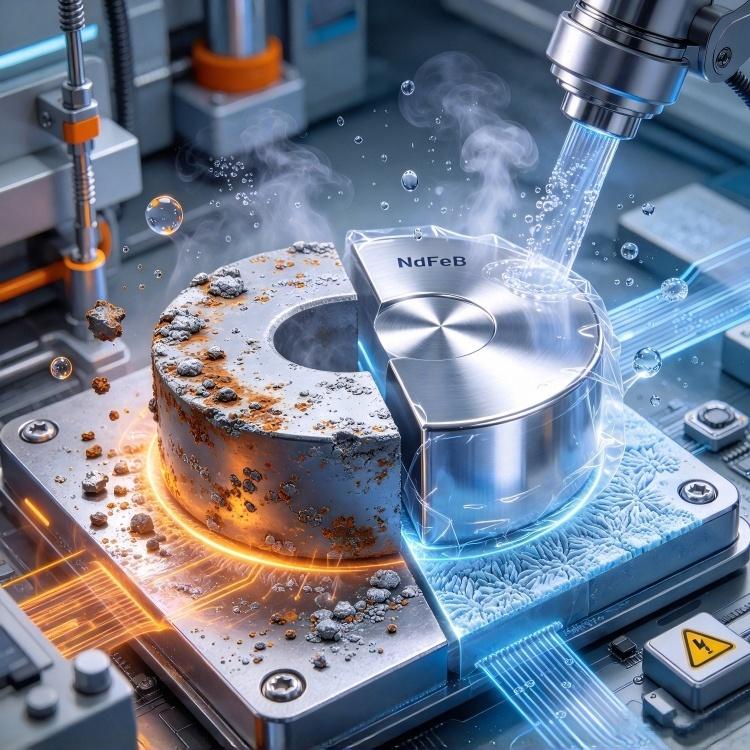
Surface protection is another important consideration. NdFeB magnets can be vulnerable to corrosion, so nickel-based coatings, epoxy coatings, and other protective systems may be selected according to environmental exposure, assembly requirements, and expected service life.
For engineers and procurement teams, the key is to evaluate the complete application rather than choosing a magnet based on magnetic strength alone.
As NdFeB magnet technology advances, testing will remain essential to confirming whether a material is suitable for its intended application.
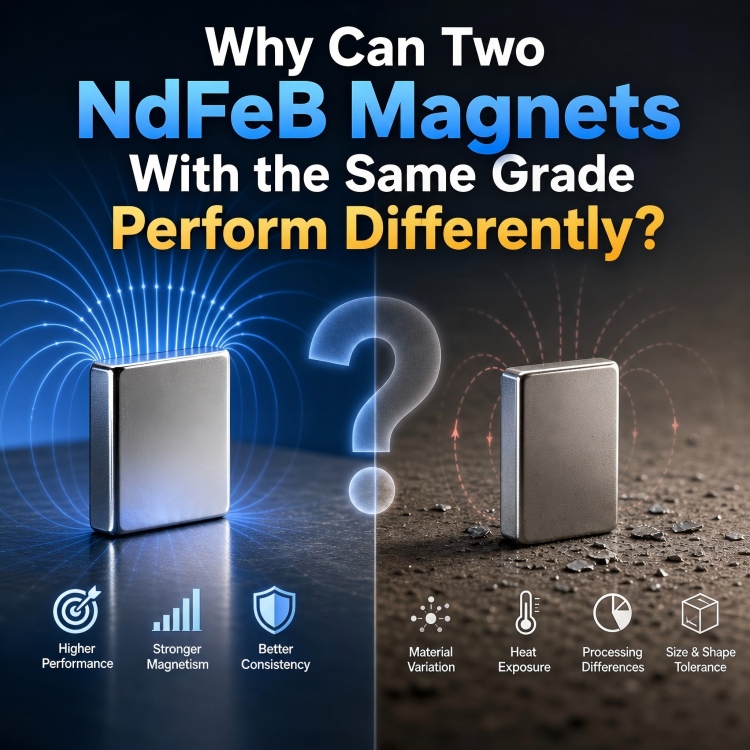
Published magnetic properties provide an important starting point, but actual performance also depends on operating temperature, magnetic circuit design, external fields, mechanical conditions, and environmental exposure.
A comprehensive evaluation may include the following factors:
Remanence: Indicates the residual magnetic flux density and helps assess the magnet’s magnetic output.
Coercivity: Measures resistance to demagnetization and is especially important under demanding magnetic and thermal conditions.
Maximum energy product: Helps characterize the magnet’s energy density and suitability for compact magnetic designs.
Temperature performance: Determines whether the magnet can maintain the required properties under its intended thermal conditions.
Corrosion resistance: Evaluates whether the magnet and its coating can withstand the operating environment.
Dimensional accuracy: Confirms that the magnet meets the mechanical requirements of the final assembly.
Testing should reflect the actual conditions in which the magnet will operate. For instance, a magnet exposed to sustained elevated temperatures may require more attention to irreversible demagnetization than one used in a relatively stable indoor environment.
Likewise, coating performance and dimensional accuracy can be critical when magnets are installed in precision assemblies.
For customers working with Dawa, defining the application requirements early can help establish appropriate specifications and inspection criteria. This makes it easier to compare products on meaningful performance factors rather than relying on general descriptions or headline magnetic values.
New technologies are expanding the options available to manufacturers, but choosing the right solution still requires a clear understanding of the application.
Before purchasing NdFeB magnets, buyers should evaluate several practical considerations.
Operating conditions: Determine the expected temperature range, external magnetic fields, mechanical stresses, and environmental exposure.
Magnetic requirements: Establish the necessary remanence, coercivity, and maximum energy product rather than specifying the highest available grade by default.
Product design: Confirm the required dimensions, tolerances, magnetization direction, and coating.
Manufacturing consistency: Review the supplier’s quality control procedures, testing capabilities, and ability to maintain consistent production.
Material sourcing: Consider rare earth availability, material efficiency, and whether recycled materials are appropriate for the application.
Total cost: Evaluate the overall cost of the magnet solution, including manufacturing, assembly, reliability, and potential maintenance implications.
These factors help determine whether a newer technology offers a practical advantage. In some cases, an advanced material or process may justify its cost through improved performance. In others, an established NdFeB magnet grade may already meet the application’s requirements.
The goal is not simply to adopt the newest technology, but to select a solution that delivers the right balance of performance, reliability, and cost.
New technologies will shape the future of NdFeB magnets by improving material efficiency, strengthening manufacturing consistency, and expanding the range of applications these magnets can serve.
Grain boundary diffusion is creating new opportunities to improve coercivity while reducing heavy rare earth consumption. Microstructure engineering is helping manufacturers refine magnetic performance, while smart manufacturing and advanced testing support more consistent quality. At the same time, recycling technologies and application-specific designs are contributing to a more resource-efficient and technically adaptable industry.
For industrial manufacturers and buyers, these developments make careful material selection more important than ever. Magnetic properties, operating temperature, corrosion protection, dimensional requirements, and manufacturing quality must be considered together to identify the most suitable solution.
At Dawa, understanding these engineering requirements is an important part of evaluating NdFeB magnet solutions for different applications. By focusing on the relationship between product specifications and real operating conditions, manufacturers and buyers can make more informed decisions as magnet technology continues to evolve.
1. What technologies are shaping the future of NdFeB magnets?
Major developments include grain boundary diffusion, microstructure engineering, reduced heavy rare earth consumption, smart manufacturing, magnet recycling, application-specific design, and improved testing methods.
2. How does grain boundary diffusion improve NdFeB magnets?
Grain boundary diffusion introduces selected elements, often dysprosium or terbium, into specific regions of a sintered magnet. It can improve coercivity and resistance to demagnetization while potentially reducing the amount of heavy rare earth material required.
3. Can NdFeB magnets become less dependent on heavy rare earth elements?
Yes. Diffusion technologies, optimized microstructures, and improved alloy design can reduce heavy rare earth requirements for certain grades. The achievable reduction depends on the required magnetic properties and operating conditions.
4. Why is recycling important for NdFeB magnets?
Recycling can recover valuable rare earth materials from manufacturing waste and end-of-life products. It may reduce demand for virgin raw materials, although recovery costs, material quality, and processing requirements affect its suitability for different applications.
5. What should buyers consider when selecting NdFeB magnets?
Buyers should evaluate magnetic properties, operating temperature, corrosion resistance, dimensions, magnetization direction, quality consistency, and total cost. The most suitable magnet is the one that meets the application’s technical requirements without unnecessary over-specification.
Dawa Jiahao, facilitate innovation and mass production