Why Can Two NdFeB Magnets With the Same Grade Perform Differently?
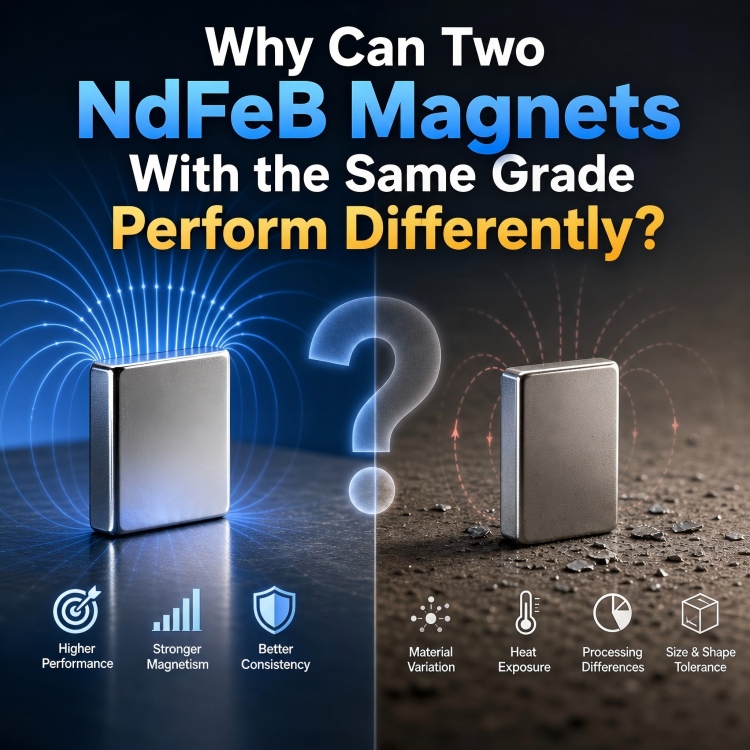
When engineers select an NdFeB magnet, the grade is often the first specification they check. N35, N42, and N52 are familiar choices, but the grade alone does not tell you how a magnet will perform inside a finished product.
Two magnets with the same nominal grade can produce different results. Material properties, dimensions, magnetization direction, temperature, coating, manufacturing tolerances, and the surrounding magnetic circuit can all affect performance.
For OEMs and engineers, this is an important point. Choosing the right NdFeB magnet means looking beyond the grade number.
The Grade Is Only Part of the Specification
An NdFeB grade provides a useful reference for magnetic performance, but engineers normally need to look at several parameters together.
Br (remanence) indicates the residual magnetic induction of the magnet after magnetization. It helps describe the magnetic flux the material can provide.
Hcj (intrinsic coercivity) indicates how well the magnet resists demagnetization. This becomes particularly important in high-temperature environments or applications exposed to opposing magnetic fields.
BHmax (maximum energy product) describes the maximum magnetic energy density of the material.
As a result, two magnets carrying the same grade label may still have different measured properties within the permitted specification range. For demanding applications, reviewing the actual material data is more useful than comparing grade numbers alone.
Size and Tolerance Can Change Magnetic Performance
The physical dimensions of a magnet have a direct relationship with its performance in an assembly.
A small difference in thickness, diameter, or length can change the distance between the magnet and other magnetic components. In a compact motor, sensor, actuator, or magnetic coupling, even a small dimensional change may affect the final magnetic field or holding force.
Tolerance also matters during mass production. A magnet that works well as a prototype may create problems if production parts vary too much in size. This is why a proper specification should include not only the magnet grade, but also dimensions and dimensional tolerances.
Magnetization Direction Is a Functional Requirement
The correct grade and size do not guarantee the correct result if the magnetization direction is wrong. Depending on the application, an NdFeB magnet may require axial, diametric, radial, or customized magnetization. The direction determines how the magnetic field interacts with surrounding components.
This becomes especially important in motors, sensors, encoders, speakers, magnetic couplings, and other precision assemblies. For engineers, magnetization should therefore be treated as part of the product design rather than simply a manufacturing detail.
Temperature is another reason why two magnets with the same grade may behave differently in real applications.
NdFeB magnets can lose magnetic performance as temperature rises, and unsuitable materials may experience irreversible demagnetization under demanding conditions.
For applications involving elevated temperatures, engineers may need grades with higher coercivity and better thermal stability, such as SH, UH, EH, or AH grades.
The key point is simple: maximum magnetic strength and temperature resistance are not the same thing.
A higher-performance grade is not automatically the right choice if the application operates in a hot environment. Material selection should match the actual working temperature and magnetic conditions.
Coating Is More Than a Surface Finish
Sintered NdFeB has excellent magnetic properties, but it also requires protection against corrosion in many environments. Common surface treatments include Ni-Cu-Ni and epoxy coatings. The appropriate choice depends on factors such as humidity, temperature, chemical exposure, and the requirements of the final assembly.
Coating thickness can also affect dimensional tolerances in precision applications. For products used outdoors, in automotive environments, or in equipment exposed to moisture, corrosion resistance should be considered during magnet selection rather than after production.
How DAWA Supports Custom NdFeB Magnet Projects
DAWA provides custom permanent magnet solutions for industrial applications, including sintered NdFeB, bonded NdFeB, SmCo, ferrite, AlNiCo, and magnetic assemblies.
Its capabilities extend beyond magnet production to areas such as magnetic circuit design, precision machining, metal processing, and custom manufacturing. This is useful when the magnet needs to work as part of a larger mechanical or magnetic assembly.
For OEM projects, this allows material selection, dimensions, magnetization, and assembly requirements to be considered together instead of treating the magnet as a standard off-the-shelf component.
The Grade Is Only the Starting Point
Two NdFeB magnets with the same grade can perform differently because the grade is only one part of the specification.
Magnetic properties, dimensions, tolerances, magnetization direction, temperature, coating, magnetic circuit design, and manufacturing consistency all contribute to the final result.
For engineers and procurement teams, the better approach is to define the application’s actual requirements first and then select the magnet around those requirements.
That is the difference between simply buying an NdFeB magnet and developing a magnetic component that performs reliably in the finished product. For custom applications, working with an experienced manufacturer such as DAWA can help connect material selection, engineering requirements, production, and quality control.
Dawa Jiahao, facilitate innovation and mass production