How Do You Choose the Right Coating for NdFeB Magnets in Harsh Environments?
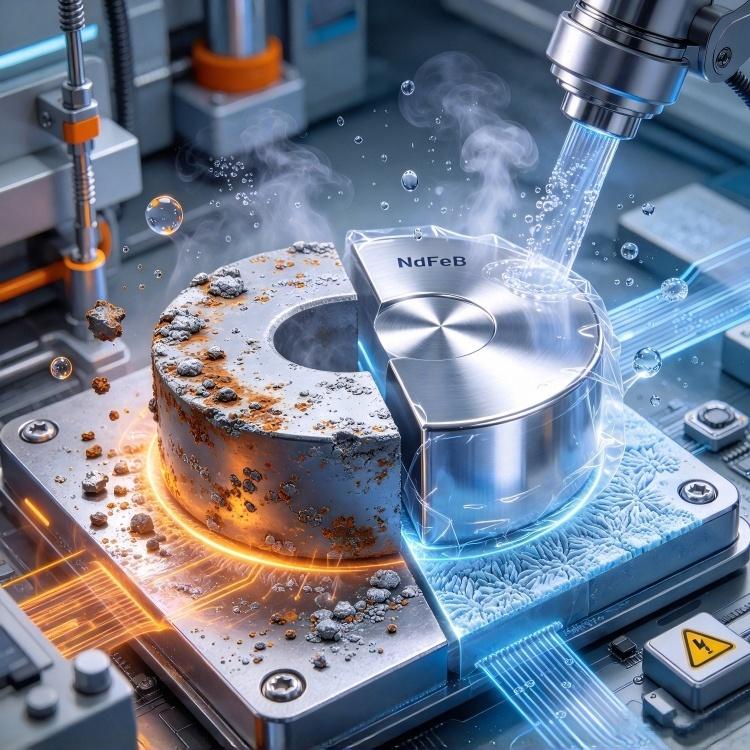
Neodymium magnets are widely used in electric motors, industrial automation systems, sensors, magnetic couplings, and many other applications where strong magnetic performance is essential. However, despite their excellent magnetic properties, sintered neodymium iron boron (NdFeB) magnets have one important weakness: their corrosion resistance is relatively poor.
When exposed to moisture, salt, chemicals, or other aggressive environmental conditions, an unprotected NdFeB magnet can corrode over time. This may damage its surface, reduce mechanical integrity, and eventually affect the reliability of the entire assembly.
That is why choosing the right NdFeB magnet coating is an important part of magnet selection, particularly for equipment operating in harsh environments.
But there is no single coating that works best for every application. Nickel plating, epoxy coating, zinc plating, and other surface treatments each have their own advantages and limitations. The right choice depends on the operating environment, service life requirements, mechanical conditions, and overall product design.
For engineers and purchasing teams, understanding these differences can help prevent premature magnet failure and unnecessary maintenance costs. At Dawa, coating selection should be considered alongside magnet grade, dimensions, and operating conditions to achieve a reliable solution for the intended application.
Sintered NdFeB magnets contain neodymium, iron, and boron. Their composition provides high magnetic energy density, but it also makes them vulnerable to oxidation and corrosion, especially when exposed to moisture or corrosive substances.
Unlike some other permanent magnet materials, uncoated neodymium magnets generally require additional surface protection in many industrial applications.
Several environmental factors can accelerate corrosion.
1. Moisture and High Humidity
High humidity can create conditions that promote corrosion on exposed magnet surfaces. If moisture enters through coating defects, damaged edges, or poorly protected areas, corrosion may develop beneath the coating.
This is particularly important for outdoor equipment, industrial machinery, and products installed in humid environments.
2. Salt Spray and Marine Conditions
Salt-containing moisture is more aggressive than ordinary water. Applications near the coast, marine equipment, and devices exposed to de-icing salts may require stronger corrosion protection than equipment used indoors.
A coating that performs well in a dry factory environment may not provide sufficient durability in a salt-rich atmosphere.
3. Chemicals and Cleaning Agents
Industrial equipment may come into contact with oils, detergents, solvents, cleaning solutions, or process chemicals. Their effects vary considerably, so chemical compatibility should be checked before selecting a surface treatment.
4. Abrasion and Mechanical Damage
Even a coating with good corrosion resistance can fail if it is scratched, chipped, or damaged during assembly. Press-fitting, repeated contact, vibration, and handling can expose the underlying NdFeB material.
For this reason, selecting an NdFeB magnet corrosion protection solution involves more than comparing coating materials. The coating must also suit the mechanical conditions of the finished product.
Several surface treatments are commonly used for neodymium magnets. The most suitable option depends on the required corrosion resistance, coating thickness, appearance, mechanical performance, and operating environment.
1. Nickel-Copper-Nickel (Ni-Cu-Ni) Coating
Nickel-copper-nickel is one of the most widely used neodymium magnet coatings. It typically consists of a nickel layer, a copper intermediate layer, and an outer nickel layer.
The multilayer structure provides a balance of corrosion protection, surface hardness, and appearance. Its metallic finish also makes it suitable for many general industrial and consumer applications.
Main advantages:
Good general-purpose surface protection when properly applied
Durable metallic finish for a wide range of applications
Suitable for many standard magnet shapes and assemblies
Commonly available for industrial and commercial NdFeB magnets
Potential limitations:
The coating can be damaged by impact, abrasion, or poor handling.
It is not automatically suitable for continuous immersion or highly corrosive environments.
The additional coating thickness must be considered when tight dimensional tolerances are required.
Ni-Cu-Ni is often a practical starting point for magnets used in indoor motors, sensors, magnetic fixtures, and general industrial equipment. However, the actual environment should always determine the final selection.
2. Epoxy Coating
Epoxy coating provides an organic protective layer that can offer good corrosion resistance when the coating is properly applied and remains intact.
Black epoxy coatings are common, although other colors may be available depending on the supplier and process. Epoxy can be useful where enhanced environmental protection is required or where a metallic finish is not the preferred solution.
Main advantages:
Good corrosion protection when coating integrity is maintained
Useful for selected humid and salt-exposure applications
Can provide electrical insulation at the surface, depending on the coating system
Available in different finishes and colors
Potential limitations:
The coating may be damaged by sharp impacts or abrasion.
Thickness can affect dimensional tolerances and assembly clearances.
Temperature limits and chemical compatibility depend on the specific coating formulation.
Damaged areas may expose the underlying magnet to corrosion.
For NdFeB magnets in harsh environments, epoxy is worth considering when corrosion protection is a priority. However, it should not be assumed that every epoxy-coated magnet is suitable for marine exposure, chemical immersion, or other severe conditions. Test results for the actual coating system are more useful than the coating name alone.
3. Zinc Coating
Zinc plating is another surface treatment used for certain NdFeB magnet applications. It can provide an economical protective finish under appropriate service conditions.
Compared with some multilayer metallic coatings, zinc may be attractive for applications with moderate environmental demands and cost constraints.
However, zinc coating has limitations in aggressive environments. Its performance depends on coating quality, thickness, exposure conditions, and the presence of additional protective treatments.
Zinc-plated magnets should therefore be evaluated carefully before use in high-humidity, salt-rich, or chemically aggressive environments.
4. Other Coatings and Specialized Surface Treatments
Some applications require alternatives to standard nickel, epoxy, or zinc finishes. Depending on the design and manufacturing process, options may include specialized polymer coatings, multilayer systems, or other protective surface treatments.
The availability and performance of these options depend on the magnet geometry, required coating thickness, and supplier capabilities.
For demanding applications, it is better to specify the environmental requirements first and then evaluate suitable coating systems rather than choosing a finish based only on appearance or cost.
The most reliable way to select a coating is to evaluate the conditions the magnet will actually experience. The following factors can help narrow the options.
1. Match the Coating to the Operating Environment
Start by identifying the main exposure risks.
For a dry indoor environment, a standard Ni-Cu-Ni coating may be sufficient. In humid environments or applications involving salt exposure, epoxy or another validated protective system may be more appropriate.
If the magnet will encounter chemicals, condensation, or continuous moisture, obtain compatibility data for the specific coating and operating conditions.
Do not assume that a coating suitable for occasional humidity will also withstand continuous immersion or concentrated salt exposure.
2. Consider Operating Temperature
Coating performance and magnet performance are related but separate considerations.
The magnet’s maximum usable temperature depends on its magnetic grade, coercivity, geometry, magnetic circuit, and actual operating conditions. The coating also has its own temperature limitations, particularly for organic coatings.
For example, an epoxy system that provides good corrosion resistance at moderate temperatures may not be appropriate for a high-temperature motor application.
When selecting a high-temperature NdFeB magnet coating, check both the coating’s temperature rating and the magnet’s resistance to irreversible demagnetization. These limits should be verified independently.
3. Check Coating Thickness and Dimensional Tolerances
Coating thickness can affect the final dimensions of a magnet. This matters when magnets must fit into precision slots, rotor assemblies, sensor housings, or other components with limited clearance.
A thicker coating may improve protection in some designs, but it can also interfere with assembly if the dimensional allowance is insufficient.
Before production, confirm the permitted coating thickness, finished dimensions, and tolerance requirements with the manufacturer. For complex geometries, sample inspection can help verify that the selected coating works with the intended assembly process.
4. Evaluate Wear, Impact, and Assembly Conditions
Magnets may be exposed to mechanical stress during installation or normal operation. Coatings can crack, chip, or wear through if the surface is subjected to excessive impact or friction.
If the magnet will be pressed into a housing, bonded to another component, or installed near moving parts, consider how the coating will interact with the assembly method.
For applications with repeated contact or vibration, testing the complete magnet assembly is more meaningful than evaluating an isolated coating sample.
5. Review the Required Service Life
The best coating is not necessarily the least expensive option or the one with the highest reported corrosion resistance. It is the coating that meets the application’s reliability requirements at an acceptable total cost.
A low-cost coating may be suitable for a short-life indoor product. Equipment expected to operate for years in a humid industrial environment may justify a more thoroughly validated protection system.
Consider maintenance access, replacement costs, downtime, and the consequences of coating failure when comparing options.
The following table provides a general starting point for comparing common surface treatments. Actual performance depends on the specific coating process and the conditions of use.
| Coating Type | Main Strength | Key Limitation | Typical Consideration |
|---|---|---|---|
| Ni-Cu-Ni | Balanced protection and metallic finish | Can be damaged by impact or aggressive exposure | General industrial and indoor applications |
| Epoxy | Good protection when the layer remains intact | Sensitive to damage and formulation-specific temperature limits | Selected humid or salt-exposure applications |
| Zinc | Economical protective finish | May be insufficient for severe corrosion conditions | Cost-sensitive applications with moderate exposure |
| Specialized coatings | Can be tailored to specific requirements | Availability, cost, and qualification vary | Demanding or application-specific environments |
This comparison is not a universal performance ranking. A well-qualified coating system designed for a particular environment may outperform a standard option that has not been validated for that use.
Selecting a coating based on its material name alone is not enough. The next step is to verify whether the finished magnet can withstand the intended environment.
Salt Spray Testing
Salt spray testing is commonly used to evaluate the corrosion resistance of coated metal components under controlled conditions. It can help identify coating defects and compare samples tested using the same procedure.
However, salt spray hours should not be treated as a direct prediction of years of service life. Laboratory exposure and actual field conditions are different, and results depend on the test method, coating system, sample preparation, and acceptance criteria.
Humidity and Environmental Testing
High-humidity testing can help assess how a coating performs under prolonged moisture exposure. For products that experience temperature changes, condensation, or repeated wet-and-dry cycles, testing should reflect those conditions where practical.
Adhesion and Surface Inspection
Coating adhesion, edge coverage, pinholes, cracks, and exposed areas all affect long-term protection. Visual inspection and suitable adhesion checks can help identify defects before magnets are assembled into finished products.
Testing After Assembly
A coating that performs well on an individual magnet may behave differently after bonding, press-fitting, machining, or other assembly operations.
For critical applications, inspect and test the magnet after the relevant manufacturing steps. This helps reveal damage or exposure risks that may not be apparent during incoming inspection.
When working with a manufacturer, specify the test method, exposure conditions, acceptance criteria, and required documentation rather than requesting a general statement that the coating is corrosion-resistant.
Common Mistakes When Selecting Neodymium Magnet Coatings
Several avoidable mistakes can lead to premature coating failure.
Choosing by price alone. A lower initial cost may result in higher replacement and maintenance expenses if the coating is unsuitable for the operating environment.
Assuming all nickel coatings are equivalent. Layer structure, surface preparation, process control, and final coating quality can influence performance.
Ignoring the edges and damaged areas. Scratches, chips, and poorly protected edges can become starting points for corrosion.
Overlooking chemical compatibility. A coating that withstands humidity may not resist a particular cleaning agent, solvent, or process chemical.
Failing to test production samples. A coating specification should be confirmed on representative parts, especially when magnet geometry, tolerances, or assembly methods are demanding.
Confusing corrosion resistance with magnetic stability. A protective coating helps preserve the magnet’s surface, but it does not automatically prevent demagnetization caused by excessive temperature or opposing magnetic fields.
Addressing these issues during design and supplier qualification is generally easier than correcting a coating problem after a product enters service.
Choosing a suitable coating requires more than selecting a finish from a product list. Magnet dimensions, magnetic grade, operating temperature, environmental exposure, and assembly requirements should all be considered together.
When evaluating an NdFeB magnet for a new project, it is useful to define the following information before requesting a quotation:
- Application: motor, sensor, magnetic coupling, automation equipment, or another use
- Operating environment: indoor, outdoor, high humidity, salt exposure, or chemical contact
- Temperature range: normal operating temperature and maximum temperature
- Magnet specifications: grade, shape, dimensions, magnetization direction, and tolerance
- Coating requirements: preferred finish, corrosion resistance, thickness, and appearance
- Validation requirements: environmental testing, inspection criteria, and quality documentation
Providing these details helps Dawa assess the application requirements and identify suitable magnet and coating options for further evaluation. For demanding environments, confirm the proposed coating’s capabilities and testing requirements before moving into mass production.
Choosing the right NdFeB magnet coating starts with understanding the environment in which the magnet will operate. Ni-Cu-Ni is a widely used option for general industrial applications, epoxy can be useful when enhanced corrosion protection is required, and zinc may suit certain cost-sensitive applications with moderate exposure.
However, no coating should be selected on reputation or material name alone. Moisture, salt, chemicals, temperature, mechanical wear, and dimensional tolerances all influence the final decision.
For engineers and purchasing teams, the most effective approach is to define the operating conditions, compare suitable coating systems, and validate the finished magnet using relevant test methods.
With the right specifications and a qualified manufacturing partner, Dawa can help customers evaluate NdFeB magnet solutions that balance corrosion protection, magnetic performance, manufacturing requirements, and long-term reliability.
Dawa Jiahao, facilitate innovation and mass production