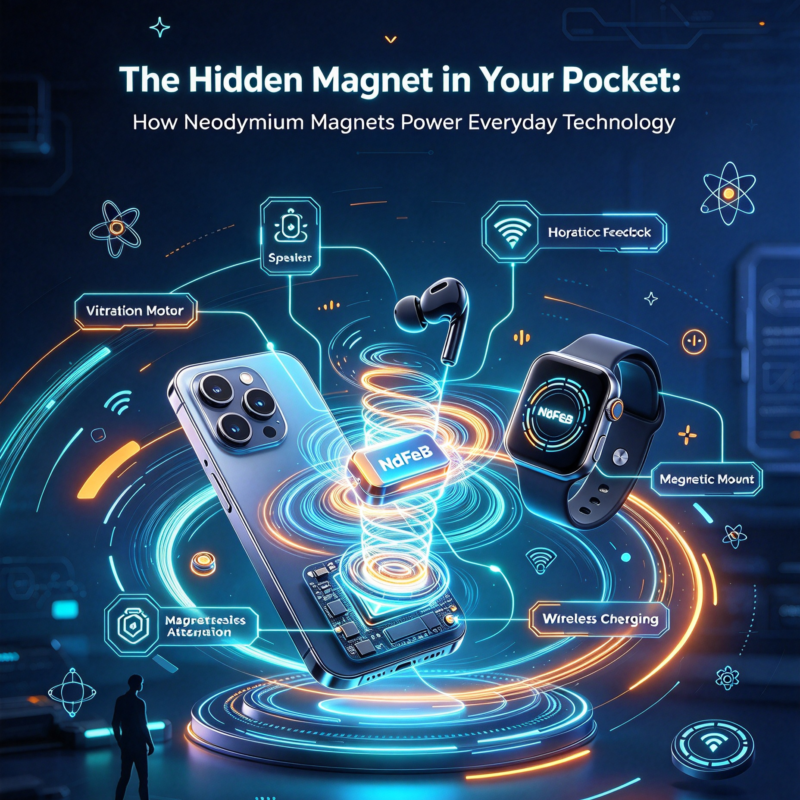
The Hidden Magnet in Your Pocket: How Neodymium Magnets Power Everyday Technology
Most people think of magnets as refrigerator decorations or school science experiments. But magnets play a much bigger role in modern life. From the speakers in your smartphone to the drivers in your wireless earbuds, magnetic components help make everyday electronics smaller, lighter, and more capable.
Neodymium magnets, also known as NdFeB or NIB magnets, are among the strongest permanent magnets commercially available. Their high magnetic energy product allows engineers to achieve strong magnetic performance in a relatively small space—an important advantage in compact electronic devices.
This article explores where neodymium magnets are used in everyday technology, how they work inside common devices, and why manufacturers often choose them over ferrite and other permanent magnet materials.
A smartphone compresses dozens of functions into a space smaller than a deck of cards. Magnets are central to several of those functions.
The speaker. When you play music or take a call, an electric current flows through a coil inside the speaker. That coil sits within the magnetic field of a permanent magnet. The interaction between the current and the field creates a physical vibration that moves the speaker diaphragm, pushing air and producing sound. Without a strong magnetic field in a tiny volume, the speaker would be too large or too weak for a phone.
The vibration motor. The “buzz” that tells you a message has arrived comes from a linear resonant actuator (LRA). Inside the LRA is a movable mass containing a magnet, a coil, and a spring. When current flows through the coil, the magnet moves, and the spring oscillates at the resonance frequency to produce vibration. The precision of modern haptic feedback—the difference between a gentle tap and a strong alert—depends on how well that magnet performs.
The camera. Some smartphone camera modules use magnetic actuators for optical image stabilization. A small magnet, a coil, and a gyro sensor work together to compensate for hand movement while you take a photo. The compact size of neodymium magnets makes this possible within a phone’s camera bump.
MagSafe and magnetic charging. Newer iPhones and many Android devices use magnetic alignment for wireless charging. The magnets ensure the charging coil on the phone aligns precisely with the coil on the charger, improving efficiency and reducing heat.
The microphone. Smartphone microphones are typically MEMS (micro-electromechanical systems) devices rather than traditional dynamic microphones. They convert sound into electrical signals using a different principle than the speaker, but permanent magnets may still be used in related audio components elsewhere in the device.
True wireless stereo (TWS) earbuds are a good example of how neodymium magnets enable compact electronic design. Depending on the product, magnets may be used in the miniature speaker driver, the earbud’s positioning mechanism, or the charging case.
The speaker magnet. Most dynamic drivers use a permanent magnet to establish the magnetic field in which the voice coil operates. When an audio signal passes through the coil, the interaction between the coil’s magnetic field and the permanent magnet produces movement, causing the diaphragm to vibrate and generate sound. Neodymium magnets are widely used in miniature drivers because their high magnetic performance helps designers achieve the required output within limited space.
Magnetic positioning and charging. Some earbuds and charging cases use small magnets to guide the earbuds into the correct position and help maintain reliable contact with the charging terminals. The arrangement varies by product design, and the positioning magnets may be located in the earbuds, the case, or both.
By combining high magnetic performance with compact dimensions, neodymium magnets help manufacturers develop smaller audio components and practical magnetic positioning systems.
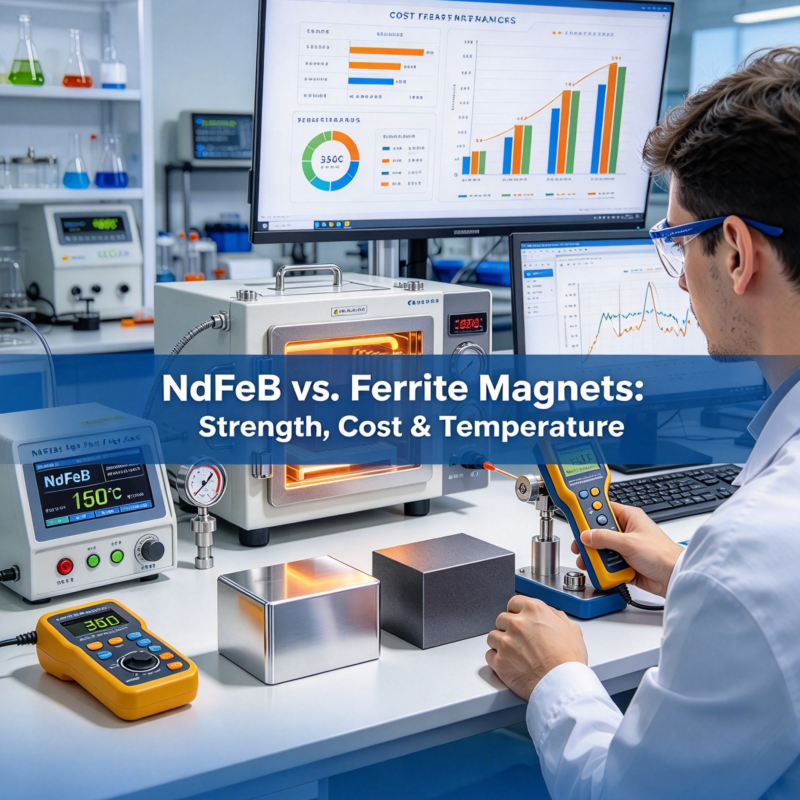
Neodymium vs. Ferrite Magnets in Everyday Electronics
Neodymium and ferrite magnets are both widely used in permanent magnet applications, but they serve different design priorities.
Neodymium magnets generally offer a much higher maximum energy product than ferrite magnets. This allows engineers to achieve the required magnetic performance in a smaller volume, making NdFeB particularly useful in miniature speakers, compact motors, sensors, and magnetic attachment systems.
Ferrite magnets remain a practical choice when material cost, corrosion resistance, and operating conditions are more important than minimizing size and weight. They are widely used in applications such as larger speakers and cost-sensitive motors.
The best choice depends on the complete magnetic circuit—not just the magnet material. Engineers must consider available space, required magnetic output, operating temperature, demagnetization risk, corrosion protection, and total system cost before selecting a magnet.
For compact consumer electronics, neodymium is often the preferred option. For applications with more available space and tighter cost targets, ferrite may still be a suitable alternative.
The neodymium magnets in your phone or earbuds are not simply mined and shaped. They are engineered materials, produced through a multi-step manufacturing process that determines their final performance.
The process begins with raw materials—neodymium, iron, boron, and sometimes dysprosium or terbium for high-temperature grades. These materials are melted in a vacuum furnace and rapidly cooled into thin alloy flakes. The flakes are then broken down into a fine powder, pressed into shape in a magnetic field, and sintered at high temperature. After heat treatment and machining, the magnets are coated—usually with nickel-copper-nickel—to protect against corrosion, and finally magnetized. Specific process parameters vary depending on the grade and production requirements.
Each of these steps affects the final magnetic properties. Raw material composition affects the maximum energy product. Sintering temperature and time affect coercivity and temperature stability. Machining tolerance affects how well the magnet fits in its assembly. Coating quality affects corrosion resistance.
For the engineers who design smartphones and earbuds, these variables are not abstract—they determine whether the speaker sounds correct, the vibration motor responds properly, and the earbud charges reliably. In precision electronic assemblies, even small dimensional deviations can affect fit, alignment, and assembly consistency. Magnetic properties are equally important: insufficient coercivity or an unsuitable grade may increase the risk of irreversible demagnetization under certain operating conditions. These factors make material selection, dimensional control, coating quality, and magnetization specifications important parts of the magnet design process.
For OEMs, working with a manufacturer that understands both magnet production and application requirements can help reduce design risks and improve consistency from prototype development to mass production.
The same strength that makes neodymium magnets useful in devices also makes them hazardous if mishandled. Small neodymium magnets can be dangerous if swallowed—especially if multiple magnets are ingested, as they can attract each other through intestinal walls and cause serious injury. Strong magnetic fields may also affect some medical devices. If you use an implantable medical device, follow the safety distances and usage instructions provided by the device manufacturer. Loose neodymium magnets should be kept away from children and handled with care.
Neodymium magnets are not a static technology. Research continues into new manufacturing processes that reduce heavy rare earth content, improve temperature performance, and enable new applications. But for the devices in your pocket today, the fundamentals are already established: neodymium magnets are the enabling material for the compact, powerful, and efficient electronics that we carry with us everywhere.
Custom Neodymium Magnets for Consumer Electronics
Designing a compact electronic product requires more than selecting a strong magnet. Magnet grade, dimensions, magnetization direction, coating, and operating temperature must all match the requirements of the final assembly.
DAWA has 35 years of experience in neodymium magnet manufacturing, supporting customers with custom magnet solutions for applications such as miniature speakers, motors, sensors, and magnetic attachment systems.
With in-house manufacturing capabilities covering sintering, machining, coating, magnetization, and inspection, DAWA supports customers from magnet specification and prototype development through production.
Whether you are developing a new consumer electronic device or optimizing an existing design, our team can help evaluate magnet specifications based on your application requirements.
Looking for a custom NdFeB magnet for your next project? Visit the DAWA Magnet website or contact our team to discuss your requirements.
What devices in my home contain neodymium magnets?
Smartphones, wireless earbuds, laptops (speakers and hard drives), smartwatches, magnetic phone mounts, and many toys and DIY projects. If a device has a speaker, a vibration motor, or a magnetic attachment, it likely contains a permanent magnet—often neodymium.
Why do earbuds use magnets?
Magnets may serve two functions: driving the speaker to produce sound, and providing magnetic positioning between the earbud and the charging case. The exact configuration varies by product design.
Are neodymium magnets dangerous to have in my phone?
No. The magnets inside a phone are securely enclosed and designed for the application. The hazards are associated with loose, unenclosed magnets—particularly if swallowed.
Can I replace a ferrite magnet with a neodymium magnet?
In some cases, yes—but the magnetic circuit must be re-evaluated. Neodymium magnets are much stronger, so a direct substitution without adjusting the design can cause unintended forces or magnetic saturation.
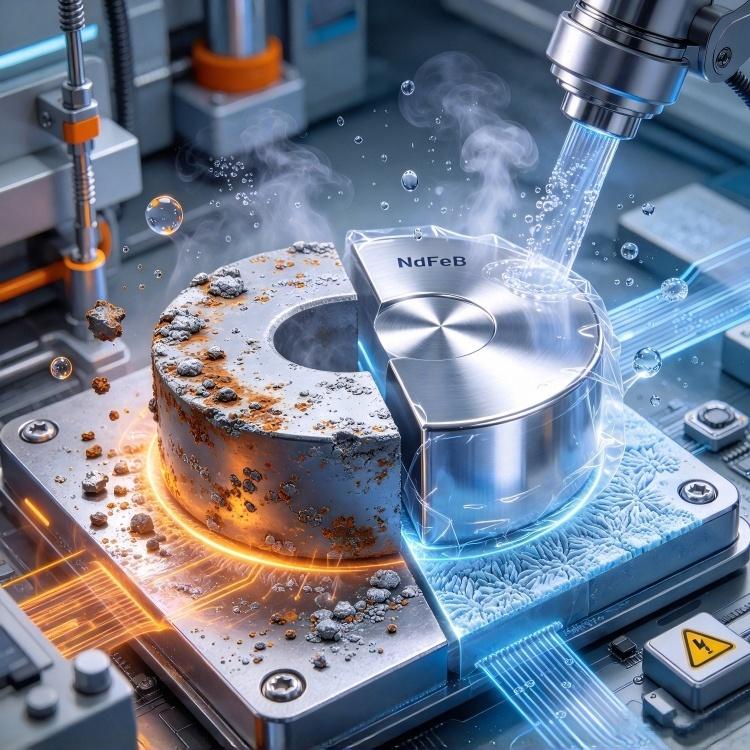
Why are neodymium magnets coated?
The iron-rich composition of NdFeB makes it susceptible to corrosion. A protective coating (typically Ni-Cu-Ni) is commonly applied to improve corrosion resistance in humid or corrosive environments.
What is the strongest magnet available for consumer products?
Neodymium magnets (NdFeB) are the strongest permanent magnets commercially available. Grades like N52 offer the highest magnetic energy product for a given volume.
Dawa Jiahao, facilitate innovation and mass production