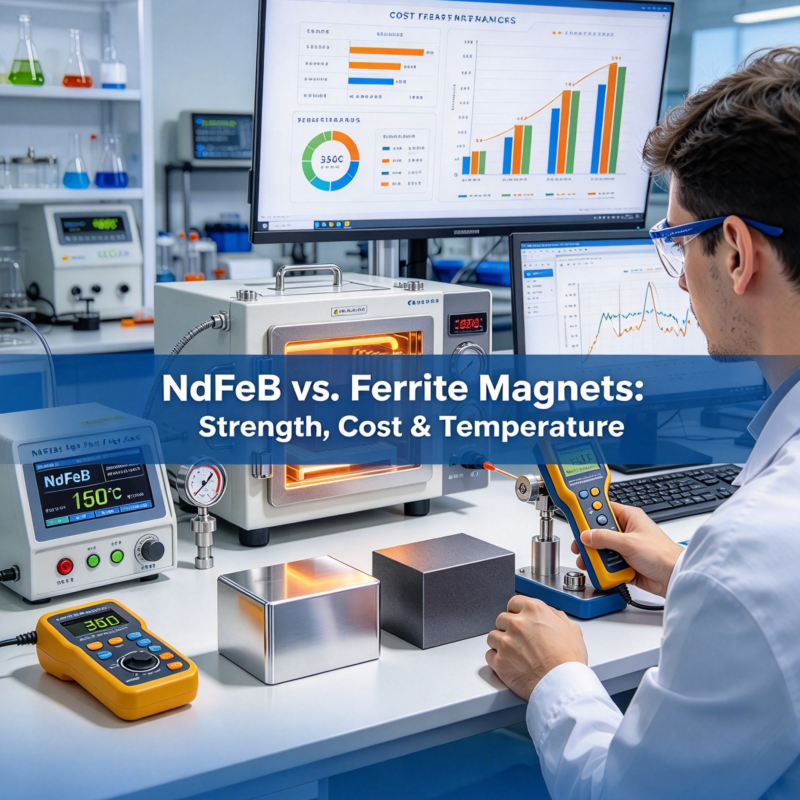
NdFeB vs. Ferrite Magnets: Strength, Cost & Temperature
The word “magnet” is used so broadly that it can be misleading. A piece of lodestone pulled from the ground and a sintered NdFeB magnet inside an electric vehicle motor are both called magnets—but they belong to different categories of material with different origins, different performance levels, and different engineering applications.
This article explains the difference between natural magnets and manufactured permanent magnets, then compares the two most common industrial permanent magnet materials—NdFeB and ferrite—so engineers and procurement teams can make more informed specification decisions.
A natural magnet is a naturally occurring magnetic material. The most well-known example is lodestone—a naturally magnetized form of the mineral magnetite (Fe₃O₄). Lodestone is, in itself, a naturally occurring permanent magnet: it retains magnetization without any artificial processing.
Lodestone forms when magnetite is exposed to the Earth’s magnetic field over geological time, or when lightning strikes create localized magnetic fields strong enough to magnetize the mineral. The result is a stone that can attract small pieces of iron.
Natural magnets are historically important—they were humanity’s first encounter with magnetism and formed the basis of the earliest navigation compasses. However, their magnetic properties and consistency typically cannot meet the requirements of modern industrial applications. The magnetic strength varies significantly from sample to sample, depending on geological conditions, and cannot be engineered to a specification.
What Is a Manufactured Permanent Magnet?
A manufactured permanent magnet is an engineered material designed to maintain a specific magnetic field without requiring external energy input. The term “permanent” refers to the fact that the material retains its magnetization after the external magnetizing field is removed—a property shared by both natural lodestone and engineered materials.
Manufactured permanent magnets fall into four primary material categories:
| Material | Composition | Key Characteristics |
|---|---|---|
| NdFeB (Neodymium) | Neodymium, iron, boron | Highest maximum energy product; sensitive to temperature and corrosion without coating |
| SmCo (Samarium Cobalt) | Samarium, cobalt | Excellent high-temperature stability; higher cost |
| Ferrite (Ceramic) | Iron oxide combined with barium or strontium | Low cost; good corrosion resistance; moderate magnetic strength |
| Alnico | Aluminum, nickel, cobalt, iron | High-temperature stability; lower magnetic strength |
Among these, NdFeB magnets and ferrite account for the vast majority of industrial magnet production. They represent the two ends of the cost-performance spectrum—and the comparison between them is one of the most common specification decisions in motor design, sensor engineering, and consumer electronics.
At a high level, NdFeB magnets offer substantially higher maximum energy products and are preferred when compact size and high magnetic output are required. Ferrite magnets offer lower magnetic strength but are significantly lower in cost and inherently resistant to corrosion. The right choice depends on the specific balance of size, weight, temperature, environment, and budget in the application.
The table below summarizes the key differences.
| Parameter | NdFeB (Sintered) | Ferrite (Ceramic) |
|---|---|---|
| Maximum Energy Product (BHmax) | Approx. 220–500 kJ/m³ (28–63 MGOe) | Approx. 7–42 kJ/m³ (1–5 MGOe) |
| Remanence (Br) | 0.97–1.45 T | 0.2–0.48 T |
| Intrinsic Coercivity (Hcj) | Varies by grade—standard grades typically 740–1000 kA/m; high-coercivity grades (SH, UH, EH, AH) can exceed this range substantially | 120–360 kA/m |
| Maximum Operating Temperature | Typically 80°C for standard grades; up to 230°C with high-coercivity grades | Up to 250°C for many grades |
| Corrosion Resistance | Poor without coating—requires Ni-Cu-Ni, epoxy, or similar | Excellent—inherently corrosion-resistant |
| Mechanical Strength | Brittle; prone to chipping and cracking | Hard and brittle; generally comparable to NdFeB in fragility |
| Raw Material Cost | High—relies on rare earth elements | Low—made from abundant iron oxide and barium/strontium carbonate |
| Temperature Coefficient of Coercivity | Negative (approximately −0.4%/°C, varies by grade) | Positive or near-zero |
Reference values are indicative ranges compiled from manufacturer material datasheets for sintered NdFeB (N35–N52, SH/UH grades) and ferrite (Y30, Y35 grades). Actual values vary by specific grade, geometry, magnetic circuit operating point, and test conditions. Buyers should confirm specifications with the supplier for the specific grade being considered.
The most significant difference is maximum energy product. NdFeB magnets offer substantially higher maximum energy products than ferrite magnets—typically an order of magnitude higher. This makes NdFeB the preferred material when a strong magnetic field is required in a small volume.
To achieve an equivalent magnetic field in a given air gap, a ferrite magnet would generally require a larger volume than an NdFeB magnet. The exact ratio depends on the magnetic circuit design, air gap, operating point, and the specific grades being compared—it cannot be determined from BHmax values alone.
For applications where space and weight are constrained—TWS earbuds, servo motors, drone propulsion systems—this difference is often decisive.
Temperature performance is where the comparison becomes more nuanced.
NdFeB magnets are sensitive to temperature. Their coercivity decreases as temperature rises, with a typical temperature coefficient of approximately −0.4%/°C for coercivity. Standard N-grade NdFeB magnets are typically rated for maximum operating temperatures around 80°C. High-coercivity grades (such as SH, UH, EH, and AH) provide improved resistance to demagnetization at elevated temperatures. Depending on the grade and manufacturing process, this may involve the use of heavy rare earth elements such as dysprosium or terbium, which can increase material cost. The actual maximum operating temperature depends on the specific grade, the magnetic circuit operating point, the presence of external demagnetizing fields, and the duration of exposure.
Ferrite magnets behave differently. Their temperature coefficient of coercivity is positive or near-zero—meaning their resistance to demagnetization does not degrade in the same way as NdFeB at elevated temperatures. Many ferrite grades can operate continuously at temperatures around 250°C. However, the actual maximum operating temperature still depends on the specific ferrite grade, the magnetic circuit, and the operating conditions.
For applications where the operating temperature exceeds NdFeB’s practical limits—automotive under-hood sensors, industrial furnace equipment, some aerospace applications—ferrite may be the more reliable choice despite its lower magnetic strength.
Corrosion Resistance: Ferrite Wins Out of the Box
Ferrite magnets are ceramic materials with inherent chemical stability. They do not rust or oxidize under normal conditions and require no protective coating.
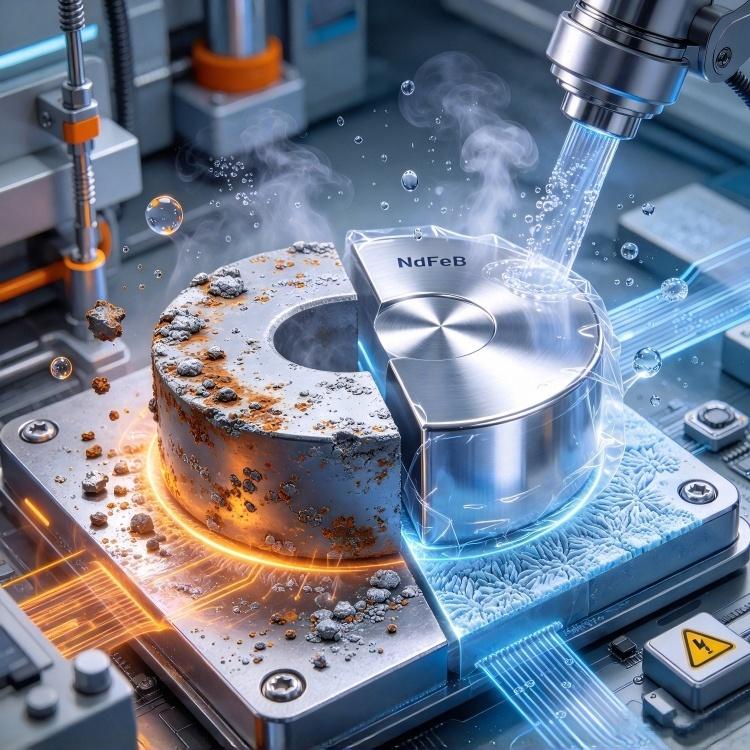
NdFeB magnets are a different story. Their iron-rich composition makes them susceptible to oxidation. Protective coatings such as Ni-Cu-Ni or epoxy are commonly used to improve corrosion resistance in humid or corrosive environments. The appropriate coating depends on exposure conditions, assembly requirements, and the expected service life of the magnet. Coating adds a manufacturing step, increases cost, and introduces a potential failure mode if the coating is damaged during assembly.
Ferrite magnets are made from abundant raw materials—iron oxide combined with barium or strontium carbonate. They are inexpensive to produce and well-suited for large-scale manufacturing.
NdFeB magnets rely on rare earth elements, which are subject to significant price volatility and supply chain concentration. The raw material cost for NdFeB is substantially higher than ferrite, though the exact difference depends on the specific grade, order volume, and prevailing rare earth prices.
The procurement decision is not always straightforward. In applications where space is constrained, ferrite’s lower material cost may be offset by the larger volume required to achieve equivalent magnetic performance. In high-volume production, a smaller NdFeB magnet may actually result in lower total system cost than a larger, cheaper ferrite magnet.
When to Choose NdFeB vs. Ferrite
The right material depends on the application requirements. Here is a practical guide:
Choose NdFeB when:
-
Maximum magnetic strength is required in the smallest possible volume
-
Weight is a critical design constraint (drones, portable electronics, robotics)
-
Operating temperature stays within the selected grade’s rating
-
Corrosion protection can be provided through coating
-
System-level cost—not just magnet cost—is the optimization target
Choose ferrite when:
-
Cost is the primary constraint and size/weight are less critical
-
The operating environment is corrosive or humid, and coating is undesirable
-
Operating temperatures exceed NdFeB’s practical limits
-
The application can tolerate larger magnet volume
-
The magnetic field requirement is moderate
For motor designers and procurement engineers, the material decision often comes down to five practical factors:
1. Available space and target torque
If the motor envelope is fixed and the torque requirement is high, NdFeB is usually the only material that can meet the performance target within the available volume. If the motor can be larger, ferrite may be sufficient at lower cost.
2. Operating temperature
If a motor operates continuously at elevated temperatures, the selected NdFeB grade should be evaluated against the actual magnet temperature and demagnetization risk. A standard N-grade may be insufficient in some designs, making a high-coercivity grade or an alternative magnetic material worth evaluating.
3. Demagnetization risk
Motors with high armature reaction fields or frequent fault currents require magnets with sufficient intrinsic coercivity (Hcj) to resist demagnetization at operating temperature. NdFeB grades with higher Hcj are available, but at higher cost. Ferrite’s positive temperature coefficient of coercivity can be advantageous in some high-temperature designs.
4. Corrosion environment and coating requirements
If the motor operates in a humid, saline, or chemically aggressive environment, NdFeB will typically require a protective coating. Ferrite does not. This affects both cost and long-term reliability.
5. Total system cost
Magnet piece price is only one component. Material cost, machining yield, coating cost, assembly time, and the risk of field failures all contribute to total system cost. In some cases, a higher-priced NdFeB magnet may reduce total motor cost by enabling a smaller rotor, lower weight, or higher efficiency.
DAWA has been manufacturing NdFeB magnets for 35 years. Production covers sintering, machining, coating, magnetization, and final inspection within its own manufacturing facilities.
In-house sintering. DAWA operates its own sintering production, which provides visibility into material quality and magnetic consistency from the earliest stage of manufacturing.
Precision machining. For qualified geometries, dimensional tolerances down to ±0.02 mm can be supported. Wire EDM is available for complex shapes requiring ultra-tight tolerances.
Custom magnetization. Axial, diametric, radial, and multi-pole magnetization are available based on application requirements. Magnetization fixtures are designed and produced internally.
Coating options. Multi-layer nickel-copper-nickel is standard. Epoxy, gold, and other coatings are available depending on the operating environment.
Inspection. Dimensional inspection is performed on critical features. Magnetic performance is verified before shipment, and test data can be provided upon request.
For NdFeB applications, DAWA provides grade selection support based on operating temperature, magnetic circuit design, dimensional requirements, corrosion environment, and budget. For projects where ferrite may be the more suitable material, DAWA can assist with material comparison and trade-off evaluation, though DAWA’s manufacturing capability is focused on NdFeB.
DAWA has experience supplying custom neodymium magnets and other high-precision magnet solutions for applications including TWS earbuds, servo motors, and industrial automation systems.
What is the difference between a natural magnet and a manufactured permanent magnet?
A natural magnet, such as lodestone, occurs in nature with magnetic properties already present. A manufactured permanent magnet is an engineered material designed to maintain a specific magnetic field. Both are permanent magnets in the sense that they retain magnetization without external energy input—but natural magnets cannot be engineered to a specification.
Are natural magnets used in industry?
Natural magnets are not used in modern industrial applications because their magnetic properties and consistency cannot meet engineering requirements.
Which is stronger, NdFeB or ferrite?
NdFeB magnets offer a substantially higher maximum energy product than ferrite magnets, typically an order of magnitude higher. This makes NdFeB the preferred material when a strong magnetic field is required in a small volume. The exact performance difference in a given application depends on the magnetic circuit design.
Can ferrite magnets operate at higher temperatures than NdFeB?
In general, many ferrite grades can operate continuously at temperatures around 250°C, while standard NdFeB grades are typically limited to around 80°C. High-coercivity NdFeB grades (SH, UH, EH) extend this limit to 150–230°C at higher cost. The actual maximum operating temperature depends on the specific grade, magnetic circuit operating point, and the presence of external demagnetizing fields.
Why do NdFeB magnets need coating?
NdFeB magnets contain a high percentage of iron, making them susceptible to oxidation and corrosion. Protective coatings such as Ni-Cu-Ni or epoxy are commonly used to improve corrosion resistance in humid or corrosive environments. The appropriate coating depends on exposure conditions, assembly requirements, and expected service life. Ferrite magnets are inherently corrosion-resistant and require no coating.
When should I choose ferrite over NdFeB?
Choose ferrite when cost is the primary constraint, when the operating temperature exceeds NdFeB’s practical limits, when the environment is corrosive, or when the application can tolerate larger magnet volume.
Does DAWA manufacture ferrite magnets?
DAWA specializes in NdFeB magnet manufacturing with in-house sintering, machining, coating, magnetization, and inspection. For projects where ferrite may be the more suitable material, DAWA can assist with material comparison and trade-off evaluation.
Can NdFeB and ferrite magnets be used in the same motor?
In principle, yes—but the magnetic circuit would need to be designed around the specific properties of each material. NdFeB and ferrite have different Br, Hcj, and temperature behavior, so they are not directly interchangeable in a given design without re-optimization.
Dawa Jiahao, facilitate innovation and mass production