How Do You Choose Between Flexible Rubber Magnets and Bonded NdFeB?
Choosing the right magnet for an industrial product is not always as straightforward as selecting the strongest available material. In some applications, flexibility and easy installation matter more than magnetic force. In others, the magnet needs to deliver a stronger magnetic field within a limited space while maintaining precise dimensions.
This is where flexible rubber magnets and bonded NdFeB magnets come into consideration. Both are manufactured using magnetic powder combined with a binder, but their material compositions, magnetic performance, and typical applications can be quite different.
For product designers, engineers, and OEM buyers, understanding these differences helps prevent unnecessary costs and design changes later in production.
At DAWA Magnetic, selecting a suitable magnet starts with the actual requirements of the application. Rather than focusing on one property alone, it is important to consider magnetic strength, installation conditions, product geometry, operating environment, and manufacturing cost together.
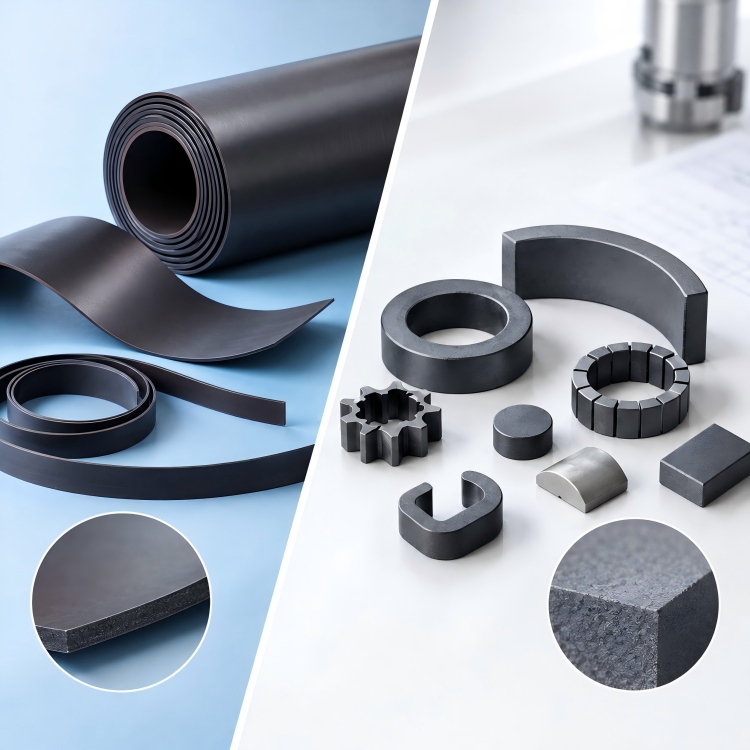
Flexible rubber magnets are made by combining magnetic powder, commonly ferrite, with a flexible rubber or polymer binder. Unlike rigid permanent magnets, they can be supplied in sheets, strips, rolls, and custom-cut shapes.
Their flexibility makes them particularly useful when a magnetic component needs to follow a curved surface or cover a relatively large area.
For example, flexible rubber magnets are widely used in magnetic signs, advertising displays, refrigerator magnets, magnetic labels, and selected industrial holding applications. Depending on the product design, they can also be supplied with adhesive backing or cut into specific shapes.
One of the main advantages of flexible rubber magnets is their ease of handling. They can often be cut or shaped to fit the intended installation area without the specialized machining required for many rigid magnets.
However, their magnetic performance is generally lower than that of bonded NdFeB magnets because conventional flexible ferrite compounds contain ferrite powder rather than high-energy neodymium magnetic material.
For applications where broad surface contact, flexibility, and economical production are the main priorities, flexible rubber magnets can be a practical choice.
Bonded NdFeB magnets are made by combining neodymium-iron-boron magnetic powder with a polymer binder. The resulting material offers the advantages of neodymium-based magnetic performance while allowing manufacturers to produce components using processes such as injection molding or compression bonding.
Compared with conventional flexible ferrite magnets, bonded NdFeB magnets generally provide higher magnetic performance, making them suitable for applications where space is limited and stronger magnetic output is required.
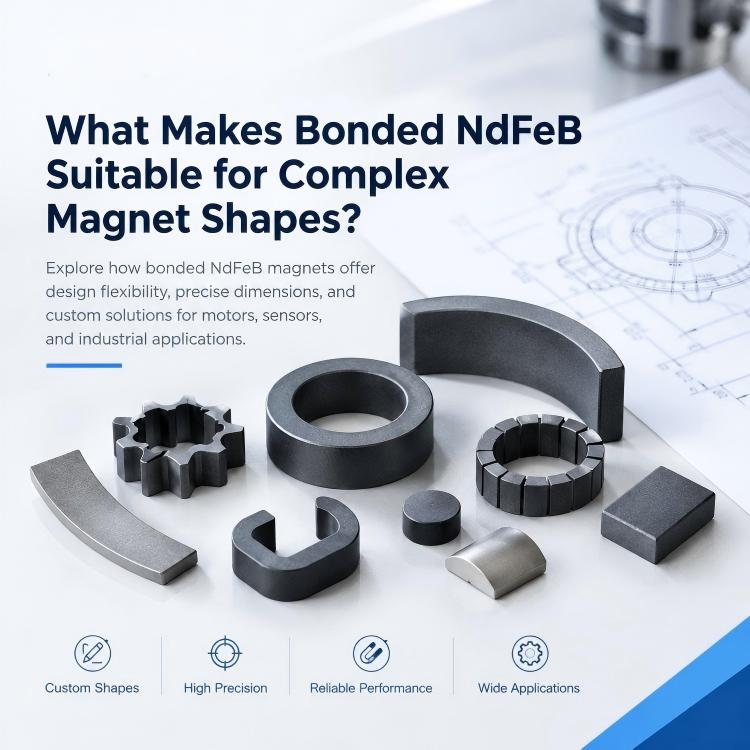
Their manufacturing flexibility also supports a range of component geometries, including rings, curved profiles, and other application-specific shapes. Depending on the process and tooling, selected features can be integrated during forming rather than created through extensive secondary machining.
These characteristics make bonded NdFeB magnets useful in compact motors, magnetic encoders, sensors, and precision electromechanical assemblies.
It is worth noting that bonded NdFeB magnets are not necessarily flexible. Although they contain a polymer binder, many bonded NdFeB components are rigid. Their main advantage is the combination of neodymium magnetic properties and flexible manufacturing options, rather than the ability to bend like a rubber magnet sheet.
The two materials serve different design purposes. Understanding the differences helps engineers narrow down their options before requesting samples or quotations.
1. Magnetic Strength
Magnetic strength is often the first factor engineers consider, particularly when a magnet must generate sufficient holding force or magnetic flux within a compact assembly.
Conventional flexible ferrite rubber magnets are suitable for applications that require moderate magnetic force over a relatively large surface. They are commonly used in signs, displays, magnetic strips, and general-purpose holding products.
Bonded NdFeB magnets generally offer higher magnetic performance than conventional ferrite-based flexible magnets. This makes them more suitable for compact components where the available space is limited or a stronger magnetic field is required.
However, actual performance depends on the magnetic formulation, dimensions, magnetization pattern, air gap, and surrounding magnetic circuit. A material comparison alone cannot determine the holding force of a finished product.
Choose flexible rubber magnets when moderate magnetic force is sufficient and flexibility is important.
Consider bonded NdFeB magnets when stronger magnetic performance is needed within a compact design.
2. Flexibility and Shape Requirements
The physical shape of a magnet can influence both installation and product performance.
Flexible rubber magnets can bend to follow curved surfaces and are available in sheets, strips, and custom-cut formats. This makes them suitable for applications where a rigid magnet would be difficult to install or where the magnetic material needs to cover a larger area.
Bonded NdFeB magnets offer a different type of design flexibility. Depending on the manufacturing method, they can be formed into complex three-dimensional geometries that match a component’s structure.
For instance, a flexible magnetic strip may be suitable for a removable sign, while a molded bonded NdFeB ring may be more appropriate for a compact sensor or motor component.
The distinction is important: flexible rubber magnets provide physical flexibility, while bonded NdFeB magnets provide greater freedom in manufacturing certain complex shapes.
When choosing between the two, consider whether the magnet needs to bend during installation or whether it needs a customized geometry to fit a precision assembly.
3. Dimensional Accuracy and Component Integration
Dimensional requirements become increasingly important when magnets are installed inside compact products or assembled with other components.
Flexible rubber magnets can be cut, slit, or die-cut into specified dimensions. They work well when the application allows some flexibility in the shape and installation method.
Bonded NdFeB magnets can be formed using dedicated tooling, allowing selected geometric features to be incorporated during manufacturing. This can be beneficial for products that require repeatable dimensions or a close fit with surrounding components.
Nevertheless, achievable tolerances depend on the manufacturing process, material formulation, tooling design, and part geometry. Tight tolerances should be confirmed with the manufacturer before production begins.
For OEM projects, providing a technical drawing and identifying critical dimensions early can help determine which material and manufacturing process are most suitable.
4. Manufacturing Cost and Production Volume
Cost should be evaluated in relation to the entire product rather than the price of the magnetic material alone.
Flexible rubber magnets are often economical for large-area magnetic applications, particularly when they can be supplied in rolls or sheets and processed through straightforward cutting operations.
Bonded NdFeB magnets may involve higher material costs and additional tooling expenses, depending on the design and production method. However, they can be worthwhile when their magnetic performance allows a smaller component or when a molded design reduces the need for secondary machining and assembly.
Production volume also matters. Dedicated tooling may be more economical for repeated high-volume orders, while simpler cutting methods can be attractive for sheet-based magnetic products.
When comparing quotations, consider material cost, tooling, processing, inspection, assembly, and the expected production quantity. This provides a more realistic picture of the total cost.
5. Operating Environment
The operating environment can determine whether a magnet remains reliable throughout its service life.
Flexible rubber magnets are commonly selected for applications involving regular handling, curved mounting surfaces, and relatively simple installation requirements. Their suitability for outdoor use, moisture exposure, or elevated temperatures depends on the specific formulation and any protective layers.
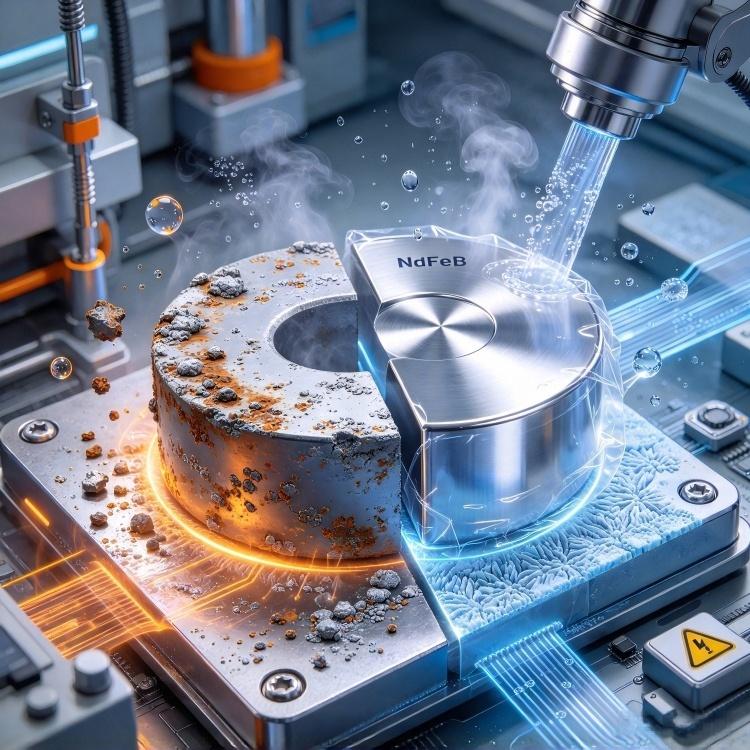
Bonded NdFeB magnets require careful consideration of temperature limits, moisture exposure, and chemical compatibility. The polymer binder and magnetic powder formulation affect their environmental performance, so the finished component should be evaluated under its actual working conditions.
Neither material should be selected solely because it performs well at room temperature. For industrial products, engineers should verify the operating temperature, expected mechanical stress, exposure to moisture or chemicals, and required service life.
The most effective way to compare flexible rubber magnets and bonded NdFeB magnets is to consider how they will be used in the finished product.
Applications for Flexible Rubber Magnets
Flexible rubber magnets are a practical option for products that require a bendable magnetic material or broad surface coverage.
Typical applications include:
Magnetic signage and advertising: Flexible sheets can be cut into different shapes for promotional displays and removable signs.
Magnetic labels and markers: Thin magnetic strips can be used for labeling, identification, and organizational systems.
Refrigerator magnets and household products: Flexible magnetic material supports lightweight products with straightforward installation requirements.
Curved mounting surfaces: The material can follow certain curved surfaces where a rigid magnet would be less convenient.
General-purpose magnetic holding: Flexible strips can provide distributed magnetic contact for applications that do not require high magnetic force.
For these products, flexibility, easy processing, and cost efficiency may be more important than maximizing magnetic energy density.
Bonded NdFeB magnets are more suitable for selected applications that require stronger magnetic performance and customized component geometry.
Typical applications include:
Compact motors: Molded magnetic components can be designed to fit specific rotor or motor structures.
Magnetic encoders: Ring-shaped magnets with appropriate multipole magnetization can support rotational position and speed detection.
Precision sensors: Custom magnetic geometries can help meet specific field distribution and installation requirements.
Consumer electronics: Compact components can benefit from higher magnetic performance within limited installation space.
Integrated magnetic assemblies: Molded features can help simplify the integration of magnets into selected mechanical designs.
The suitability of bonded NdFeB depends on the required magnetic output, operating temperature, mechanical loads, and manufacturing process. For applications demanding very high magnetic energy density, sintered NdFeB may also need to be evaluated.
Before choosing a material, it helps to answer a few practical questions about the product.
First, determine the required magnetic force. If the application only needs light holding force across a relatively large area, flexible rubber magnets may be sufficient. If the component must produce a stronger magnetic field in a limited space, bonded NdFeB deserves closer consideration.
Second, identify the required physical behavior. Does the magnet need to bend, roll, or conform to a surface? If so, flexible rubber magnets are the more natural starting point. If the component needs a molded ring, curved profile, or other specific three-dimensional geometry, bonded NdFeB may offer greater manufacturing flexibility.
Third, define the dimensional requirements. Specify the overall dimensions, critical tolerances, installation clearances, and any features that interact with other parts. These details help the manufacturer assess process feasibility.
Fourth, evaluate the working environment. Temperature, moisture, chemicals, vibration, and mechanical stress can all affect material selection. Confirm that the chosen magnet can meet the expected operating conditions.
Finally, compare the total production cost. Consider the material, tooling, processing, assembly, and order volume. A magnet with a higher unit price may still be appropriate if it simplifies the overall design, while a lower-cost material may be the better option for less demanding applications.
Working through these factors in order makes the selection process more straightforward and reduces the risk of choosing a material based on magnetic strength alone.
For manufacturers developing new products, choosing between flexible rubber magnets and bonded NdFeB is only one part of the design process. The material must also fit the component geometry, magnetic requirements, manufacturing method, and expected production volume.
DAWA Magnetic offers multiple permanent magnet material categories, including rubber magnets, bonded NdFeB, and sintered NdFeB. This broader product range provides a starting point for evaluating different solutions according to the needs of an application.
When discussing a custom magnet project with DAWA, buyers should prepare the intended application, technical drawing or sample, required magnetic performance, operating conditions, and estimated order quantity.
These details help clarify whether a flexible magnetic sheet, a molded bonded NdFeB component, or another permanent magnet material is the more appropriate choice.
For OEM and industrial buyers, early communication about the design requirements can also help identify manufacturing constraints before tooling and mass production begin.
Flexible rubber magnets and bonded NdFeB magnets are designed to solve different problems. Flexible rubber magnets are often the better choice when bendability, easy cutting, broad surface contact, and economical production are the priorities. Bonded NdFeB magnets are generally more suitable when higher magnetic performance and customized component geometry are required.
The right decision depends on the finished product rather than the magnet material in isolation.
By evaluating magnetic strength, physical flexibility, dimensional requirements, operating conditions, and total manufacturing cost, engineers can select a solution that meets both technical and commercial objectives.
Looking for a magnet tailored to your application? Contact DAWA Magnetic to discuss your design requirements and explore suitable permanent magnet solutions.
Dawa Jiahao, facilitate innovation and mass production