What Makes Bonded NdFeB Suitable for Complex Magnet Shapes?
When a product requires a magnet with an unusual profile, thin walls, multiple poles, or precise geometric features, choosing the right magnetic material becomes an important part of the design process. A conventional sintered magnet may deliver excellent magnetic strength, but its manufacturing limitations can make certain shapes difficult or costly to produce.
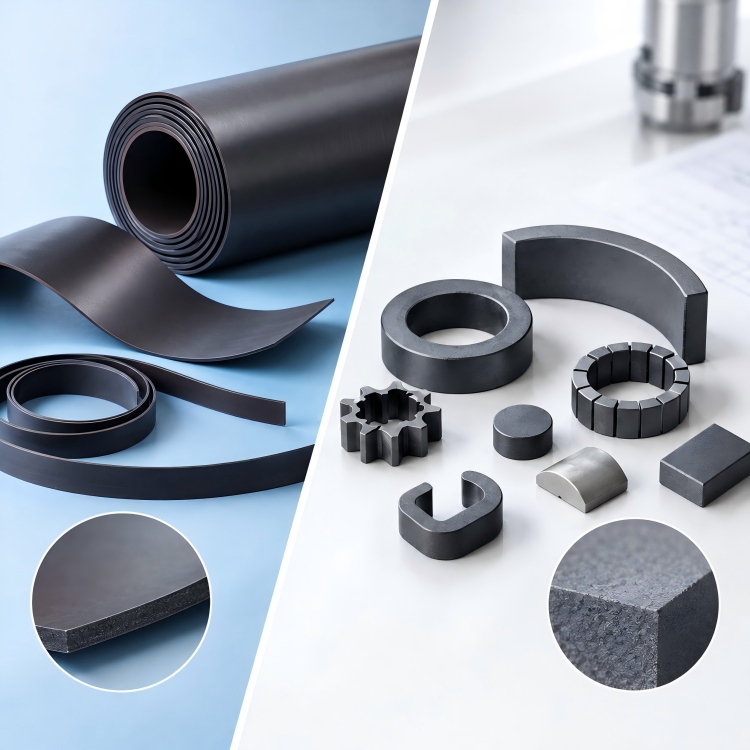
This is where bonded NdFeB magnets offer a practical alternative. By combining neodymium-iron-boron magnetic powder with a polymer binder, bonded neodymium magnets can be manufactured into a wider variety of shapes, including components that are difficult to achieve through conventional sintering and machining.
For engineers and OEM manufacturers, the main advantage is not simply the ability to produce unusual shapes. It is the opportunity to integrate magnetic performance, dimensional accuracy, and component design into a more efficient manufacturing process.
Bonded NdFeB magnets are permanent magnets made by mixing neodymium-iron-boron magnetic powder with a polymer binder. The mixture is then formed into the required shape using a suitable molding or forming process.
Unlike sintered NdFeB magnets, which are produced through powder metallurgy and high-temperature sintering, bonded neodymium magnets use a binder to hold the magnetic particles together. This difference in manufacturing process has a direct impact on the shapes, dimensions, and geometries that can be produced.
Depending on the material formulation and production method, bonded NdFeB magnets can be manufactured through processes such as injection molding or compression bonding.
Injection-molded bonded magnets are particularly useful for complex geometries because the material can flow into a designed mold cavity. Compression-bonded magnets are also suitable for specific precision applications, although their geometric capabilities depend on the tooling and forming process.
For manufacturers developing compact motors, sensors, encoders, and other precision components, this flexibility can simplify the design of magnetic parts.
1. Greater Freedom in Magnet Geometry
One of the main reasons manufacturers choose bonded NdFeB magnets is their ability to accommodate complex geometries.
Traditional sintered neodymium magnets are relatively hard and brittle. Although they can be machined into different shapes, certain features may require additional processing, specialized tooling, or careful handling to prevent chipping and cracking.
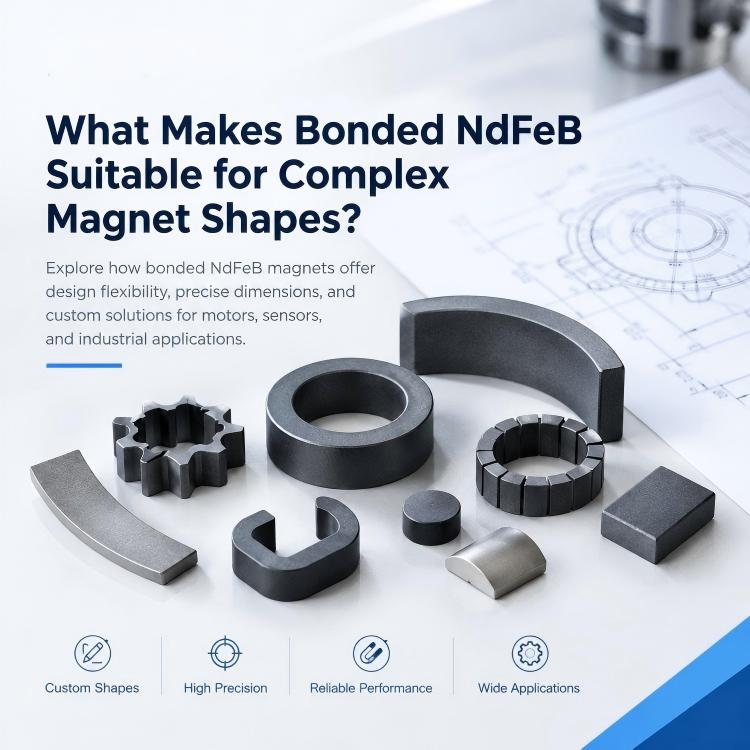
Bonded NdFeB magnets offer more flexibility during the forming stage. Depending on the molding process, designers may be able to produce curved profiles, rings, thin sections, stepped features, and other geometries that are difficult to manufacture economically using conventional sintered magnets.
This makes custom bonded NdFeB magnets particularly attractive for products in which the magnet must fit a specific housing or follow the shape of a rotating component.
For example, a compact sensor may require a ring-shaped magnet with multiple magnetic poles, while a miniature motor may need a curved magnet that fits closely around its rotor. Producing these features as part of the forming process can reduce the need for extensive secondary machining.
2. Better Integration with Complex Components
In many applications, a magnet is not an independent part. It must work together with a shaft, housing, rotor, sensor, or other mechanical component.
A small dimensional mismatch can affect assembly, alignment, or magnetic performance. Designing the magnet to match the surrounding structure is therefore an important consideration.
Injection-molded bonded NdFeB magnets can accommodate a range of integrated geometric features, subject to material flow, mold design, and manufacturing limitations. In suitable designs, these features can help simplify assembly and reduce the number of separate components.
For OEM manufacturers, this can create opportunities to redesign a magnetic component around the overall product rather than treating the magnet as a standard part that must be adapted later.
However, not every feature should be incorporated directly into the magnet. Wall thickness, mold filling, mechanical loading, and the required magnetic properties must all be considered during product development.
3. Potential for More Consistent Dimensions
Dimensional accuracy is particularly important when magnets are used in compact assemblies, automated equipment, and precision sensing systems.
Because bonded NdFeB magnets are formed using controlled tooling, suitable production processes can achieve consistent dimensions across repeated manufacturing runs. This can reduce the need for extensive post-processing when the geometry and tolerances are appropriate for the selected process.
For applications involving multiple magnets, consistent dimensions can also simplify assembly and improve repeatability.
Nevertheless, dimensional accuracy depends on several factors, including mold design, binder content, material shrinkage, process control, and the complexity of the component. Tight tolerances should be agreed upon with the magnet manufacturer before production begins.
At DAWA Magnetic, discussing the drawing, critical dimensions, and application requirements early in the development process helps establish whether a bonded magnet is suitable for the intended design.
4. Support for Multipole Magnetization
Some magnetic components need more than a simple north-south magnetic orientation. They may require multiple alternating poles or a specific magnetic field distribution to perform their intended function.
Bonded NdFeB magnets can be suitable for multipole applications, particularly when injection molding is combined with an appropriate magnetic field and tooling design. Depending on the process, the magnetic powder may be oriented during molding, allowing manufacturers to tailor the magnetic properties to the application.
This capability is useful in applications such as magnetic encoders, position sensors, small motors, and certain rotating magnetic assemblies.
It is important to distinguish between the shape of a magnet and its magnetization pattern. A complex physical shape does not automatically produce a complex magnetic field. The required pole arrangement, orientation, and magnetic performance must be specified separately during the design stage.
For engineers developing custom bonded neodymium magnets, considering the mechanical geometry and magnetization requirements together can help avoid costly redesigns.
5. Reduced Need for Secondary Machining
Machining brittle magnetic materials into intricate profiles can increase production time, material waste, and processing costs. Some geometries may also be difficult to machine without damaging thin sections or delicate features.
Bonded NdFeB magnets can reduce these challenges when the required shape can be produced directly through molding or forming.
By creating more of the final geometry during the initial manufacturing stage, manufacturers may reduce secondary machining operations and simplify production. The actual cost advantage depends on order volume, tooling investment, material requirements, and the complexity of the part.
For large production runs, injection molding may be attractive because the tooling cost can be distributed across many components. For smaller quantities or different geometries, another manufacturing process may be more economical.
The best choice depends on the complete production requirement rather than shape complexity alone.
Both bonded and sintered NdFeB magnets have important roles in permanent magnet applications. The right choice depends on the balance between magnetic performance, geometry, mechanical requirements, and cost.
Bonded NdFeB Magnets vs. Sintered NdFeB Magnets
1. Shape Flexibility
Bonded NdFeB Magnets: Well suited to many molded geometries.
Sintered NdFeB Magnets: More limited by brittle material behavior and machining requirements.
2. Magnetic Performance
Bonded NdFeB Magnets: Generally have a lower energy product than comparable sintered grades.
Sintered NdFeB Magnets: Generally offer a higher energy product.
3. Multipole Designs
Bonded NdFeB Magnets: Can support selected multipole designs through suitable manufacturing processes.
Sintered NdFeB Magnets: Can support multipole magnetization with appropriate magnetizing fixtures.
4. Dimensional Features
Bonded NdFeB Magnets: Can integrate selected geometric features during molding.
Sintered NdFeB Magnets: Complex features may require additional machining.
5. Production Economics
Bonded NdFeB Magnets: Tooling can be cost-effective for suitable high-volume production.
Sintered NdFeB Magnets: Often a better choice when high magnetic strength is the primary requirement.
6. Typical Design Priorities
Bonded NdFeB Magnets: Best suited to applications prioritizing geometric flexibility, component integration, and dimensional repeatability.
Sintered NdFeB Magnets: Best suited to applications requiring high magnetic output and compact magnetic circuits.
The distinction is important: bonded NdFeB magnets are not automatically better than sintered NdFeB magnets. Their advantage is often greater design flexibility, while sintered magnets remain a strong choice when maximum magnetic performance is required in a limited space.
Engineers should compare the required magnetic energy product, operating temperature, demagnetization resistance, mechanical constraints, and total manufacturing cost before selecting a material.
The ability to form magnets into application-specific geometries makes bonded NdFeB suitable for a range of compact and precision products.
Miniature Motors and Rotating Components
Small motors often have limited installation space and specific rotor geometries. Bonded NdFeB magnets can support curved, ring-shaped, or integrated designs where the forming process meets the required magnetic and mechanical specifications.
The final design must still account for torque requirements, operating temperature, rotational speed, and the strength of the surrounding structure.
Magnetic Encoders and Position Sensors
Encoders and sensors may use ring magnets or other shaped components with defined pole patterns. Consistent geometry and suitable multipole magnetization help these devices detect position, speed, or rotational movement.
Bonded NdFeB can be a practical option when the design requires a customized magnetic pattern or a shape that integrates closely with the sensor assembly.
Consumer Electronics and Compact Devices
Space constraints often influence the design of small electronic products, actuators, and precision mechanisms. Custom bonded magnets can help manufacturers fit magnetic components into housings with limited clearance or unconventional internal structures.
Material selection should consider not only the available space but also temperature exposure, mechanical loads, and long-term magnetic stability.
Automotive and Industrial Sensors
Certain automotive and industrial sensing systems require compact magnetic components with repeatable geometry. Bonded NdFeB magnets may be appropriate when the required field strength, operating conditions, and durability can be achieved with the selected formulation.
For demanding environments, engineers should evaluate temperature limits, moisture exposure, chemical compatibility, and any applicable industry qualification requirements.
A complex shape is only one part of the specification. Before requesting a quotation or starting tooling development, buyers and engineers should clarify several technical requirements.
1. Magnetic performance
Define the required magnetic field, energy product, coercivity, and magnetic orientation based on the application. Do not select a material solely because it is described as neodymium.
2. Geometry and dimensional tolerances
Provide a technical drawing or 3D model showing the overall dimensions, critical interfaces, wall thicknesses, and tolerance requirements. Features that are difficult to mold should be reviewed before the design is finalized.
3. Manufacturing process
Discuss whether injection molding, compression bonding, or another manufacturing route is appropriate. The selected process affects geometric freedom, tooling requirements, achievable tolerances, and production economics.
4. Operating temperature
Bonded magnets contain a polymer binder, so their thermal limitations depend on the binder system and magnetic formulation. Verify the permitted operating temperature and magnetic stability under actual working conditions.
5. Mechanical and environmental requirements
Consider impact resistance, vibration, rotational forces, moisture, and exposure to oils or chemicals. A suitable design may also require protective coatings, encapsulation, or a specific mounting arrangement.
6. Production volume and total cost
Tooling, material utilization, inspection, and secondary processing all affect the final price. Discuss forecast quantities and expected annual demand to compare the economics of different manufacturing methods.
Addressing these factors early helps manufacturers identify potential design issues before they become expensive production problems.
Why Work with DAWA Magnetic for Custom Magnet Solutions?
Selecting a suitable magnet manufacturer involves more than finding a supplier that can produce the required shape. The manufacturer should understand how magnetic properties, geometry, production methods, and application conditions interact.
DAWA Magnetic provides a starting point for discussing permanent magnet requirements across different material categories. For projects involving bonded NdFeB magnets, buyers should communicate their technical drawings, required magnetic performance, operating environment, and expected production quantities so that the appropriate manufacturing route can be evaluated.
A clear specification also helps determine whether bonded NdFeB is the right solution or whether sintered NdFeB, SmCo, ferrite, or another magnetic material would better meet the application requirements.
For OEM projects, this early technical discussion can help reduce unnecessary design changes and establish realistic expectations for performance, tolerances, and manufacturing cost.
Bonded NdFeB magnets are particularly valuable when a product requires more than a standard magnetic shape. Their molding flexibility, potential for integrated features, and suitability for selected multipole designs make them useful for compact motors, sensors, encoders, and other precision components.
However, the best magnet is not necessarily the one that offers the most geometric freedom. It is the one that meets the application’s magnetic, mechanical, thermal, and manufacturing requirements at an acceptable total cost.
For engineers and OEM buyers working on complex magnetic components, evaluating bonded NdFeB alongside sintered NdFeB and other permanent magnet materials is a practical first step toward a reliable design.
Looking for a custom permanent magnet solution? Contact DAWA Magnetic to discuss your application, technical specifications, and manufacturing requirements.
Dawa Jiahao, facilitate innovation and mass production