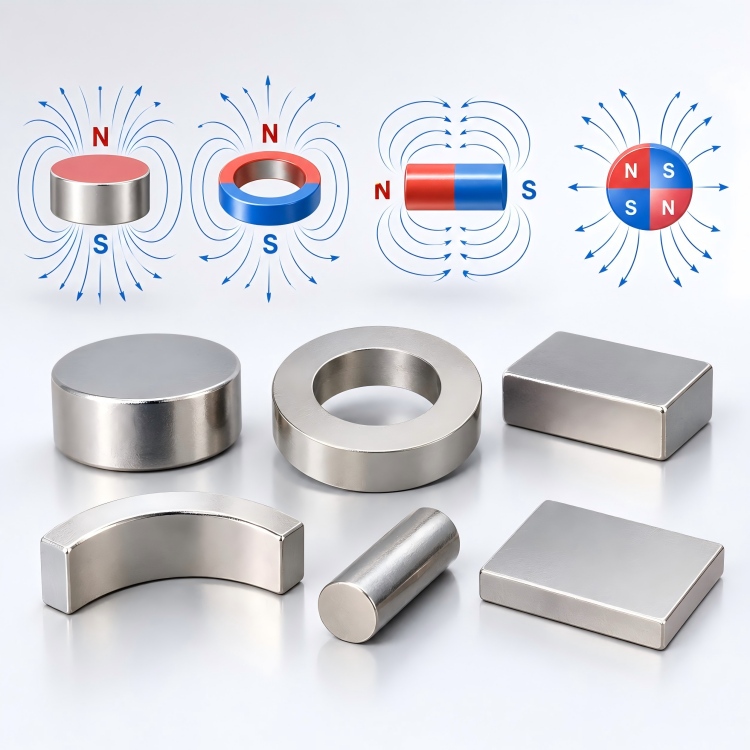
Why Is Magnetization Direction Important in Custom NdFeB Magnets?
When ordering custom neodymium magnets, buyers often focus on dimensions, magnetic grade, coating, and required holding force. However, one technical detail can have a significant impact on whether a magnet works as expected: magnetization direction.
Two NdFeB magnets may have identical dimensions and material grades but produce different magnetic field distributions because they are magnetized in different directions. For manufacturers developing motors, sensors, magnetic couplings, electronic components, or other magnetic products, this difference needs to be considered during the design stage.
Understanding magnetization direction helps engineers specify the right custom NdFeB magnets and avoid problems during product assembly and testing.
Magnetization direction refers to the orientation in which a permanent magnet is magnetized. It determines how the north and south poles are arranged within the magnet and how the magnetic field is distributed around it.
For sintered NdFeB magnets, the magnetization direction is generally established during the manufacturing process. The magnetic field orientation is closely related to the magnet’s internal structure and the direction in which it is magnetized.
This is particularly important because a magnet does not produce the same field pattern in every orientation. Changing the magnetization direction can change where the magnetic poles are located and how the magnet interacts with nearby magnetic components.
For example, a cylindrical neodymium magnet can be magnetized through its thickness, along its diameter, or in a more specialized pole configuration. Although the external shape may remain unchanged, each configuration serves different design requirements.
Therefore, magnetization direction should be treated as an essential specification when developing custom neodymium magnets, rather than an optional detail.
2. Common Magnetization Directions Used in NdFeB Magnets
The appropriate magnetization direction depends on the magnet’s shape, dimensions, magnetic circuit, and intended application. Several configurations are commonly used in industrial and commercial products.
Axial Magnetization
Axially magnetized magnets have their north and south poles on opposite flat faces along the magnet’s central axis. This configuration is commonly used for disc-shaped and cylindrical NdFeB magnets.
It is suitable for applications where magnetic attraction or repulsion is required through the top and bottom surfaces. Depending on the design, axial magnetization can be used in magnetic fixtures, sensors, small motors, and positioning components.
Radial Magnetization
Radially magnetized magnets have their magnetic poles arranged around the radial direction of the magnet. This configuration is relevant to certain ring-shaped components and motor designs where the magnetic field needs to interact with surrounding components in a radial arrangement.
Radial magnetization can be more demanding than conventional axial magnetization, particularly when the magnet geometry and required pole distribution are complex.
Diametric Magnetization
Diametrically magnetized cylindrical magnets have their north and south poles on opposite sides of the curved surface rather than on the two flat ends.
This arrangement is useful in applications involving rotating magnetic fields or angular position detection. For example, certain magnetic sensors use diametrically magnetized magnets to detect rotational movement.
Multipole Magnetization
Multipole magnetization creates several north and south pole regions on a single magnet. The number, position, and arrangement of the poles depend on the application.
It is used in some motor assemblies, magnetic encoders, and other components that require a specific magnetic field pattern. The pole arrangement needs to match the design of the surrounding magnetic system.
Choosing the correct magnetization direction is not simply about deciding where the poles should be located. It also affects how the magnet functions within the complete product.
One important consideration is the magnetic circuit. In a motor or magnetic assembly, the magnet needs to interact with other components in a defined direction. If the pole orientation does not match the intended magnetic circuit, the resulting field distribution may not provide the required operating conditions.
Installation is another factor. Some magnets must be positioned with a specific pole facing a particular surface or component. An incorrect orientation can cause attraction where repulsion is expected, or prevent the magnet from working correctly with adjacent parts.
Magnetization direction also matters in sensing applications. A sensor designed to detect changes in a particular magnetic field orientation may not produce the expected signal if the magnet is installed with the wrong pole arrangement.
For this reason, engineers should evaluate magnetization direction together with magnet dimensions, magnetic grade, air gap, and the geometry of surrounding components.
A common challenge in custom magnet development is that buyers provide a drawing showing the external dimensions but do not clearly identify the required magnetization direction.
This can create unnecessary communication during sampling and testing. A magnet may meet the specified diameter, thickness, and material grade but still fail to match the magnetic requirements of the finished product.
To reduce this risk, manufacturers and buyers should confirm several details before production:
- Magnet geometry: Specify whether the magnet is a disc, ring, cylinder, block, arc, or another custom shape.
- Magnetization direction: Clearly indicate axial, radial, diametric, or multipole magnetization where applicable.
- Pole arrangement: Identify the required north and south pole positions, including the number and distribution of poles for multipole designs.
- Magnetic grade: Specify the required NdFeB grade according to the application’s magnetic and temperature requirements.
- Assembly conditions: Explain how the magnet will be installed and how it interacts with surrounding components.
- Testing requirements: Confirm whether magnetic flux, surface field, or pole orientation needs to be inspected.
A technical drawing with clear magnetization markings, supported by a sample or magnetic field diagram when necessary, can make the development process more straightforward.
Not every magnet shape can be magnetized in every possible direction using the same production method. The geometry, dimensions, material characteristics, and magnetizing fixture all influence the available options.
Sintered NdFeB magnets are typically produced through powder metallurgy and are anisotropic materials. Their magnetic properties are influenced by the orientation established during the manufacturing process. The intended magnetization direction must therefore be considered in relation to the material’s preferred magnetic orientation.
The final magnetizing process also requires suitable equipment and fixtures to establish the specified pole arrangement. For complex or multipole designs, the magnetizing fixture needs to match the required magnetic pattern.
Inspection is equally important. Visual checks can confirm dimensions and surface condition, but they cannot independently verify the complete magnetic pole arrangement. Appropriate magnetic testing is needed to confirm whether the finished component meets the specified requirements.
For OEM projects involving custom NdFeB magnets, discussing these technical details with the manufacturer before sampling can help reduce design changes and improve consistency between samples and production batches.
6. Choosing the Right Magnetization Direction for Your Application
The best magnetization direction depends on what the magnet needs to do inside the final product.
For disc and cylindrical magnets used in straightforward holding applications, axial magnetization may be suitable. Diametrically magnetized cylindrical magnets may be more appropriate for certain rotating sensing applications. Ring-shaped magnets used in motors may require axial, radial, or multipole configurations depending on the motor architecture.
There is no universal magnetization direction that works for every application. The correct choice comes from the relationship between the magnet, the magnetic circuit, and the operating requirements of the complete assembly.
For purchasing teams, this means that selecting a custom NdFeB magnet should involve more than comparing price and dimensions. Confirming the magnetic orientation early helps ensure that the supplied component is compatible with the product design.
Magnetization direction is a fundamental part of custom magnet specification. It influences pole placement, magnetic field distribution, installation orientation, and compatibility with the surrounding components.
For manufacturers developing motors, electronic devices, magnetic assemblies, and industrial equipment, providing clear magnetization requirements is an important step toward obtaining the right component.
DAWA supplies sintered NdFeB magnets in different shapes and configurations for a range of industrial applications. By sharing application details, technical drawings, and magnetic requirements during the initial discussion, buyers can work toward a magnet specification that better matches their product design and manufacturing needs.
Dawa Jiahao, facilitate innovation and mass production