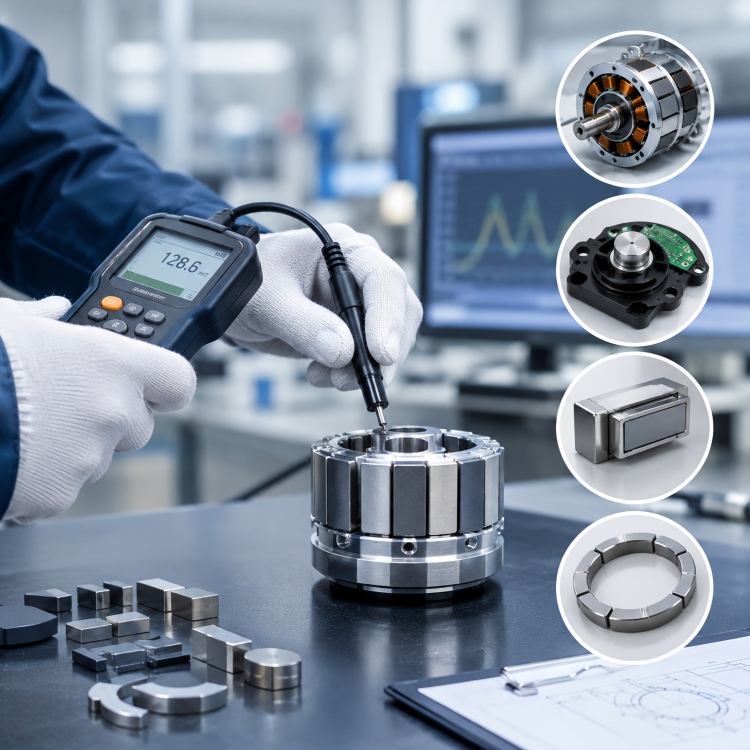
Why Must Magnet Performance Be Tested After Final Assembly?
A permanent magnet may meet every specification during incoming inspection, yet the finished product can still fail to deliver the expected magnetic performance. The reason is simple: a magnet rarely works alone. Once installed in a mechanical assembly, its performance depends on the surrounding materials, mounting position, air gaps, magnetization direction, and overall magnetic circuit.
For manufacturers of motors, sensors, industrial equipment, and precision components, testing individual magnets is only part of quality control. Magnet performance testing after final assembly helps verify that the complete component performs as intended under actual operating conditions.
At DAWA, understanding the relationship between magnet properties, component design, and manufacturing accuracy is essential when developing reliable custom magnets and magnetic assemblies for industrial applications.
Why Is Testing Individual Magnets Not Enough?
Individual magnet inspection typically focuses on measurable properties such as magnetic flux density, dimensions, surface condition, and magnetization direction. These checks help confirm whether a magnet meets its specified requirements before assembly.
However, the performance of a finished magnetic component depends on more than the magnet itself.
During assembly, several factors can change how the magnetic system behaves:
- Installation gaps: Even a small increase in the distance between a magnet and its target can reduce the available magnetic force.
- Positioning accuracy: Incorrect placement may shift the magnetic field away from the intended working area.
- Surrounding materials: Steel parts and other magnetic materials can redirect magnetic flux and alter the field distribution.
- Magnetization direction: An incorrect pole orientation can weaken attraction or produce an unintended magnetic response.
- Assembly tolerances: Variations in dimensions and component alignment can create inconsistent performance between finished products.
A magnet may therefore pass its individual inspection but fail to deliver the required holding force, sensing response, or magnetic coupling performance after installation.
This is why magnetic assembly testing should form part of the overall quality assurance process.
How Does Final Assembly Affect Magnet Performance?
1. Air Gaps and Mounting Positions Change Magnetic Force
The distance between a magnet and its target plays an important role in many applications. Magnetic force generally decreases as the working gap increases, although the exact relationship depends on the magnet’s geometry, magnetic properties, and surrounding structure.
For example, a magnetic latch may hold securely during a prototype test but become less reliable when production tolerances increase the gap between the magnet and the mating surface.
Likewise, a sensor magnet installed slightly off-center may generate a different signal from the one expected during design validation.
Testing the assembled component allows engineers to evaluate the actual magnetic force or field at the intended working position instead of relying solely on measurements taken from an individual magnet.
2. Nearby Components Can Alter the Magnetic Field
Magnets are often installed alongside steel housings, brackets, shafts, and other mechanical parts. These components can influence the magnetic circuit by providing alternative paths for magnetic flux.
This effect can be useful when the assembly is designed to concentrate magnetic flux in a specific area. However, an unsuitable configuration may produce an unexpected field distribution or reduce performance at the working surface.
For custom magnetic assemblies, engineers should therefore evaluate the magnet together with its housing and other surrounding components.
Final assembly testing helps confirm whether the complete design delivers the intended magnetic behavior and whether adjustments to the structure are necessary.
3. Assembly Errors Can Affect Product Consistency
A product that performs well during initial development must also perform consistently during mass production.
Differences in adhesive thickness, component alignment, mounting depth, or magnet orientation can cause variations between finished units. These differences may be difficult to identify through individual magnet inspection alone.
For applications involving sensors, positioning systems, and magnetic holding mechanisms, inconsistent magnetic output can lead to downstream assembly problems or product failures.
By including magnet performance testing in the production process, manufacturers can identify assembly-related deviations earlier and improve the consistency of finished magnetic components.
Which Tests Should Be Conducted After Final Assembly?
The appropriate inspection method depends on the product’s function and acceptance criteria. Not every magnetic component requires the same testing procedure.
Magnetic Field and Flux Density Measurement
A gaussmeter or an appropriate magnetic field measurement system can help verify field strength at specified locations. Engineers may use these measurements to confirm that the assembled component produces the required magnetic field within the intended operating area.
Measurement positions and distances should remain consistent so that results can be compared reliably.
Magnetic Holding Force Testing
For magnetic fixtures, closures, and holding systems, pull-force testing can evaluate whether the assembled product provides sufficient retention force.
The test should reproduce the relevant contact conditions, including the target material, surface condition, and working gap. Otherwise, the measured force may not reflect real-world performance.
Magnetization Direction Verification
Checking pole orientation after assembly is particularly important when components contain multiple magnets or require a specific magnetic arrangement.
Incorrect orientation can affect attraction, repulsion, coupling, or sensing behavior. Verification helps ensure that the magnetic configuration matches the engineering drawing and assembly requirements.
Functional Testing Under Operating Conditions
Some applications require more than a static magnetic measurement. Motors, sensors, and automated mechanisms may need functional tests that evaluate their response during movement, rotation, or normal operation.
These tests connect magnetic measurements with the actual purpose of the component, providing a more meaningful assessment of product performance.
Magnetic testing is most effective when it is integrated into the manufacturing workflow rather than reserved for troubleshooting after a failure.
A practical quality control process can include:
- Incoming inspection: Verify magnet dimensions, material specifications, and required magnetic properties.
- Prototype validation: Confirm that the proposed magnetic design works with the intended housing and mechanical structure.
- In-process inspection: Check critical dimensions, magnet orientation, and assembly positioning.
- Final assembly testing: Verify the performance of the completed component against approved specifications.
- Production monitoring: Track recurring test results to identify process variation and support continuous improvement.
The inspection plan should reflect the application’s risk level, performance requirements, and production volume. Establishing clear acceptance criteria before mass production also helps prevent disagreements between component suppliers and finished-product manufacturers.
Reliable magnetic performance begins with suitable material selection and continues through engineering, machining, assembly, and verification.
DAWA serves customers seeking permanent magnets and custom magnetic components for different industrial applications. For these projects, the relationship between magnet specifications and the final mechanical design is an important consideration.
When developing a custom magnet or magnetic assembly, buyers should provide clear technical drawings, required magnetic properties, magnetization direction, dimensional tolerances, and expected operating conditions. Information about the surrounding materials and the component’s intended function can also help engineers evaluate the design more effectively.
For suitable projects, integrating magnet manufacturing with machining and assembly coordination can help address potential fit and performance issues before production scales up.
A well-defined magnetic assembly testing process also gives manufacturers a clearer basis for evaluating finished components, investigating deviations, and maintaining consistent product quality.
Testing individual magnets confirms that the magnets meet their specified requirements. Testing after final assembly answers a different and equally important question: does the complete component perform correctly in its intended application?
Air gaps, positioning errors, surrounding materials, and assembly tolerances can all influence magnetic behavior. Without final verification, these factors may remain undetected until the product reaches a customer or enters service.
For manufacturers working with permanent magnets and custom magnetic assemblies, integrating magnet performance testing into quality control helps reduce avoidable assembly problems, improve production consistency, and validate the finished design.
DAWA recognizes the importance of connecting magnet specifications with the requirements of the complete component. By considering performance throughout the manufacturing process, businesses can make better-informed decisions when developing reliable magnetic solutions.
Dawa Jiahao, facilitate innovation and mass production