Bonded Neodymium Magnets: Materials, Manufacturing Advances, and Motor Applications
A bonded neodymium magnet is a composite material made by mixing neodymium magnetic powder—typically NdFeB or ferrite—with a polymer binder, then forming the mixture into shape using injection molding or compression molding.
The resulting magnet is less brittle than sintered magnets, capable of complex shapes without machining, and often lighter. The trade-off is lower magnetic performance compared to sintered grades, but this is acceptable for many applications where shape complexity, weight, and assembly cost matter more than absolute peak performance.
Engineers evaluating magnet options typically start with this question: why choose bonded over sintered?
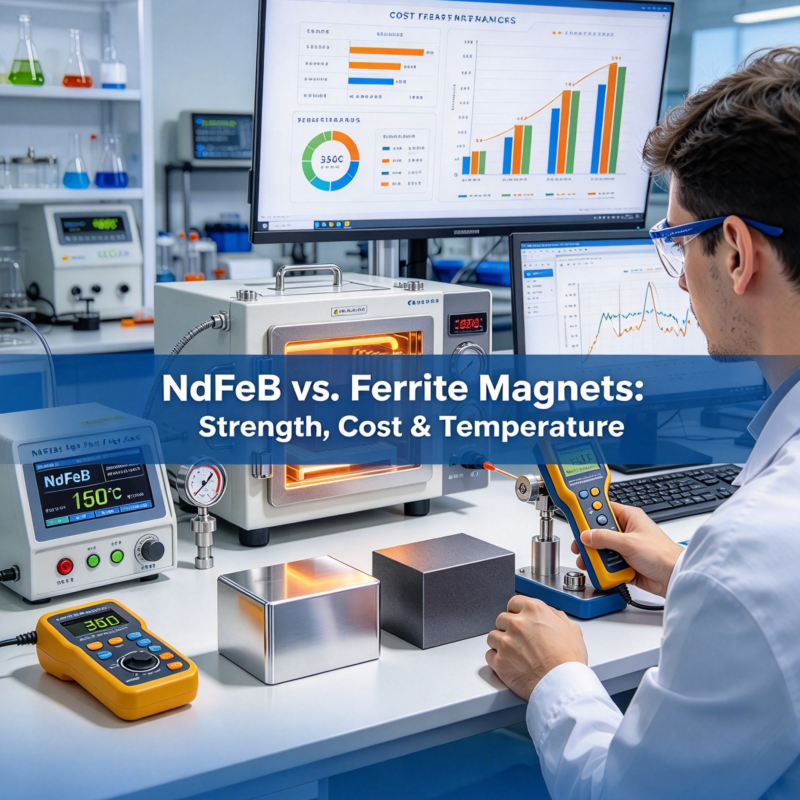
The following comparison highlights the main engineering differences between bonded and sintered NdFeB magnets:
| Factor | Bonded NdFeB | Sintered NdFeB |
|---|---|---|
| Magnetic Performance | Lower (5–10 MGOe) | Higher (35–55 MGOe) |
| Shape Flexibility | Excellent—complex geometries possible | Limited—simple shapes, requires machining |
| Post-Machining | Minimal or none | Often required, adds cost |
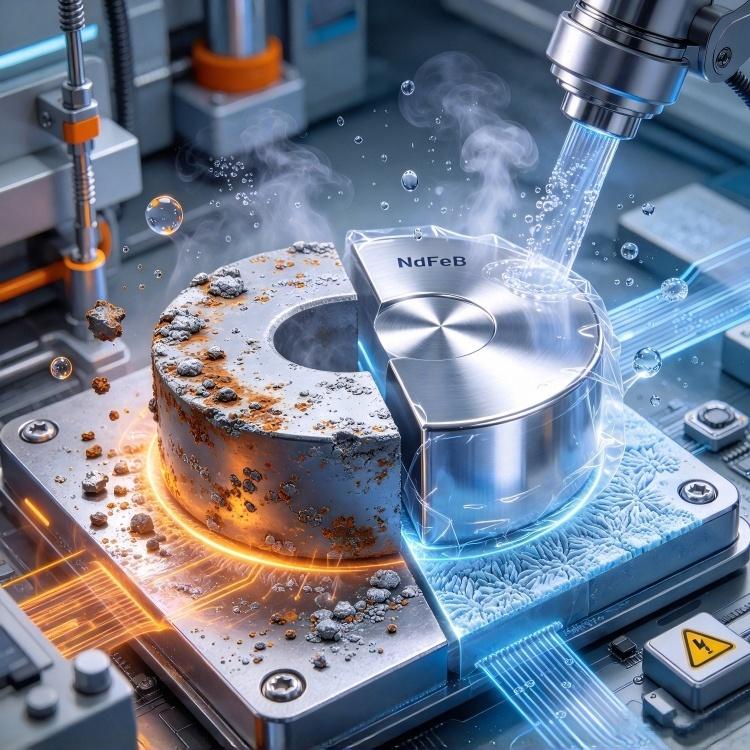
| Corrosion Resistance | Binder-dependent, can be inherently resistant | Requires coating (Ni, epoxy, etc.) |
| Heat Tolerance | Binder-limited (80–175°C depending on binder) | Grade-dependent (80–230°C) |
| Production Method | Injection or compression molding | Sintering + grinding + coating |
| Best Applications | Complex shapes, high volume, moderate performance | High torque density, extreme conditions |
| Typical Cost | Lower for complex shapes | Higher for complex shapes |
Actual performance varies by magnetic powder, binder system, orientation, and grade. The values above represent typical ranges for commercial grades.
When Bonded Makes Sense
Choose bonded magnets when:
-
The geometry is complex and machining sintered magnets would be expensive
-
Overmolding onto another component is required
-
Weight reduction is a priority
-
Production volume is high enough that molding is cost-effective
-
Corrosion resistance is needed without an additional coating step
When Sintered Makes Sense
Choose sintered magnets when:
-
Maximum magnetic strength per unit volume is required
-
Operating temperature exceeds bonded binder limits
-
The application demands maximum torque density
-
Shape is simple enough that sintering and grinding is cost-effective
Bottom line: Bonded is not better or worse than sintered—it is a different technology for a different set of requirements. DAWA supports both bonded and sintered magnet projects from prototype evaluation through volume production, with full in-house control over dimensional tolerances, magnetization direction, magnetic grade, and surface protection.
Magnetic Powders
The magnetic powder inside a bonded magnet is the primary source of its performance. Continuous refinement of NdFeB powder compositions has gradually increased the energy product that bonded magnets can achieve.
Early bonded NdFeB magnets operated in the 5–7 MGOe range. Current premium grades reach 8–10 MGOe—still below sintered magnets, but significantly better than a decade ago. The practical impact: higher torque density in the same footprint, smaller motors for the same output, and more design options for space-constrained applications.
PPS Binders
The binder has historically been the weak link in bonded magnets. Nylon-based binders (PA6, PA12) typically max out between 80°C and 150°C. Beyond that, they soften, creep, or degrade—and the magnet loses both dimensional stability and magnetic performance.
Polyphenylene Sulfide (PPS) has changed this. PPS-bonded magnets operate reliably up to 175°C, with documented performance showing minimal flux loss after extended exposure at elevated temperatures.
What this means in practice:
-
Motors can now run in hotter environments—engine compartments, enclosed machinery, high-ambient industrial settings
-
Better long-term reliability—PPS resists thermal creep and hydrolysis (moisture-induced breakdown), so the magnet stays in place and performs consistently over time
-
No coating required—PPS is inherently corrosion-resistant, eliminating a manufacturing step and a potential failure mode
3D Printing for Prototyping and Custom Runs
Additive manufacturing has become relevant for bonded magnet production. While it is not yet a replacement for high-volume injection molding, it has transformed prototyping and custom design.
Engineers can now print bonded magnets directly from CAD files in days, without waiting weeks for mold tooling. This enables rapid design iteration, custom geometries that would be difficult with traditional tooling, and gradient properties—adjusting magnetic powder concentration across the part to optimize flux distribution.
The magnetic performance of 3D-printed bonded magnets currently matches injection-molded parts, but the real value is in speed and flexibility, not mass production.
Recycled NdFeB powder can now be used to produce bonded magnets with performance exceeding that of scrap-sourced material.
Complex Geometries Without Machining
Injection-molded bonded magnets have always been able to form complex shapes—rings, arcs, multi-pole configurations—directly out of the mold. No secondary grinding. No wasted material.
Magnetization is applied after molding using multi-pole fixtures, with pole counts from 2 to 128 on ring or arc geometries.
Key capabilities:
-
High pole counts for increased torque output
-
Direct overmolding onto steel shafts—no adhesive bonding required
-
Encapsulation in PPS for full environmental protection
-
Tight dimensional control—micron-level tolerances are achievable
High-temperature demagnetization can be divided into two types:
Reversible Demagnetization
Reversible demagnetization occurs when magnetic strength decreases temporarily due to heat but returns after the magnet cools down.
Example:
- The magnet operates near its temperature limit
- Magnetic performance decreases slightly
- Strength recovers after returning to normal temperature
Irreversible Demagnetization
Irreversible demagnetization happens when heat permanently damages the magnetic alignment.
Common causes include:
- Excessive operating temperature
- Long-term thermal exposure
- Incorrect magnet grade selection
Once irreversible demagnetization occurs, the magnet cannot fully recover its original strength.
Industrial Servo Motors
Servo motors require precise control and consistent positioning. The magnet in the encoder ring must maintain its dimensional stability through temperature cycling—otherwise, positioning errors can be misdiagnosed as mechanical wear.
Bonded magnets with PPS binders deliver the necessary stability. They hold their shape, hold their magnetic characteristics, and maintain encoder accuracy over temperature swings.
Robotics and Collaborative Robots
Robot joints are space-constrained. High torque is required in a small package, and weight matters.
Anisotropic bonded NdFeB rings have been shown to reduce motor volume by 20% and weight by 30% while maintaining or increasing output torque.
Automotive Auxiliary Motors
A modern car contains 20 to 40 small electric motors—coolant pumps, electric power steering (EPS), HVAC blowers, oil pumps, and more.
Many of these motors operate in the engine compartment, where temperatures routinely reach 150–180°C. They also need to be reliable, cost-effective, and often require complex shapes.
PPS-bonded magnets address these requirements:
-
Heat tolerance up to 175°C
-
Inherent corrosion resistance (no coating needed)
-
Complex shapes molded directly—no assembly of multiple arc segments
-
Reduced part count and assembly time
Drone Motors
Drone motors require lightweight, high-pole-count magnets that can withstand rapid heating and cooling cycles. The ability to produce custom thin-walled bonded magnets via 3D printing helps drone designers optimize propulsion systems for weight and efficiency.
Medical Devices
Motorized surgical instruments and pumps must survive autoclaving—steam sterilization at 121°C. PPS-bonded magnets provide the necessary thermal and moisture resistance without degrading over repeated sterilization cycles.
This is the question that ultimately matters for engineers. Here is a decision framework:
Choose bonded when:
-
Geometry is complex enough that machining sintered magnets would be expensive
-
Overmolding onto a shaft or other component is required
-
Weight is a critical design factor
-
Corrosion resistance is needed without an additional coating step
-
Operating temperature stays within the binder’s limits (up to 175°C for PPS)
-
High-volume production makes molding cost-effective
-
Magnetic strength is adequate and design flexibility matters more
Choose sintered when:
-
Maximum magnetic flux density is required
-
Torque density is the top priority
-
Operating temperature exceeds 175°C
-
Shape is simple enough that sintered grinding is cost-effective
-
Extreme environmental conditions require the thermal and chemical stability of sintered material
Bonded gives you shape flexibility. Sintered gives you maximum magnetic strength. Pick the one that matches your priority.
At DAWA, we work with both technologies and help customers make this decision based on their specific requirements—not a blanket recommendation.
Manufacturing Considerations
If you are evaluating bonded magnets for your application, here are the practical factors to consider:
Binder Selection
The binder determines:
-
Operating temperature limit
-
Corrosion resistance
-
Mechanical strength
-
Dimensional stability
PPS is the preferred choice for demanding environments, but nylon binders may be cost-effective for less demanding applications.
Magnetic Powder Quality
Particle size, distribution, and alloy composition affect:
-
Magnetic properties (Br, Hcj, BHmax)
-
Flowability during molding
-
Consistency from batch to batch
Dimensional Tolerances
Bonded magnets can achieve micron-level tolerances in some cases, depending on tooling quality, binder shrinkage characteristics, and process control.
Magnetization
After molding, bonded magnets are magnetized using multi-pole fixtures. Achievable pole count and field profile depend on magnet geometry, powder properties, and fixture design.
Volume and Cost
Injection molding is cost-effective at high volumes. Tooling costs are significant upfront but amortize over production volume. 3D printing is cost-effective for prototypes and low-volume runs, but unit costs are higher than molded parts.
At DAWA Magnet, we have been manufacturing neodymium magnets for 35 years. We understand that bonded and sintered technologies each have their place, and the choice depends on the application.
DAWA supports bonded magnet projects from prototype evaluation through volume production. We maintain full in-house control over:
-
Dimensional tolerances – micron-level precision for critical fits
-
Magnetization direction – multi-pole and custom field profiles
-
Magnetic grade – matching powder performance to requirements
-
Surface protection – PPS binder provides inherent corrosion resistance; no coating needed
Unlike many suppliers that outsource key steps—sintering, grinding, molding, or coating—we control the entire production chain. This gives us consistent magnetic performance from batch to batch, a single point of accountability, and faster problem resolution.
Our engineering team can evaluate magnet geometry, magnetization direction, magnetic grade, and temperature requirements based on the application.
We were among the first manufacturers in China to develop magnet solutions for TWS earbuds, servo motors, and other high-precision applications. This early involvement has given us extensive experience supporting customers through prototype validation, process optimization for volume production, and long-term quality consistency.
35 years, one focus: building magnets that perform. From powder preparation through final inspection, we keep all critical variables inside our own operations.
What is a bonded neodymium magnet?
A bonded neodymium magnet is a composite of NdFeB magnetic powder and a polymer binder, formed through injection or compression molding. It offers complex geometries and corrosion resistance at the cost of lower magnetic performance compared to sintered magnets.
How does bonded NdFeB compare to sintered NdFeB?
Bonded magnets offer excellent shape flexibility, minimal machining, and inherent corrosion resistance, but have lower magnetic performance (5–10 MGOe). Sintered magnets deliver maximum torque density (35–55 MGOe) and higher temperature tolerance, but require coating and are limited in shape complexity.
What improvements have been made to bonded magnets in recent years?
Key advances include PPS binders that extend operating temperature to 175°C, better magnetic powders that increase energy product, and 3D printing for rapid prototyping and custom geometries. Recycled NdFeB powder is also being used to produce bonded magnets with improved performance.
When should I choose bonded over sintered for my motor application?
Choose bonded when you need complex geometries, weight reduction, corrosion resistance without coating, or cost-effective high-volume production—and when magnetic performance meets your requirements. Choose sintered when maximum torque density is required.
What temperature can PPS-bonded magnets handle?
PPS-bonded magnets operate reliably up to approximately 175°C. Nylon-bonded magnets typically max out at 80–150°C, so binder selection is critical for high-temperature applications.
Does DAWA Magnet offer bonded magnet manufacturing?
Yes. With 35 years of neodymium magnet experience and full in-house production control, DAWA supports bonded magnet projects from prototyping through volume production.
Dawa Jiahao, facilitate innovation and mass production