In modern industrial automation, automotive engineering, and renewable energy, the ndfeb magnet is the undisputed heavyweight champion. Known as the strongest permanent magnets on earth, a single strong neodymium magnet can lift hundreds of times its own weight, driving everything from massive wind turbines to micro-sensors.
But how are these powerhouse components actually made? How does a raw earth element transform into a high-precision industrial tool? As a global premier neodymium magnet manufacturer, DAWA takes you on an insider tour of the precise, high-tech metallurgy behind the rare earth magnet.
Quick Summary: The NdFeB Manufacturing Lifecycle
Before we dive into the metallurgy, here is a high-level overview of how DAWA transforms raw elements into certified industrial neodymium magnets:
| Stage | Process Name | Engineering Objective |
| 01 | Vacuum Melting | Liquefying Neodymium, Iron, and Boron into a precise alloy strip. |
| 02 | Jet Milling | Pulverizing the alloy into micron-sized, uniform powder grains. |
| 03 | Magnetic Alignment | Pressing powder inside a magnetic field to lock the magnetic direction. |
| 04 | Vacuum Sintering | Heating the brick to fuse particles into a dense, solid block. |
| 05 | CNC Machining | Slicing, grinding, and drilling (e.g., countersunk holes) to blueprints. |
| 06 | Anti-Corrosion Plating | Applying Ni-Cu-Ni, Epoxy, or Zinc coatings to prevent oxidation. |
| 07 | Pulse Magnetization | Activating the permanent magnetic field via high-voltage coils. |

The Deep-Dive Sintering Process: Step-by-Step
1. Melting and Alloying (The Blueprint)
The lifecycle of a neodymium magnet starts in a vacuum induction furnace. Engineers mix high-purity Neodymium (Nd), Iron (Fe), and Boron (B) according to exact grade requirements (e.g., N35 up to N52).
Engineers melt the mixture using intense electromagnetic fields and then rapidly cool it through strip casting to form thin, brittle alloy flakes.
2. Jet Milling (Achieving Micron Uniformity)
To create a high-performance strong neodymium magnet, engineers must convert alloy flakes into ultra-fine powder. At DAWA, engineers use Jet Milling, a process where high-pressure inert gas (nitrogen) forces particles to collide with each other and grind them down to 3–5 microns (finer than a grain of flour).
3. Magnetic Alignment & Pressing
This stage creates the core structure of the magnet. Engineers pour loose powder into a mold and apply a massive external magnetic field. This field forces the microscopic magnetic domains of the NdFeB magnet powder to align in a single direction. While the particles remain aligned, a mechanical press compacts them into a dense solid block.
4. Sintering & Heat Treatment (The Fusion)
Engineers place the compacted blocks into a vacuum sintering furnace and heat them to approximately 1000°C to 1100°C. Under these controlled high-temperature conditions, the material densifies as atomic diffusion bonds the particles together. During sintering, the block shrinks and transforms into a dense, solid permanent NdFeB rare earth magnet.
5. Precision CNC Machining
Engineers machine the sintered magnets to achieve final specifications because the material shrinks unevenly during furnace processing. Since neodymium is extremely brittle and hard, engineers avoid traditional drill bits that would shatter it.
DAWA engineers use state-of-the-art wire EDM (Electrical Discharge Machining), diamond grinding wheels, and CNC milling equipment to cut blocks into custom discs, rectangles, or specialized rings with precision countersunk holes for screw mounting.
6. Multi-Layer Surface Coating
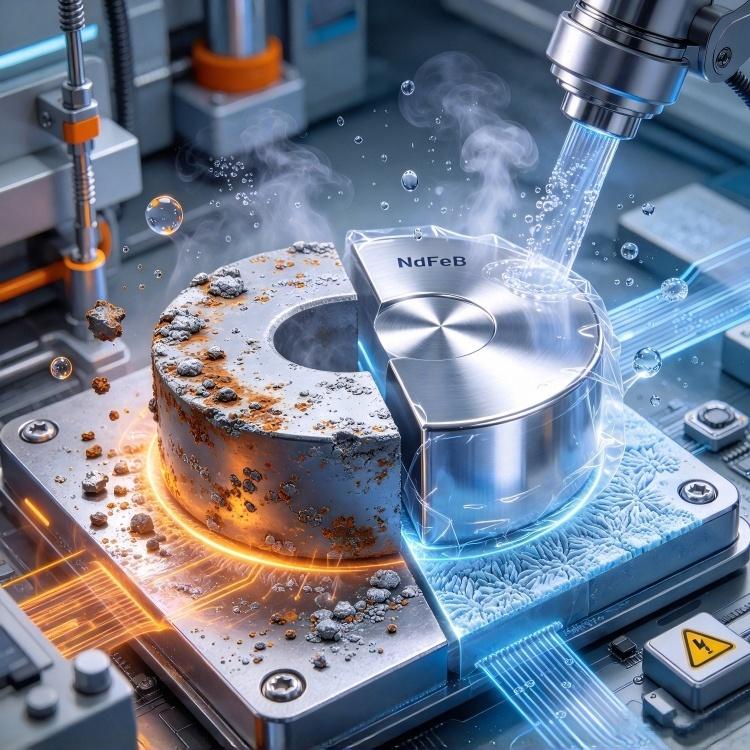
Raw NdFeB material oxidizes rapidly when it comes into contact with moisture, so engineers apply protective coatings to ensure long-term durability.
- Ni-Cu-Ni (Nickel-Copper-Nickel): Engineers apply this as the industrial standard for strong mechanical and wear resistance.
- Black/Grey Epoxy: Engineers choose this coating for marine, outdoor, and high-humidity environments.
- Zinc (Zn): Engineers use this cost-effective coating for enclosed electronic housings.
7. Ultra-High Pulse Magnetization
Up until this final step, the machined and coated parts are not yet magnetic. They are placed inside a massive copper coil connected to a high-voltage capacitor bank. A sudden, massive pulse of electricity (thousands of amps) passes through the coil, permanently freezing the internal domains in place and activating the full N52-grade force.

Industrial Sourcing FAQ
Why is the particle size in Jet Milling so critical?
If the powder grains are uneven or too large, the internal magnetic domains will fight against each other, drastically reducing the overall pulling force and thermal stability of the final magnet.
Can sintered neodymium magnets be modified after magnetization?
No. Altering, drilling, or heating a fully magnetized neodymium magnet will cause severe demagnetization, structural cracking, or even spark a dangerous metal fire. All machining must happen before the magnetization pulse.
Your Trusted Partner: Why Source from DAWA?
In global supply chains, consistency is the difference between a successful assembly and a costly product recall.Even a 1% deviation in chemical ratios or a 10°C drop in sintering temperature will compromise structural integrity. As an ISO-certified neodymium magnet manufacturer, DAWA guarantees precision at every stage. From custom N52 block engineering to heavy-duty pot magnet assemblies, we provide transparent technical datasheets, strict Gaussian testing, and direct factory-to-business wholesale pricing.
Ready to optimize your hardware pipeline? Contact the DAWA engineering team today for a technical blueprint review and bulk quotation!