What Is the Maximum Operating Temperature of Neodymium Magnets?
Introduction: Why Temperature Matters for Neodymium Magnets
Neodymium magnets (NdFeB magnets) are widely used in electric motors, automation equipment, renewable energy systems, and industrial applications because of their excellent magnetic strength.
However, temperature is one of the most important factors affecting magnet performance. Many buyers believe that stronger magnets can automatically withstand higher temperatures, but this is not always true. Different neodymium magnet grades have different temperature resistance capabilities.
Choosing the correct maximum operating temperature of neodymium magnets is essential to prevent magnetic loss and ensure long-term product reliability. As a professional magnet manufacturer, DAWA provides customized high temperature NdFeB magnet solutions for various industrial applications.
What Is Maximum Operating Temperature?
The maximum operating temperature refers to the highest temperature at which a neodymium magnet can continuously operate while maintaining stable magnetic performance.
When the working temperature exceeds this limit, the magnet may experience:
- Reduced magnetic force
- Lower magnetic flux density
- Irreversible demagnetization
- Shorter service life
However, exceeding the operating temperature does not mean the magnet immediately loses all magnetism. The actual impact depends on the magnet grade, exposure time, and working environment.
Several factors determine how well a neodymium magnet performs at high temperatures.
Magnet Grade
The magnet grade is the most important factor. High-temperature grades such as SH, UH, EH, and AH have higher coercivity, allowing them to resist heat-related demagnetization.
Coercivity
Higher coercivity means better resistance against external magnetic fields and thermal effects. This is why high-temperature NdFeB magnets are designed with enhanced coercivity.
Working Environment
Temperature is not the only consideration. Humidity, vibration, chemical exposure, and mechanical stress can also affect magnet performance.
Magnetic Circuit Design
Proper magnetic design helps magnets work efficiently and reduces the risk of thermal demagnetization.
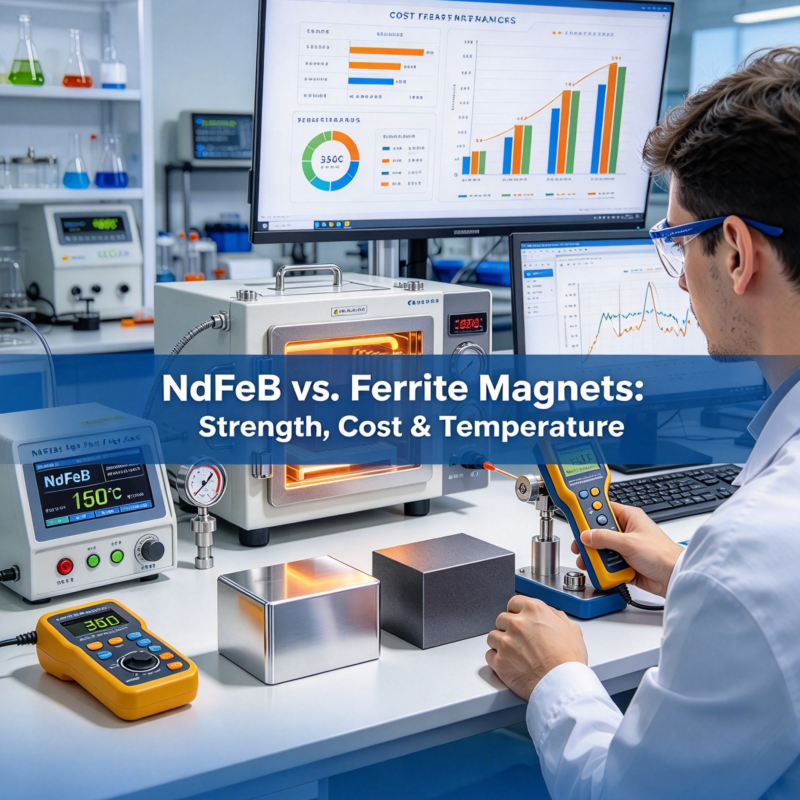
NdFeB Magnet Operating Temperature Chart
| Grade | Maximum Operating Temperature | Typical Applications |
|---|---|---|
| N Grade | Around 80°C | Electronics, speakers |
| M Grade | Around 100°C | Sensors, small motors |
| H Grade | Around 120°C | Industrial equipment |
| SH Grade | Around 150°C | EV motors, servo motors |
| UH Grade | Around 180°C | High-performance motors |
| EH Grade | Around 200°C | Aerospace, special equipment |
| AH Grade | 200°C+ | Extreme temperature applications |
Different applications require different magnet grades. For example, electric vehicle motors usually require SH or UH grade magnets because of the high heat generated during operation.
When a neodymium magnet operates above its recommended temperature range, several problems may occur.
Magnetic Performance Decreases
High temperatures weaken magnetic domain alignment, reducing magnetic output.
Irreversible Demagnetization
If the temperature exceeds the magnet’s capability, the loss of magnetism may become permanent.
Reduced Product Efficiency
In motors and generators, weakened magnets can reduce performance and increase energy consumption.
Therefore, selecting a suitable temperature grade is important for maintaining stable operation.
The Curie temperature and maximum operating temperature are different concepts.
The maximum operating temperature represents the safe working range where the magnet maintains stable performance.
The Curie temperature is the point where the magnet completely loses its magnetic properties.
For example, a neodymium magnet may have a Curie temperature above 300°C, but its recommended working temperature may only be 150°C. Engineers should always select magnets based on operating temperature rather than Curie temperature.
FAQ
Can neodymium magnets work at 150°C?
Yes. SH-grade neodymium magnets are commonly used for applications around 150°C.
Will a magnet lose magnetism at 180°C?
Standard grades may experience demagnetization, but UH-grade magnets are designed for higher temperature environments.
Can demagnetized magnets recover?
No. If irreversible demagnetization occurs, the original magnetic strength cannot be fully restored.
Dawa Jiahao, facilitate innovation and mass production