What Are Neodymium Magnets? Composition, Strength, and Real-World Applications
How the Nd₂Fe₁₄B Crystal Structure Creates Strong Magnetism
Neodymium magnets are permanent magnets built on the Nd₂Fe₁₄B intermetallic compound—a tetragonal crystalline structure that enables exceptional alignment of unpaired electrons. This crystal structure gives NdFeB magnets high remanence and energy density, with commercial grades reaching around 1.4 tesla in remanence and more than 50 MGOe in maximum energy product. This high energy density allows engineers to achieve the required magnetic performance with a smaller magnet volume than ferrite alternatives. However, the same structural rigidity that enhances magnetic anisotropy also imparts brittleness, requiring careful handling and protective integration in real-world designs.
Why ‘Rare-Earth’ Is Misleading — Abundance, Sourcing, and Strategic Classification
The term “rare-earth” is geologically misleading. Neodymium is about as abundant in Earth’s crust as nickel, but it rarely concentrates in economically viable, extractable deposits. Over 70% of global supply comes from China, where refining infrastructure, export policies, and environmental regulations shape availability. As a result, neodymium is classified as a critical mineral by the U.S. Department of Energy and the European Commission—not because it is scarce, but because of its irreplaceable role in clean energy and national security technologies. Demand from electric vehicles, wind turbines, and other high-performance applications is expected to continue increasing, putting additional pressure on rare-earth supply chains.
Strength vs. Ferrite and Samarium-Cobalt: Quantifying the Advantage
Neodymium magnets lead all commercial permanent magnets in magnetic output, with remanence (Br) ranging from 1.0 to 1.4 tesla and maximum energy products (BHₘₐₓ) between 35 and 55 MGOe. This gives them roughly 5–10 times the energy density of ferrite magnets and a significant advantage over samarium-cobalt. A neodymium magnet of identical size produces roughly three times the magnetic flux of a ferrite counterpart—enabling compact, high-torque motors and precision actuators. Yet this performance hinges on the Nd₂Fe₁₄B lattice, which also introduces key operational constraints.
The N-Rating System (N35–N55): Decoding Grade Labels for Real-World Performance
Neodymium magnet grades such as N35, N42, and N52 are based on their approximate maximum energy product (BHₘₐₓ), expressed in MGOe. For example, N52 represents a grade with a maximum energy product of approximately 52 MGOe. Higher grades are useful in space- or weight-sensitive applications, although grade selection must also consider operating temperature, mechanical requirements, and cost. Suffixes like M, H, or SH denote thermal stability (e.g., N42H withstands up to 120°C), helping engineers match material properties to operating conditions without over-engineering.
Critical Trade-Offs: Temperature Sensitivity, Demagnetization Risk, and Brittleness
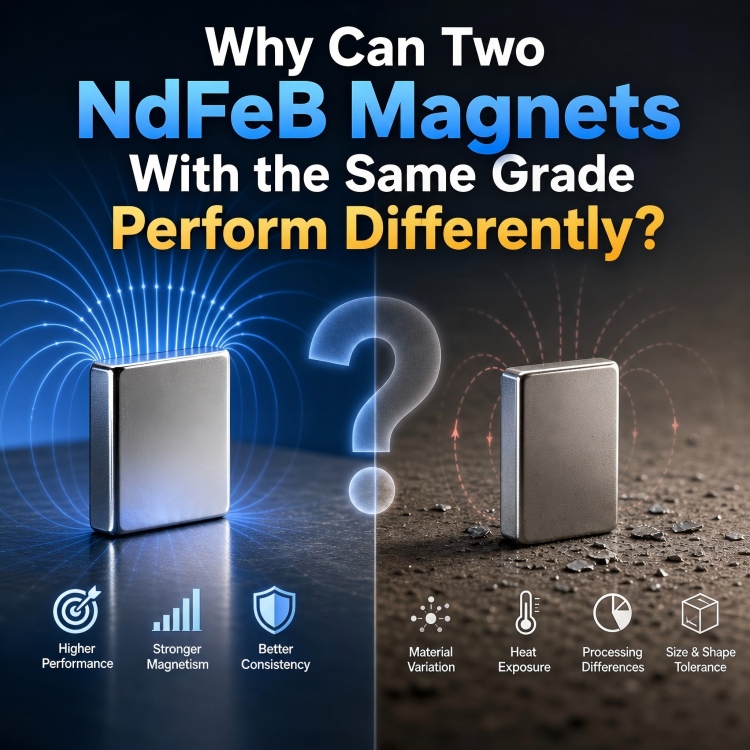
Their high magnetic performance comes with three important design considerations: temperature, corrosion, and mechanical brittleness. First, temperature sensitivity: many standard NdFeB grades have a maximum operating temperature around 80°C, while high-temperature grades can be designed for substantially higher temperatures. Even high-coercivity variants may not match samarium-cobalt’s 350°C ceiling. Exceeding the specified temperature limits risks irreversible demagnetization. Second, corrosion vulnerability: their iron-rich composition (about 60% Fe) invites rapid oxidation when exposed to moisture or salts—necessitating robust surface protection. Third, mechanical fragility: they have lower tensile strength and impact resistance compared to ferrite magnets, making them more prone to chipping or cracking under shock or improper assembly.
Inherent Vulnerability: Iron-Rich Matrix Oxidation and Galvanic Corrosion Mechanisms
Neodymium magnets‘ high iron content creates intrinsic electrochemical instability. In humid or saline environments, moisture can initiate oxidation at grain boundaries, accelerating rust formation. Contact with dissimilar metals—such as aluminum housings or stainless steel fasteners—may trigger galvanic corrosion, further degrading structural integrity. Uncoated magnets can show significant corrosion within months under coastal or industrial conditions. The microstructure and exposed surfaces of sintered NdFeB can make the material vulnerable to moisture and corrosive environments, which is why protective coatings are commonly used.
Coating Comparison: Ni-Cu-Ni, Epoxy, Gold, and Parylene
Effective corrosion mitigation relies on engineered coatings matched to application demands:
| Coating Type | Thickness Range | Key Advantages | Primary Applications |
|---|---|---|---|
| Ni-Cu-Ni | 15–25 μm | Industrial durability, cost balance | Motors, industrial equipment |
| Epoxy | 20–50 μm | Chemical resistance, affordability | Consumer electronics, tools |
| Gold | 3–8 μm | Conductivity, corrosion resistance | Specialized medical/electronic applications |
| Parylene | 0.5–2 μm | Uniform coverage, moisture barrier | Aerospace, micro-electronics |
Nickel-copper-nickel (Ni-Cu-Ni) remains the benchmark for general-purpose use—offering reliable corrosion resistance and mechanical robustness. Epoxy coatings provide economical protection for consumer-grade applications where aesthetics and moderate environmental exposure prevail. Gold plating may be considered for applications requiring biocompatibility, with the complete material system evaluated according to applicable ISO 10993 requirements. Vapor-deposited parylene delivers pinhole-free, conformal barriers ideal for microscale components where dimensional tolerance is critical.
Consumer Electronics: Earbuds, Smartphones, and Magnetic Closures
Neodymium magnets are foundational to modern miniaturization in consumer electronics. In wireless earbuds, they drive ultra-compact dynamic drivers with precise frequency response. Smartphones rely on them for Hall-effect sensors, haptic feedback actuators, and MagSafe-style alignment systems. Hard disk drives use them to position read/write heads with nanometer-level accuracy. Magnetic latches in foldable tablets, smartwatches, and premium cases leverage their high pull force in minimal form factors.
Motors: Servo, BLDC, PMSM, and EV Traction
In motor applications, neodymium magnets enable high torque density and efficiency. Servo motors and brushless DC (BLDC) motors use them for precise speed and position control. Permanent magnet synchronous motors (PMSMs) can achieve very high efficiency and torque density, making them widely used in electric vehicle traction systems where compact size and energy efficiency are important. Their power-to-weight ratio supports lighter, more responsive drivetrains.
Robotics: Actuators and Encoders
Robot joints and actuators benefit from the compact power of neodymium magnets. They enable high torque output in space-constrained designs, reducing motor volume and weight while maintaining performance. Magnetic encoders using neodymium magnets provide precise position feedback for closed-loop control in collaborative robots and industrial automation systems.
Renewable Energy: Direct-Drive Wind Turbine Generators
In direct-drive wind turbines, neodymium magnets eliminate gearboxes entirely—reducing mechanical losses, maintenance needs, and failure points. This design approach can improve annual energy yield compared to geared alternatives. As the wind energy sector continues to grow, demand for large-scale neodymium magnets in generator applications is increasing accordingly.
At DAWA Magnet, we have been manufacturing neodymium magnets for 35 years. Our experience spans consumer electronics, motors, robotics, automotive systems, and industrial automation.
Unlike many suppliers that outsource critical steps—sintering, grinding, coating—we maintain complete in-house control over the entire production chain. This vertical integration delivers:
-
Consistent magnetic performance from batch to batch
-
Micron-level dimensional tolerances for critical fits
-
Reliable multi-layer nickel-copper-nickel coating systems that pass rigorous salt-spray and humidity testing
-
Flexible customization for shape, magnetization direction, and thermal grade
With 35 years of NdFeB manufacturing experience, our engineering team evaluates magnet geometry, magnetization direction, magnetic grade, operating temperature, coating requirements, and assembly conditions before recommending a suitable material and production process.
DAWA controls the critical production stages from powder preparation and sintering to machining, coating, magnetization, and final inspection. We were among the first manufacturers in China to develop magnet solutions for TWS earbuds, servo motors, and other high-precision applications—giving us extensive experience supporting customers through prototype validation, process optimization, and long-term quality consistency.
What are neodymium magnets made of?
Neodymium magnets are composed primarily of neodymium, iron, and boron, forming the Nd₂Fe₁₄B intermetallic compound with a tetragonal crystalline structure.
Why are neodymium magnets called “rare-earth” magnets?
They are labeled “rare-earth” because they contain neodymium, a rare-earth element. However, neodymium is not actually rare in the Earth’s crust; the term refers to the difficulty of finding economically extractable deposits.
What is the difference between N35, N42, and N52 magnets?
The number indicates the approximate maximum energy product in MGOe. N35 represents approximately 35 MGOe, N42 represents approximately 42 MGOe, and N52 represents approximately 52 MGOe. Higher numbers mean stronger magnets for the same size, but they also tend to be more brittle and more temperature-sensitive.
Is N52 always better than N42?
Not necessarily. N52 provides higher maximum energy product, but N42 or other grades may be more suitable when operating temperature, corrosion resistance, mechanical requirements, or cost are more important than maximum magnetic performance.
How strong are neodymium magnets compared to other types?
Neodymium magnets are 5–10 times stronger than ferrite magnets and significantly stronger than samarium-cobalt magnets, making them the strongest commercial permanent magnets available.
Can neodymium magnets lose their strength over time?
Yes. The main causes are heat (exceeding maximum operating temperature), corrosion (moisture attacking unprotected surfaces), and physical damage (cracks or chips). Proper coating and thermal management can significantly extend their lifespan. (Related article: [How Magnets Lose Strength and What You Can Do About It])
What are the common coatings used for neodymium magnets?
Common coatings include nickel-copper-nickel (Ni-Cu-Ni), epoxy, gold, and parylene, each chosen based on durability, chemical resistance, or biocompatibility needs.
What are the main applications of neodymium magnets?
They are used in consumer electronics (earbuds, smartphones), motors (servo, BLDC, EV traction), robotics (actuators, encoders), renewable energy (wind turbines), medical devices, and aerospace technologies.
For technical specifications, custom design support, or to request samples, visit the DAWA Magnet website or contact our engineering team directly.
Dawa Jiahao, facilitate innovation and mass production