Custom NdFeB Magnets in 2026: How OEMs Can Reduce Cost Through Better Magnet Specifications
Most procurement conversations about neodymium magnets start with price per kilogram. That is the wrong starting point.
Price per kilogram tells you what you paid for the material. It does not tell you what the magnet will cost you in assembly scrap, motor inefficiency, or field failures. The better question is not “How much does the magnet cost per kilogram?” but “What will this magnet cost us at the system level?”
That includes material cost, machining yield, assembly time, motor efficiency, thermal stability, coating performance, scrap rate, and the potential cost of field failures. In procurement terms, this is the total cost of ownership—and for custom NdFeB magnets, the specification decisions made at the RFQ stage have more influence on TCO than the piece price negotiated afterward. A low piece price attached to a high minimum order quantity, long lead time, or inconsistent quality record can be the most expensive option on the table.
This article examines why magnet specifications—not just magnet grade—determine system-level cost, and how a custom magnet partner can help OEMs convert specification decisions into competitive advantage.
Demand for sintered NdFeB magnets continues to grow across EV motors, industrial automation, robotics, consumer electronics, and other high-performance applications. At the same time, OEM buyers are facing greater pressure around rare-earth supply, material costs, temperature performance, and supplier diversification. As a result, magnet procurement is becoming less about buying a standard grade at the lowest price and more about selecting the right magnetic material, geometry, tolerance, and manufacturing process for the application.
Rare Earth Supply and Supplier Diversification
China’s rare earth export control situation remains a live consideration for procurement teams. According to China’s Ministry of Commerce, the export control measures announced on October 9, 2025, have been suspended through November 10, 2026, in line with the consensus reached during China-U.S. economic and trade consultations in Kuala Lumpur. Export applications for genuine civilian use that meet relevant conditions will be approved in accordance with the law.
For buyers, the practical takeaway is not that supply is secure—it is that the policy environment remains subject to change. A dual-track procurement strategy, balancing cost-competitive global sourcing with strategic partnerships across multiple qualified suppliers, reduces exposure to policy shifts and logistics disruptions.
The EU’s Critical Raw Materials Act (CRMA) is also shaping supplier qualification decisions. By 2030, the Act sets benchmarks for domestic extraction, processing, recycling, and diversification of strategic raw material supply. While the CRMA primarily addresses raw materials rather than finished permanent magnets, its requirements can still influence the rare-earth supply chain behind NdFeB magnets.
For OEM buyers, the broader implication is clear: supplier diversification, material traceability, and long-term supply planning are becoming increasingly important when qualifying magnet suppliers.
Why the Same NdFeB Grade Can Perform Differently
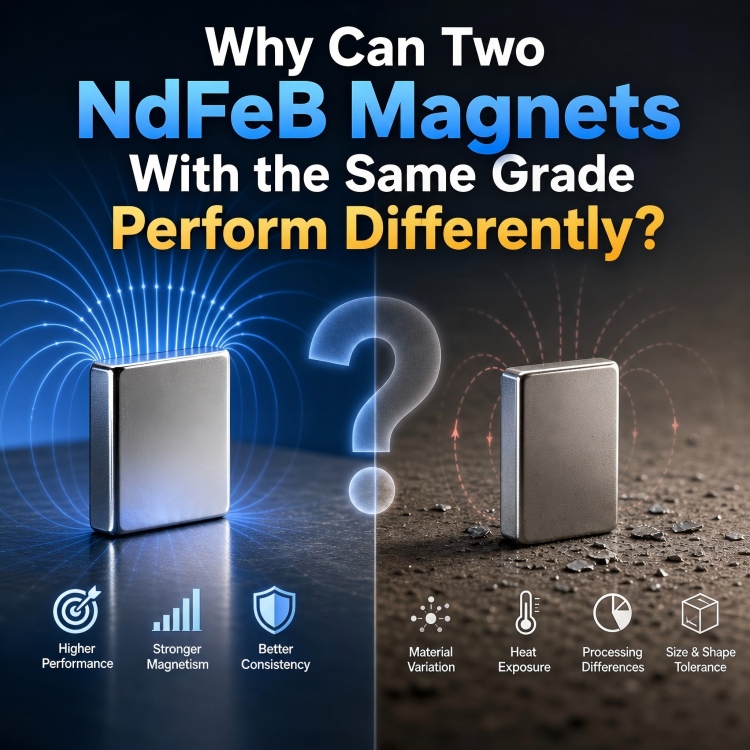
Diversification alone is not enough. Two magnets labeled N42 may meet the same nominal grade specification while showing differences in Br, Hcj, temperature coefficients, dimensional accuracy, coating performance, and batch-to-batch consistency.
Different raw material sources, different sintering profiles, different grain boundary diffusion conditions—all of these affect the final magnetic properties. When supply chains diversify, the need for rigorous specification and qualification increases, not decreases.
For OEMs sourcing custom neodymium magnets, supplier capability matters as much as the nominal magnet grade.
Here is a cost that does not appear on a magnet quotation: the cost of a motor that underperforms because the magnet was over-specified in one dimension and under-specified in another.
Grade and Operating Temperature
The magnet grade determines the magnetic strength available in a given volume. But grade alone does not determine whether the magnet will perform reliably at operating temperature.
A standard N52 magnet may not provide sufficient coercivity for a motor operating continuously at elevated temperatures. If the application operates at higher temperatures, a high-coercivity grade such as N42SH may provide better thermal stability, depending on the actual operating temperature and magnetic circuit design.
This is where the relationship between grade and system performance becomes a cost decision. Choosing a higher N-grade for room-temperature strength may result in demagnetization at operating temperature. Choosing a lower N-grade with higher Hcj may deliver more reliable performance at the same cost or less.
For motor and high-temperature applications, Hcj and the demagnetization curve can matter more than the N-number alone. A qualified NdFeB magnet manufacturer should be able to support grade selection based on operating temperature, not just room-temperature magnetic strength.
Geometry and Air Gap
The magnet geometry determines how the magnetic field distributes in the motor’s air gap. An arc segment that does not match the rotor curvature introduces air gap variation, which causes torque ripple, vibration, and noise. A magnet that is thicker than required may increase material cost without improving performance.
In high-volume production, even a small reduction in magnet volume can translate into significant annual material savings. Simulation-based magnetic circuit optimization can sometimes reduce the amount of magnet material required while maintaining the target magnetic field.
Dimensional Tolerance
Tolerance affects assembly fit, air gap in motors, and sensor alignment. Tight tolerances require additional grinding passes, more inspection, and higher scrap rates. Loose tolerances may lead to assembly difficulties or performance variation.
The cost increase is not linear. Tighter tolerances may require additional machining passes, specialized tooling, more frequent inspection, and higher scrap rates. The actual impact depends heavily on part geometry and production volume.
Specify tight tolerances only where they are functionally necessary, and allow wider tolerances on non-critical dimensions. For qualified geometries, tolerances down to ±0.02 mm can be supported—depending on magnet size, shape, coating, and critical dimensions specified on the drawing.
Magnetization Pattern
Simple axial or diametric magnetization is relatively low cost. Multi-pole magnetization—where the magnet is magnetized with alternating poles around a circumference—requires custom fixtures and more time.
Multi-pole configurations with different pole counts can be produced on suitable ring or arc geometries, depending on the magnet design and magnetization fixture. The cost increases with pole count and complexity.
Magnetization direction determines the field pattern. If the direction does not match the motor design—axial instead of diametric, or incorrect pole configuration—the motor will not produce the expected torque.
Coating and Corrosion Protection
Coating affects both performance and longevity. Ni-Cu-Ni is the standard, but epoxy, zinc, gold, and parylene each offer different trade-offs between cost, corrosion resistance, and compatibility with the assembly environment.
Epoxy can be a suitable option for applications requiring additional environmental protection or electrical insulation, while other coating systems may be preferable for specific temperature, corrosion, or assembly requirements. Actual salt spray performance should be confirmed through supplier test data under specified test conditions.
A coating does not increase the intrinsic temperature rating of the NdFeB material; maximum operating temperature is primarily determined by the magnet grade and its magnetic properties.
A standard catalog magnet is designed for general-purpose use. A custom magnet is designed for your application. The difference is often measured in system cost.
Customization does not automatically mean higher cost. In many OEM applications, the opposite can be true. A magnet that is optimized for geometry, grade, tolerance, and magnetization can reduce material usage, machining waste, assembly complexity, and the need for over-specification.
The goal is not to select the strongest magnet. The goal is to select the magnet that delivers the required performance under the actual operating conditions—no more, no less.
Grade Selection
Grade selection should be based on operating temperature, not just room-temperature strength. For high-temperature applications, Hcj and the demagnetization curve matter more than the N-number.
Geometry Optimization
Geometry should match the motor’s air gap and assembly constraints. Simulation-based optimization can sometimes reduce material usage while maintaining the target magnetic field.
Tolerance Optimization
Tolerance should be specified only where functionally necessary. Tighter tolerances increase cost, and the increase is not linear.
Magnetization Optimization
Magnetization should match the field requirement. Axial, diametric, radial, or multi-pole—the pattern should be specified based on the application, not chosen by default.
Coating Selection
Coating should be selected based on the actual environment, not a default choice.
Not all suppliers who claim “custom capability” can deliver it. Custom magnet manufacturing requires control over the entire production chain—sintering, machining, coating, magnetization, and inspection.
Outsourcing critical processes can increase supply-chain complexity and reduce direct visibility into the factors that influence final performance, particularly when process controls and traceability are limited.
In-House Sintering
Sintering is where the magnet’s magnetic properties are established. Raw material composition, strip casting parameters, jet milling particle size, pressing alignment, sintering temperature and time, and heat treatment conditions all converge to determine Br, Hcj, and the shape of the demagnetization curve. A supplier with in-house sintering has direct control over these variables.
Precision Machining
Machining determines dimensional tolerance and surface quality. Sintered NdFeB is brittle and difficult to machine. Diamond grinding, wire EDM, and multi-blade cutting each have different capabilities and cost structures. A supplier who can select the right machining method for the part geometry—rather than forcing every part through the same process—can achieve better yield and tighter tolerances at lower cost.
Custom Magnetization
Magnetization is the final step that determines the magnet’s field pattern. Multi-pole magnetization, custom field profiles, and precise angular alignment require custom fixtures and magnetization equipment. A supplier who designs and builds these fixtures internally can support application-specific magnetization that off-the-shelf suppliers cannot.
Coating Capability
A supplier who controls coating in-house can adjust thickness, adhesion, and sealing parameters to match the application. This matters for applications in humid, saline, or chemically aggressive environments.
Inspection and Traceability
Quality is invisible in magnets. Two parts can look identical and measure differently. A supplier who performs dimensional inspection and magnetic performance verification—and provides test data with each batch—gives OEM buyers the information needed to validate incoming material and maintain production consistency.
Engineering Support
A capable custom magnet supplier should be able to review drawings, recommend suitable grades, identify manufacturing risks, and suggest changes that improve yield or reduce cost before production begins. This is one of the key differences between a manufacturer with in-house engineering capability and a trading company that relies on external manufacturing partners.
DAWA has been manufacturing NdFeB magnets for 35 years. Production covers sintering, machining, coating, magnetization, and final inspection within its own manufacturing facilities.
In-house sintering. DAWA operates its own sintering production, which provides visibility into material quality and magnetic consistency from the earliest stage of manufacturing.
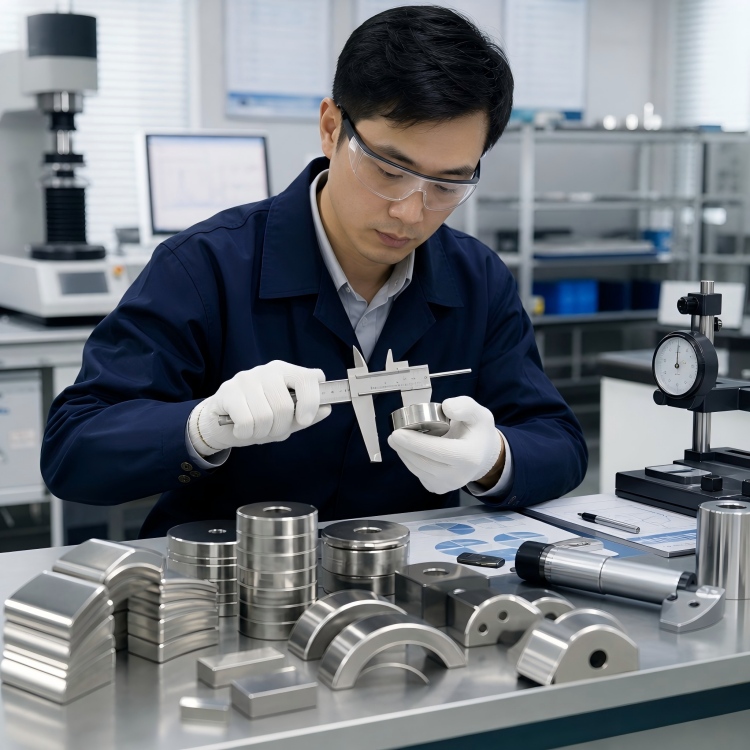
Precision machining. For qualified geometries, dimensional tolerances down to ±0.02 mm can be supported. Wire EDM is available for complex shapes requiring ultra-tight tolerances.
Custom magnetization. Axial, diametric, radial, and multi-pole magnetization are available based on application requirements. Magnetization fixtures are designed and produced internally.
Coating options. Multi-layer nickel-copper-nickel is standard. Epoxy, gold, and other coatings are available depending on the operating environment.
Inspection. Dimensional inspection is performed on critical features. Magnetic performance is verified before shipment, and test data can be provided upon request.
This integrated production model allows DAWA to support projects from prototype development through volume production, particularly where dimensional accuracy, magnetic consistency, and custom magnetization are critical. The objective is not simply to manufacture a magnet to drawing, but to help OEM customers achieve the required magnetic performance, dimensional consistency, and production efficiency at the target cost.
DAWA has experience supplying custom-size neodymium magnets and other high-precision magnet solutions for applications including TWS earbuds, servo motors, and industrial automation systems.
How does custom NdFeB magnet manufacturing reduce system cost?
Custom manufacturing allows the magnet to be optimized for the actual operating conditions—grade, geometry, tolerance, magnetization, and coating—rather than selecting the highest available grade for a general-purpose application. Optimizing specifications can reduce material cost, assembly cost, and the risk of field failures.
Is a higher-grade NdFeB magnet always better?
No. A higher magnetic grade is not automatically better for every application. The appropriate grade depends on the required magnetic performance, operating temperature, available space, demagnetization risk, and cost target. In some applications, a lower grade with higher coercivity may outperform a higher-energy-product grade under elevated temperatures.
What is the difference between a magnet manufacturer and a magnet trading company?
A manufacturer with in-house control over key processes such as sintering, machining, magnetization, and inspection can provide greater visibility into material consistency, process control, and customization. A trading company may still provide suitable products, but OEM buyers should understand which manufacturing processes are controlled directly and which are outsourced.
What tolerance can be achieved on custom NdFeB magnets?
For qualified geometries, tolerances down to ±0.02 mm can be supported. The achievable tolerance depends on magnet size, shape, coating, and the critical dimensions specified on the drawing.
What should OEMs include in a custom NdFeB magnet RFQ?
An OEM RFQ should ideally include the magnet grade or required magnetic performance, dimensions, dimensional tolerances, magnetization direction or pole configuration, coating, operating temperature, quantity, application environment, and a 2D or 3D drawing. For motor applications, information about the air gap, operating temperature, and required magnetic field can also help the supplier recommend a more appropriate specification.
How does magnetization direction affect motor performance?
Magnetization direction determines the field pattern. If the direction does not match the motor design—axial instead of diametric, or incorrect pole configuration—the motor will not produce the expected torque.
Why does in-house sintering matter for custom magnets?
Sintering determines the magnet’s magnetic properties. A supplier with in-house sintering controls the raw material composition, pressing alignment, sintering temperature, and heat treatment—all of which affect Br, Hcj, and temperature stability.
Does DAWA support custom magnet projects from prototype to volume production?
Yes. DAWA supports custom shapes, magnetization directions, and coating options based on application requirements. Engineering support is available for grade selection, manufacturability review, and process optimization from prototype through volume production.
Need a Custom NdFeB Magnet Specification?
If you are developing a motor, sensor, consumer electronic device, robotic actuator, or other magnetic assembly, send us your drawing and application requirements. DAWA can help evaluate magnet grade, geometry, tolerance, magnetization, and coating options for your project.
Dawa Jiahao, facilitate innovation and mass production