Custom Neodymium Magnets: How DAWA’s Engineering Team Solves Application-Specific Magnet Problems
Most magnet suppliers can quote you a standard N42 disc from a catalog. The harder problem starts when that standard disc does not fit your housing, does not survive your operating temperature, or does not produce the field pattern your sensor needs.
A custom magnet therefore needs to be evaluated as part of the finished assembly. Its dimensions, magnetic properties, coating, and magnetization must all meet the requirements of the application. Solving these problems requires more than changing the magnet’s dimensions—the supplier also needs to understand how the magnet will be manufactured, assembled, and used.
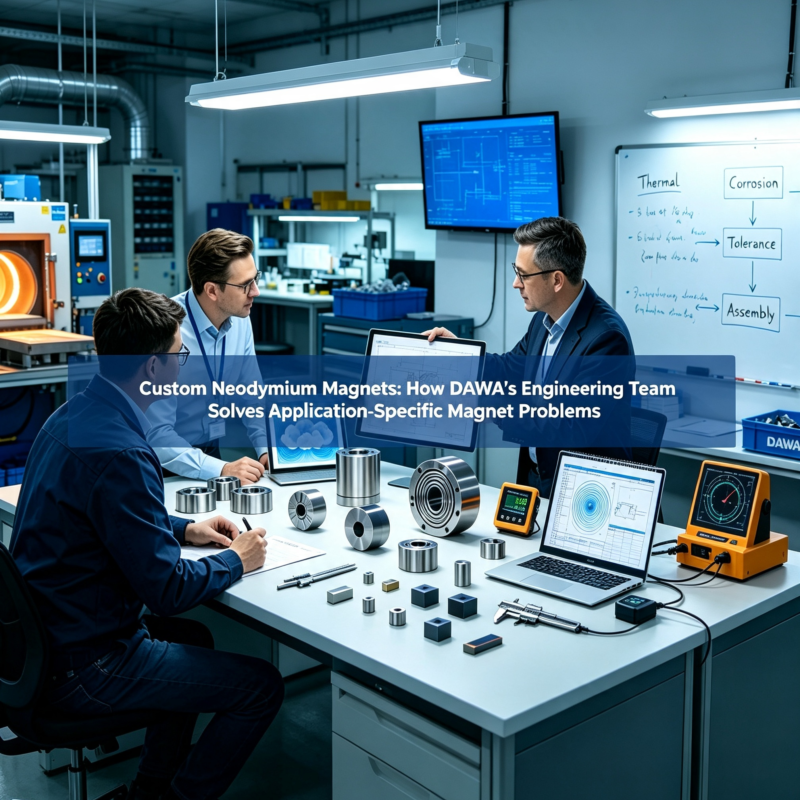
DAWA has been manufacturing NdFeB magnets for 35 years. Production covers sintering, machining, coating, magnetization, and inspection within our own manufacturing system. For OEM customers, one team can review the drawing, evaluate the application conditions, recommend a specification, and carry it through to production—without handing critical steps to a third party.
Standard magnets work well for many applications, but they may not meet the dimensional, thermal, or magnetic requirements of a specific product.
In practice, we see the same categories of problems repeated across industries:
Geometry does not match the assembly. A round disc may not fit an arc-shaped rotor slot. In a motor, the arc segment must follow the rotor curvature so that the air gap stays consistent around the circumference. If the curvature is off, the air gap varies, and torque ripple appears. A rectangular block may not clear a sensor housing; the field pattern at the sensing element shifts, and the output drifts.
Tolerance is too loose for the assembly. A magnet that is 0.05 mm oversize may not fit; one that is undersize may shift and change the air gap. In precision assemblies, even small dimensional deviations affect fit, alignment, and performance.
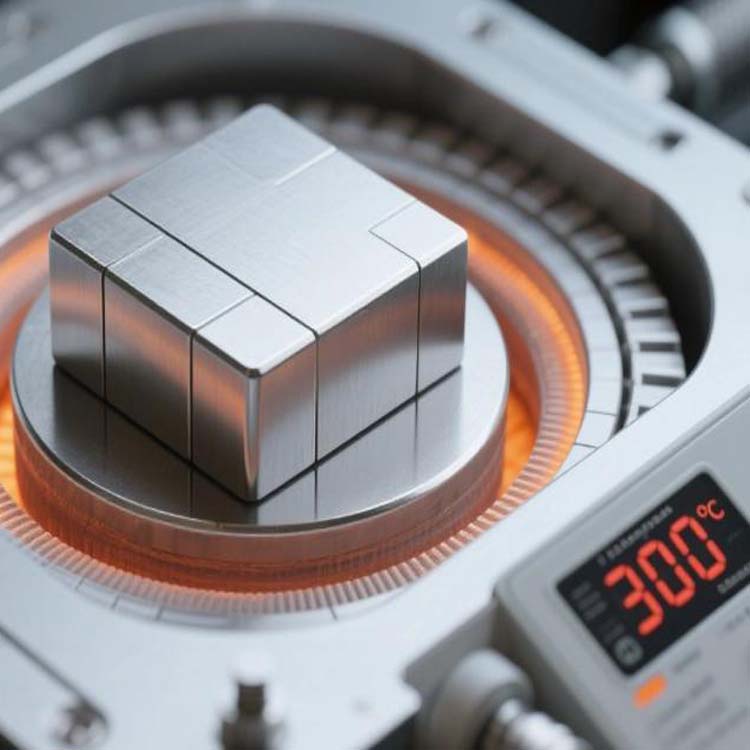
The grade is wrong for the operating temperature. A standard N-grade magnet may deliver strong room-temperature performance but lose coercivity at the motor’s actual operating temperature. If the magnet’s coercivity is insufficient for the actual operating conditions, irreversible demagnetization may occur, reducing the motor’s magnetic performance.
The coating does not match the environment. A coating that performs well in a dry indoor product may fail in a sweat-exposed earbud, a humid outdoor sensor, or a marine assembly. Coating thickness also affects dimensional fit: for a miniature magnet inside an earbud, a few microns of additional coating can change the assembly clearance.
The magnetization pattern is incorrect. A magnet magnetized axially cannot substitute for one magnetized diametrically or with multiple poles. For a multi-pole ring, the pole positions and field distribution must match the sensor’s expected signal pattern. This requires a dedicated magnetization fixture—not a standard magnetizer setup.
Batch consistency is not controlled. Two lots may meet the same nominal grade but differ in Br, Hcj, or dimensional conformity. For a motor or sensor program, that variation shows up as torque ripple, calibration drift, or assembly rejects.
Each of these problems has a technical solution. Finding it requires a supplier who understands both magnet manufacturing and the application.
Custom is not a single variable. A custom magnet project may involve adjustments across several dimensions at once—and the interactions between them matter.
| Customization Area | What We Can Adjust | Boundary / Note |
|---|---|---|
| Grade | N, M, H, SH, UH, EH, AH series | Matched to operating temperature and demagnetization risk |
| Geometry | Discs, blocks, rings, arcs, custom-shaped magnets, semi-circle, star and irregular profiles | Reviewed for manufacturability before quoting |
| Dimensions and tolerance | For qualified geometries, tolerances down to ±0.02 mm | Actual tolerance depends on size, shape, coating thickness, and critical dimensions |
| Magnetization | Axial, diametric, radial, multi-pole, custom field profiles | Custom fixtures designed and produced internally |
| Coating | Ni-Cu-Ni, epoxy, zinc, gold, parylene, application-specific systems | Selected based on exposure environment, with testing where required |
| Inspection | Dimensional checks, magnetic property verification, durability testing | Defined in the inspection plan agreed with the customer |
Three practical points on the boundaries:
Tolerance is geometry-dependent. ±0.02 mm is achievable for qualified geometries, but the actual tolerance depends on magnet size, shape, coating thickness, and the critical dimensions on the drawing. We confirm this during drawing review—not after the order is placed.
Grade selection is an engineering decision, not a catalog lookup. For motor and high-temperature applications, Hcj and the demagnetization curve matter more than the N-number alone. A grade that provides high Br at room temperature may not maintain sufficient coercivity at operating temperature.
Coating choice follows the environment. For a ring magnet with nickel coating, Ni-Cu-Ni may be appropriate for a general industrial assembly. For a sweat-exposed wearable, we would evaluate whether a different coating system or a thicker Ni-Cu-Ni layer is needed—and confirm it with testing.
A custom magnet project involves multiple process steps, and the order in which they are evaluated affects the outcome.
Here is how a typical project runs at DAWA.
1. Drawing and Requirement Review
We start with your drawing and application information: operating temperature, assembly method, magnetic circuit, environmental exposure, annual volume, and any inspection or acceptance criteria. If the drawing is incomplete, we ask for the missing inputs rather than guessing.
2. Design-for-Manufacturability Feedback
Before quoting, we review the design against the manufacturing process. This is where we flag issues that are cheaper to fix now than later:
-
A feature that is too thin to machine reliably
-
A tolerance that is tighter than the application requires
-
A shape that will reduce material yield and increase cost
-
A magnetization pattern that requires a custom fixture
-
A coating that may not survive the specified environment
In drawing reviews, it is not uncommon for a thin-walled ring or a sharp internal corner to fall below what the grinding process can hold consistently. When that happens, we flag it during review and suggest a small geometry change—so the customer avoids a redesign cycle after tooling. That kind of feedback comes from production experience: we have seen which designs work at volume and which ones create problems.
3. Grade and Coating Recommendation
After reviewing the operating temperature and magnetic circuit, we recommend a grade that provides the required coercivity and resistance to demagnetization. The final selection depends on the motor’s actual working conditions—not on the highest available N-number.
Coating recommendations follow the same logic: match the coating to the exposure environment, then verify with testing where required.
4. Sampling and Validation
We produce samples for fit and function testing. Where the application requires it, samples can be checked for dimensional conformity, magnetic performance, and durability under specified conditions. If a sample shows a problem, the results are reviewed with the production team before the next stage.
5. Production and Consistency
Once the specification is fixed, production runs within our in-house process. Because sintering, machining, coating, magnetization, and inspection are under one production system, process feedback can be acted on before a lot is completed—rather than after the magnets have shipped.
6. Problem Investigation
If a customer reports a field issue—demagnetization, coating failure, dimensional mismatch, or inconsistent performance—we can trace the problem back through the production records. That is only possible when the critical processes are controlled in-house.
Motor Arc Segments: Air Gap, Temperature, and Demagnetization
A motor designer needs arc segments that fit a curved rotor slot, maintain a precise air gap, and survive continuous operation at elevated temperature.
The arc radius must match the rotor curvature so the air gap stays consistent around the circumference. The grade must provide sufficient Hcj at the operating temperature to resist demagnetization under the motor’s field conditions. And the dimensional tolerance must be tight enough to avoid air gap variation that causes torque ripple.
For this type of project, we review the rotor geometry and operating temperature, recommend a grade with sufficient Hcj for the thermal environment, machine the arc segments to the required tolerance for qualified dimensions, and verify the magnetization pattern. The objective is a magnet that maintains its performance at operating temperature—not just on a datasheet.
TWS Earbuds: Miniature Size, Sweat Exposure, and Coating Thickness
A TWS earbud contains a small disc magnet in the speaker driver and a positioning magnet for the charging case. The magnet must be small enough to fit the earbud, strong enough to drive the speaker, and coated to meet the corrosion-resistance requirements defined for the product’s expected use conditions.
Space is the constraint that drives every other decision. The magnet must fit within the driver housing, which limits its diameter and thickness. Coating thickness becomes a dimensional variable—a few microns of additional coating can change the assembly clearance. And the coating must also meet the corrosion-resistance requirements defined for the product’s expected use conditions.
For this type of project, we evaluate the driver geometry and required field, select a grade and coating suitable for the exposure environment, confirm the dimensions against the assembly, and support artificial sweat testing under the agreed conditions where required.
Industrial Sensors: Multi-Pole Magnetization and Field Distribution
A sensor application requires a ring magnet with multiple alternating poles and a uniform field distribution. A single-pole magnet cannot produce the required signal pattern, and pole imbalance causes measurement error.
Multi-pole magnetization is not simply “magnetizing in more directions.” The pole count, pole spacing, and field waveform must match the sensor’s expected input. The magnetization fixture must be designed for the specific pole configuration—a standard magnetizer cannot produce a uniform multi-pole pattern on an arbitrary ring geometry.
Verification also differs from a simple surface-field check. A single-point gaussmeter reading cannot confirm pole symmetry or field uniformity. The measurement must cover the circumferential field distribution, pole positions, and waveform—using multi-point field checks or magnetic field mapping as appropriate to the design.
For this type of project, we review the pole count and field requirements, design the magnetization fixture, produce the ring magnet to the required dimensions, and verify the field pattern with a measurement method that matches the requirement.
A custom magnet project involves multiple process steps: sintering, machining, coating, magnetization, and inspection. When these steps are spread across different suppliers, three practical problems appear.
Problem attribution becomes difficult. If a coated magnet fails, was the cause the coating process, the machining surface, or the magnet material? With one production system, the answer is traceable through the production records.
Feedback loops get longer. A process adjustment that could be made in days takes weeks when it has to travel between suppliers.
Quality risk increases at each handoff. Every transfer between suppliers is a point where specifications can drift.
DAWA controls these processes within our own manufacturing system—including sintering, precision machining, custom-shaped magnet production, axial/diametric/radial/multi-pole magnetization, dimensional and magnetic property inspection, and durability testing such as salt spray and artificial sweat testing where required.
Keeping these processes within one manufacturing system allows production and inspection teams to respond directly to issues found during sampling or batch production. For OEM projects, this can simplify technical communication and reduce delays when process adjustments are needed.
The more complete the information you provide, the more accurately we can recommend a specification and quote the project. Useful inputs include:
| Information | Example |
|---|---|
| Grade or performance requirement | N42SH, or required Br/Hcj/BHmax |
| Shape and dimensions | Disc, ring, block, arc, custom profile; with drawing |
| Tolerance | ±0.05 mm, ±0.02 mm, or critical dimensions only |
| Magnetization | Axial, diametric, radial, multi-pole; pole count |
| Coating | Ni-Cu-Ni, epoxy, gold, parylene, or environment description |
| Operating temperature | Continuous and peak temperature |
| Application | Motor, sensor, earbud, holding assembly, etc. |
| Annual quantity | Prototype, pilot, mass production |
| Inspection requirements | Dimensional report, magnetic data, durability testing |
If you are not sure about some of these, that is normal. Our engineering team can help define the specification based on the application.
Have a custom magnet project in development? Send DAWA your drawings, required dimensions, operating temperature, and application details. Our team can review the design, assess manufacturing feasibility, and discuss a suitable specification for sampling and production.
Looking for a custom NdFeB magnet supplier who can solve application problems, not just fill catalog orders? Contact DAWA to discuss your project.
Can DAWA customize the shape and size of neodymium magnets?
Yes. We produce discs, blocks, rings, arc segments, semi-circle and star profiles, and other custom shapes based on customer drawings. Custom-shaped magnets are reviewed for manufacturability before quoting.
What dimensional tolerances can DAWA achieve?
For qualified geometries, tolerances down to ±0.02 mm can be supported. The achievable tolerance depends on magnet size, shape, coating thickness, and the critical dimensions specified on the drawing.
Can your engineering team help select the right grade for my application?
Yes. Grade selection is based on operating temperature, magnetic circuit, demagnetization risk, and performance requirements—not simply the highest available N-number.
Do you support custom magnetization patterns?
Yes. Axial, diametric, radial, and multi-pole magnetization are available, with magnetization fixtures designed and produced internally for application-specific requirements.
Which coating should I choose for a humid or sweat-exposed application?
The coating should match the exposure environment. Ni-Cu-Ni is a common standard; epoxy, parylene, and other systems may be more suitable depending on moisture, sweat, salt, or chemical exposure. We can evaluate the environment and recommend a coating, with testing where required.
How quickly can DAWA provide samples for a custom magnet?
Sample timelines depend on the geometry, grade, coating, and magnetization requirements. For many custom projects, prototypes can be produced in a few weeks. The exact schedule is confirmed after drawing review.
What should I do if my magnet design is not fitting or performing as expected?
Send us the drawing, the application conditions, and the observed issue. Our engineering team can review the design for manufacturability, evaluate the grade and magnetization, and recommend changes before production. If the issue appears in an existing part, we can review the production records and test data to identify the cause.
Does DAWA provide inspection data with custom magnet orders?
Magnetic performance and dimensional inspection are performed according to the agreed inspection plan, and test data can be provided upon request. Durability testing—including salt spray, artificial sweat, and drop testing—can be included where the application requires it.
What is the difference between a catalog magnet and a custom magnet?
A catalog magnet is designed for general-purpose use with standard dimensions, grades, and tolerances. A custom magnet is designed around the application’s specific geometry, operating conditions, and performance requirements.
Can DAWA help if I only have a prototype requirement, not mass production?
Yes. We support projects from prototype sampling through mass production. The inspection and documentation requirements can be scaled to the project stage.
Dawa, facilitate innovation and mass production