What Causes Neodymium Magnets to Lose Their Magnetic Strength?
A neodymium magnet can perform reliably for years in the right application. Yet in some equipment, users notice that magnetic holding force has weakened, a motor no longer performs as expected, or a magnetic assembly produces an inconsistent field. The immediate assumption is often that the magnet has lost its quality. In reality, several factors can affect magnetic performance, and not all of them indicate permanent damage.
Temperature, external magnetic fields, material selection, and the design of the magnetic circuit all play a role. Understanding what causes neodymium magnet demagnetization is particularly important for manufacturers using permanent magnets in motors, sensors, industrial equipment, and other precision applications.
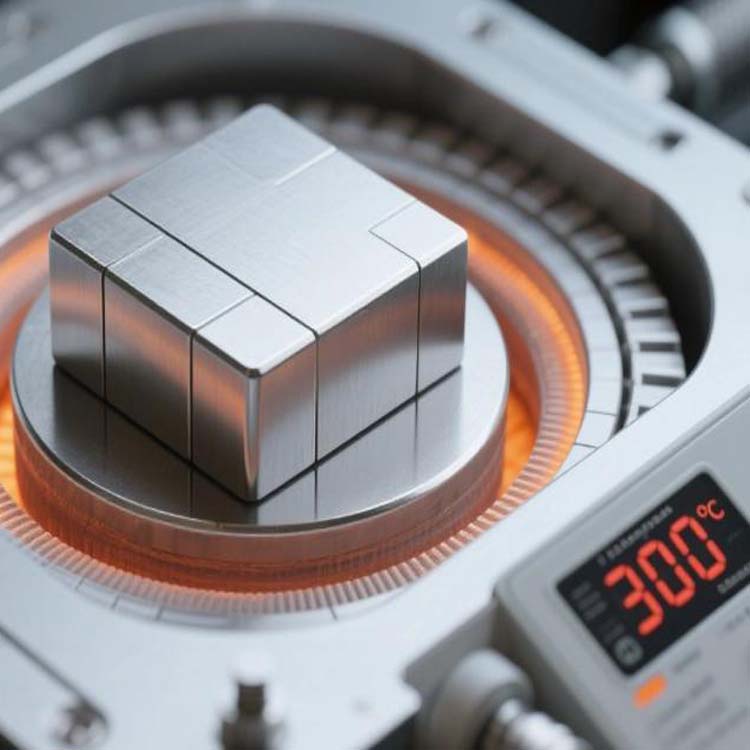
Temperature is a critical consideration when working with NdFeB magnets.
As a neodymium magnet heats up, its magnetic properties change. Some of these changes are reversible: when the magnet cools, its magnetic performance can recover. However, if the temperature becomes too high for the selected grade and operating conditions, irreversible demagnetization may occur.
The risk depends on more than the temperature reading alone.
Each NdFeB grade has its own temperature characteristics, including its Curie temperature and intrinsic coercivity. The Curie temperature is the point at which a material loses its spontaneous ferromagnetic ordering. It should not be confused with the maximum recommended operating temperature, which is generally much lower.
This distinction matters in practical applications. A magnet can experience irreversible magnetic loss well before reaching its Curie temperature, particularly when the magnetic circuit provides limited resistance to demagnetization.
Standard N-series magnets may be suitable for many room-temperature applications, but equipment exposed to sustained heat may require higher-coercivity grades.
DAWA’s available NdFeB material options include H, SH, UH, and EH temperature-resistant series. The appropriate grade should be selected according to the actual thermal conditions and magnetic circuit rather than relying on a general temperature label.
Heat is not the only factor that can weaken a permanent magnet.
A sufficiently strong magnetic field applied in the opposite direction can also drive a neodymium magnet toward demagnetization.
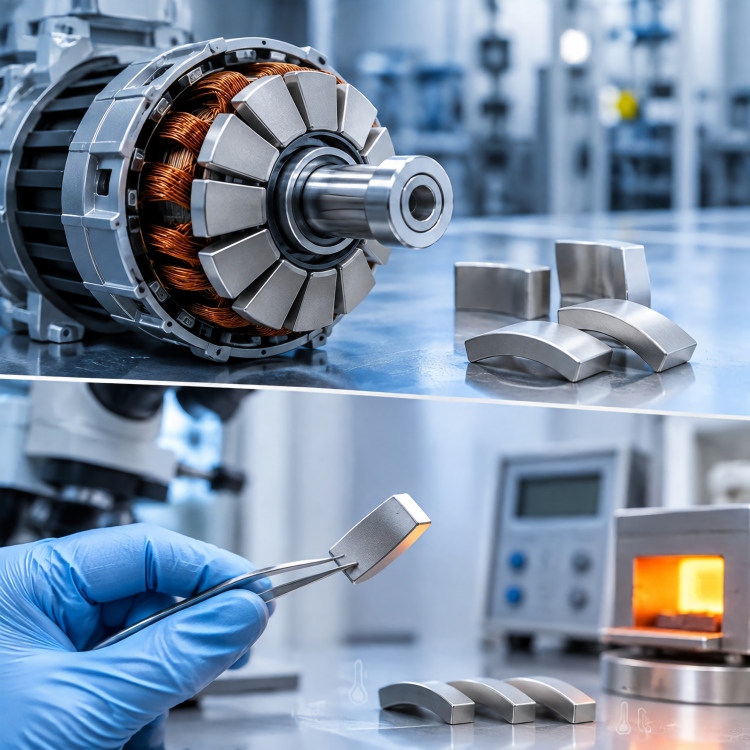
This situation may occur in electric motors, magnetic couplings, generators, and other assemblies where the magnet operates alongside electromagnetic components.
In a motor, for example, stator currents generate magnetic fields that interact with the rotor magnets. Under certain operating conditions, the opposing component of this field can become strong enough to affect the magnet’s operating point.
The risk increases when the magnet has insufficient intrinsic coercivity or when the magnetic circuit is poorly designed.
For this reason, selecting NdFeB magnets for demanding electromagnetic applications requires more than checking the maximum energy product. Intrinsic coercivity (Hcj) is especially important because it indicates how resistant the material is to irreversible demagnetization.
Engineers should evaluate the expected current range, possible overload conditions, temperature rise, and magnetic field distribution before finalizing the magnet specification.
Not every case of weak magnetic performance is caused by damage during use.
Sometimes the original material selection is the problem.
A magnet with a high energy product may appear attractive because it offers strong magnetic performance. However, if its coercivity is insufficient for the working environment, it may not maintain its intended performance under elevated temperatures or opposing magnetic fields.
This is why two magnets with similar dimensions and magnetic energy products can behave differently in the same application.
The distinction between Br, Hcb, Hcj, and BHmax is useful here:
- Br (Remanence): Indicates the magnetic flux density remaining after the magnetizing field is removed.
- Hcb (Coercivity): Describes the reverse magnetic field strength required to reduce the magnetic flux density to zero.
- Hcj (Intrinsic Coercivity): Indicates resistance to irreversible demagnetization.
- BHmax (Maximum Energy Product): Represents the maximum energy product on the demagnetization curve.
These values describe different aspects of magnetic performance. Looking at BHmax alone does not provide a complete picture of how a magnet will behave in service. For an application involving high temperatures or strong opposing fields, Hcj deserves particular attention.
Neodymium magnets contain iron and are vulnerable to corrosion if their surfaces are not adequately protected.
In humid environments, exposure to moisture or corrosive substances can damage an unsuitable coating. If corrosion progresses, the magnet may lose material, develop surface deterioration, or become mechanically compromised.
This is not necessarily the same as magnetic demagnetization, but it can reduce the reliability of the overall magnetic component.
Physical damage presents another concern. Sintered NdFeB magnets are hard and brittle, which means they can chip or crack when subjected to impact, excessive pressure, or improper handling.
A damaged magnet may no longer fit correctly into its assembly. Cracks or missing material can also affect the effective magnetic structure. For applications involving moisture, vibration, or mechanical stress, coating selection and assembly protection should be considered during the design stage.
There is another possibility that is often overlooked: the magnet may still have its original magnetic properties, but the assembled product is not producing the expected force.
Magnetic attraction is influenced by the air gap, contact surface, material between the magnet and its target, and the geometry of the magnetic circuit.
Even a small increase in the air gap can significantly reduce the attractive force in many configurations.
Misalignment, incorrect installation, changes in surrounding steel components, or a different measurement method can also produce results that appear to indicate demagnetization.
Before replacing a magnet, engineers should compare the original and current operating conditions.
A useful investigation starts with three questions:
Has the magnet experienced abnormal heat or an external magnetic field?
Check operating temperatures, overload events, and possible exposure to opposing magnetic fields.
Has the physical condition changed?
Inspect the coating, surface, dimensions, and assembly for corrosion, cracking, or deformation.
Is the magnetic performance actually lower?
Use an appropriate magnetic measurement method and compare the results under consistent conditions. A simple pull-force test can be affected by contact geometry and air gap, so it should not be treated as a direct measurement of the magnet’s intrinsic properties.
A reduction in magnetic performance does not always have a single explanation. Excessive heat and opposing magnetic fields can cause irreversible demagnetization, while corrosion, mechanical damage, and assembly issues can create similar symptoms.
The most effective way to avoid these problems is to match the magnet material and manufacturing specifications to the real operating environment.
DAWA manufactures a range of permanent magnet materials, including sintered NdFeB, SmCo, ferrite, AlNiCo, and bonded NdFeB magnets. Its capabilities also cover custom machining and magnetic assemblies for different industrial requirements.
For projects involving demanding temperatures, specific magnetic field conditions, or customized geometries, discussing the application requirements before production can help identify a more suitable magnetic solution.
Dawa, facilitate innovation and mass production