Why Are Neodymium Magnets Widely Used in Modern Electric Motors?
Electric motors are becoming smaller, lighter, and more demanding in terms of performance. From electric vehicles and industrial automation to household appliances, manufacturers are under constant pressure to deliver more power without increasing the size or weight of their equipment.
This shift has made permanent magnet technology increasingly important. Among the available magnetic materials, neodymium magnets have become a preferred option for many high-performance motor designs. Their appeal is not simply that they are powerful. The combination of high magnetic energy, compact dimensions, and design flexibility gives motor engineers more room to optimize rotor structures and overall motor performance.
One of the main reasons manufacturers choose Neodymium Magnets for Electric Motors is their high maximum energy product. Compared with many conventional permanent magnet materials, sintered NdFeB magnets can generate strong magnetic fields within a relatively small volume. This is particularly valuable in applications where installation space is limited.
Consider an electric vehicle traction motor. Reducing motor size and weight can help improve vehicle packaging and overall system efficiency. A high-performance permanent magnet allows engineers to achieve the required magnetic output without relying on an excessively large magnetic component.
The same principle applies to industrial servo motors, robotics, and precision drive systems. These applications often require a compact motor that can deliver consistent torque and respond accurately to changing operating conditions. A smaller magnet does not automatically mean a better motor, of course. Its performance depends on the complete magnetic circuit, air gap, rotor geometry, winding arrangement, and operating conditions. However, the high energy density of NdFeB materials gives designers a useful starting point.
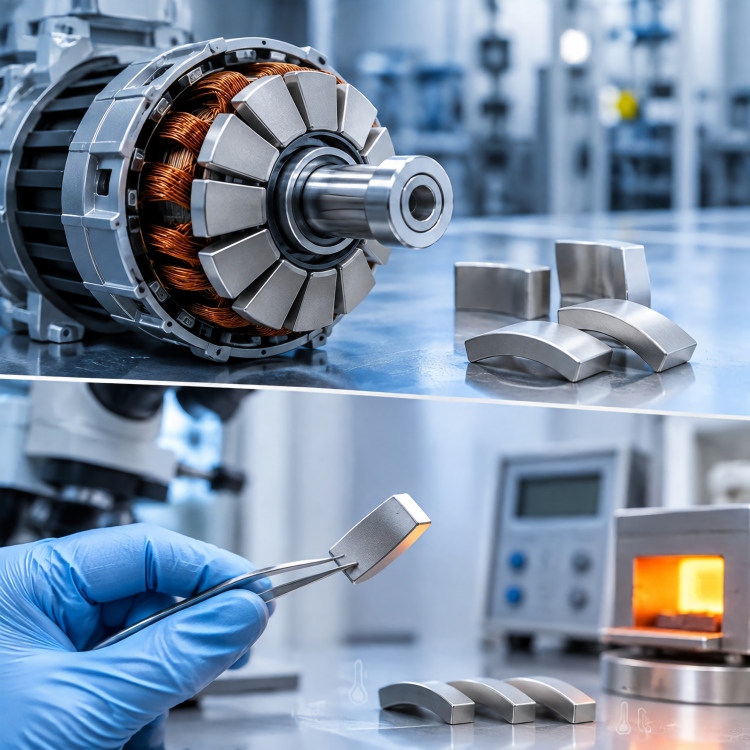
In a permanent magnet synchronous motor (PMSM), permanent magnets are incorporated into the rotor to establish a magnetic field. The stator windings generate another magnetic field when supplied with electrical current. Their interaction produces the torque that drives the motor.
The location and arrangement of the magnets influence how this magnetic interaction takes place.
Surface-mounted permanent magnet motors place magnets on the outer surface of the rotor. This arrangement can simplify certain aspects of rotor construction and is used in a range of applications.
Interior permanent magnet motors, on the other hand, position the magnets inside the rotor core. This design can provide additional opportunities for torque optimization and field weakening, depending on the rotor geometry.
Both configurations can use NdFeB motor magnets, but they do not necessarily require the same magnet shape, grade, or magnetic properties.
Arc magnets are frequently used in motor designs because their curved geometry can follow the rotor profile. Custom blocks and other shapes may also be required depending on the assembly. For manufacturers, magnet geometry is therefore part of the motor design rather than a simple purchasing detail.
NdFeB magnets are available in different grades, with variations in maximum energy product and resistance to demagnetization. A higher grade can provide stronger magnetic performance, but choosing the highest available grade is not always the most economical or technically appropriate decision.
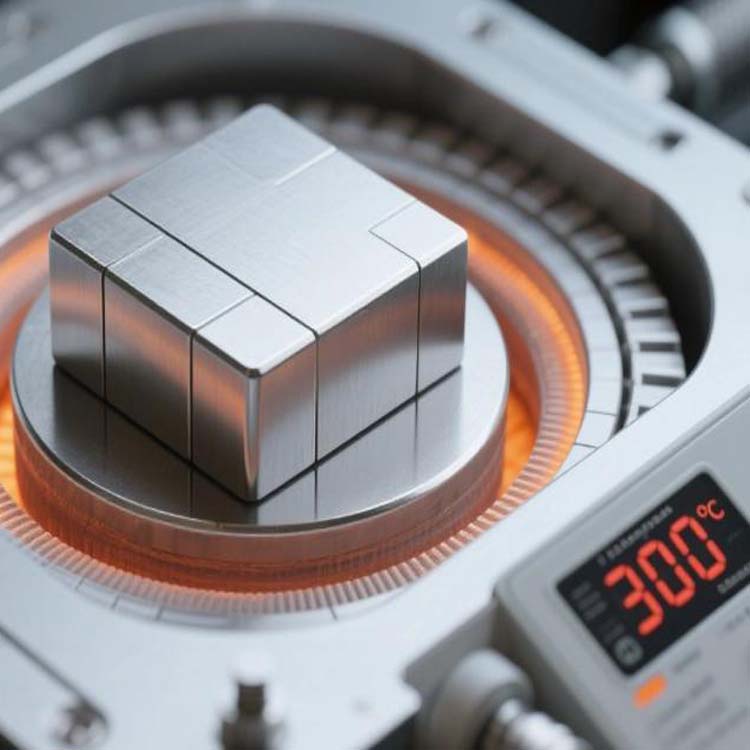
Motor engineers also need to consider intrinsic coercivity, which describes a material’s resistance to demagnetization. This becomes particularly important when a motor operates at elevated temperatures or experiences strong opposing magnetic fields.
For example, a motor used in an indoor appliance may have very different thermal requirements from a traction motor operating under demanding automotive conditions.
Temperature-resistant NdFeB grades, including H, SH, UH, and EH series, offer different levels of thermal capability. The appropriate selection depends on the actual working temperature, magnetic circuit design, and required performance margin. In practice, the motor’s thermal management system and the magnet specification need to be considered together.
Even when the magnetic grade is correct, manufacturing quality can influence how well a magnet performs after installation.
Dimensional accuracy matters because the magnet must fit the rotor assembly as designed. Variations in thickness, curvature, or other critical dimensions can affect the air gap and assembly consistency.
Magnetization is another important factor. A motor may require a specific pole arrangement, magnetization direction, or magnetic field distribution. If the magnetization specification does not match the rotor design, the finished motor may not deliver its intended performance.
Surface protection also deserves attention. NdFeB is susceptible to corrosion, particularly in environments involving moisture or other corrosive conditions. Depending on the application, nickel-based, epoxy, or other suitable coatings may be considered.
For motor manufacturers producing at scale, consistency between batches is just as important as the performance of an individual sample. Material properties, dimensions, coating quality, and magnetic measurements all contribute to the reliability of the final assembly.
The application range extends well beyond electric vehicles. In industrial automation, permanent magnet motors are used in servo systems, robotics, and precision machinery where compact size and responsive control are important.
In automotive engineering, NdFeB magnets can be found in traction motors, electric power steering systems, pumps, and other electric drive components.
Consumer appliances also make use of permanent magnet motor technology. Washing machines, air conditioning systems, and other household equipment may incorporate these magnets to support compact and efficient motor designs.
The requirements vary considerably across these sectors. A magnet intended for a high-speed motor may face different mechanical and thermal conditions from one used in a low-speed industrial drive. That is why motor magnet selection should always begin with the application rather than a standard catalog specification.
The growing demand for compact electric drives has increased the importance of high-performance permanent magnet materials. Neodymium magnets offer motor designers a valuable combination of magnetic strength, compact size, and flexible geometry.
Still, successful motor integration requires more than selecting a magnetic grade. Shape, magnetization, temperature resistance, dimensional tolerances, and surface protection all need to match the intended design.
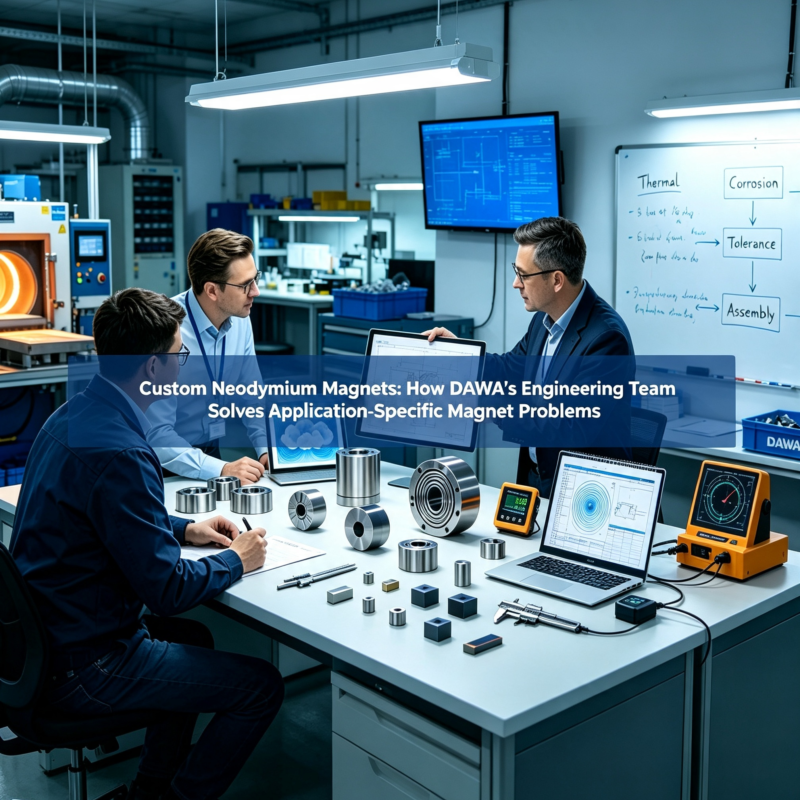
DAWA develops permanent magnet solutions for industrial and commercial applications, including sintered NdFeB magnets and customized magnetic components. For motor manufacturers, working with a supplier that understands both material properties and component requirements can help make the transition from magnetic design to production more straightforward.
Dawa, facilitate innovation and mass production