SH vs UH vs EH vs AH Magnets: Which Grade Is Right for Your Application?
Introduction: Why Are High-Temperature Magnets Becoming More Important?
With the rapid development of electric vehicles, industrial automation, robotics, and advanced electronic equipment, permanent magnets are required to work in increasingly challenging environments.
For many applications, magnetic strength alone is not enough. The magnet must also maintain stable performance under high temperatures. This is why high-temperature neodymium magnet grades such as SH, UH, EH, and AH are becoming more popular.
However, many buyers are confused about the differences between these grades. A higher temperature grade does not always mean a better choice. The right magnet grade depends on the actual working environment, temperature requirements, and application conditions.
As a professional magnet manufacturer, Dawa provides customized neodymium magnet solutions to help customers select the most suitable magnetic materials for different applications.
Understanding Magnet Grade Naming: What Do SH, UH, EH, and AH Mean?
Neodymium magnets are usually classified by two main factors:
- Magnetic performance
- Maximum working temperature
The first letter N represents standard neodymium magnets, while the additional letters indicate enhanced temperature resistance.
Common high-temperature grades include:
| Grade | Temperature Resistance | Main Feature |
|---|---|---|
| SH | Up to 150°C | High temperature stability |
| UH | Up to 180°C | Higher coercivity performance |
| EH | Up to 200°C | Extreme temperature applications |
| AH | Up to 230°C | Ultra-high temperature environments |
Compared with standard N35, N42, or N52 magnets, these high-temperature grades use special material formulations to improve resistance to thermal demagnetization.
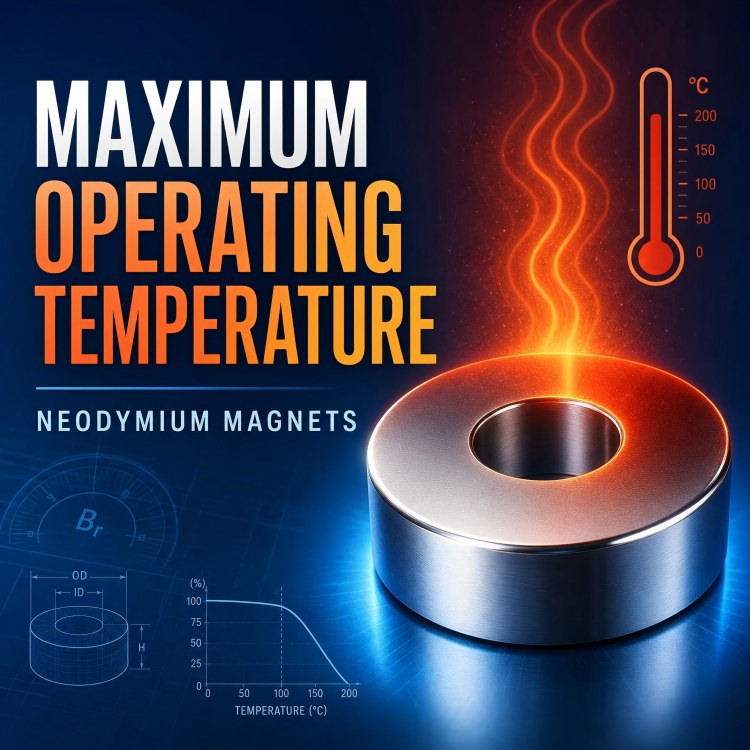
Temperature stability is one of the most important factors when selecting a neodymium magnet.
| Magnet Grade | Maximum Working Temperature | Typical Applications |
|---|---|---|
| SH | 150°C | Motors, industrial equipment |
| UH | 180°C | High-performance motors and automation systems |
| EH | 200°C | Automotive and demanding industrial applications |
| AH | 230°C | Aerospace and extreme environments |
When magnets operate beyond their recommended temperature range, magnetic performance can gradually decrease. Therefore, selecting the correct temperature grade helps improve product reliability and service life.
Magnetic Performance Comparison: Is Higher Temperature Grade Stronger?
A common misunderstanding is that a higher temperature grade always provides stronger magnetic force.
In reality, SH, UH, EH, and AH grades are mainly designed to improve coercivity (Hcj) and temperature resistance.
Key magnetic parameters include:
| Parameter | Meaning |
|---|---|
| Br | Residual induction, representing magnetic strength |
| Hcb | Coercive force, showing resistance to demagnetization |
| Hcj | Intrinsic coercivity, indicating temperature stability |
| BHmax | Maximum energy product |
As temperature requirements increase, manufacturers usually add elements such as dysprosium (Dy) or terbium (Tb) to improve coercivity. However, this may slightly affect magnetic performance and increase material cost.
The price difference between standard neodymium magnets and high-temperature grades mainly comes from material composition.
High-temperature magnets often require:
- Higher coercivity materials
- Additional heavy rare earth elements
- More complex manufacturing processes
- Stricter quality control
For example, adding Dy or Tb improves resistance to heat and demagnetization, but these rare earth elements also increase production costs. Therefore, choosing the highest temperature grade is not always the most economical solution.
Which Industries Use SH, UH, EH, and AH Magnets?
Different industries have different temperature requirements.
Consumer Electronics
Most consumer products operate at relatively low temperatures, so standard neodymium magnets or SH grades are often sufficient.
Industrial Automation
Motors, sensors, and automation equipment may experience continuous heat, making SH or UH magnets suitable choices.
Electric Vehicles
EV motors require magnets that maintain performance under high temperature and strong operating conditions. UH and EH grades are commonly used.
Aerospace and Extreme Applications
Applications exposed to extreme temperatures may require EH or AH magnets for maximum stability.
Conclusion: Choose the Right Magnet Grade for Your Application
SH, UH, EH, and AH magnets each have their own advantages. There is no single “best” grade for every application.
The correct choice depends on operating temperature, magnetic requirements, product lifetime, and cost considerations.
With professional manufacturing experience and customized solutions, Dawa helps customers select reliable neodymium magnet grades that deliver stable performance in demanding environments.
FAQ
Q1: Is SH better than N52?
Not necessarily. N52 provides higher magnetic energy, while SH provides better temperature resistance.
Q2: Which magnet grade is suitable for electric motors?
It depends on motor temperature and design requirements. SH, UH, or EH grades are commonly selected.
Q3: Can Dawa provide customized magnet solutions?
Yes. Dawa provides customized neodymium magnets with different grades, shapes, coatings, and performance requirements.
Dawa Jiahao, facilitate innovation and mass production