How Magnets Lose Strength and What You Can Do About It
Introduction: Understanding Magnetic Strength and Degradation
Magnetism comes down to something incredibly small—electrons. Inside a magnet, electrons spinning in the same direction align their individual magnetic fields, creating a cumulative force that we can measure and use. That force is quantified in units like gauss or tesla. A typical refrigerator magnet might produce about 100 gauss, while industrial-grade magnets can generate fields of several teslas—enough for heavy lifting, magnetic separation, or precision manufacturing.
But no magnet stays at peak strength forever. Magnetic degradation is the gradual loss of magnetic force over time, driven by factors like heat, physical damage, and environmental exposure. Understanding what causes this decline—and how to slow it down—is essential for anyone using permanent magnets in real-world applications, whether in trampoline parks, automotive sensors, or industrial motors.
Exposure to High Temperatures – How Heat Affects Magnetism and the Curie Temperature
Heat is one of the fastest ways to weaken a magnet. When a magnet gets hot, its atoms vibrate more vigorously. That vibration disrupts the careful alignment of magnetic domains, causing the overall magnetic field to weaken.
The most extreme case is hitting the Curie temperature—the point at which a material completely loses its magnetic properties. For neodymium magnets, the Curie temperature ranges from about 310°C to 400°C, depending on the specific grade. Ferrite magnets are slightly more heat-resistant, with Curie temperatures around 450°C.
But here’s the catch: irreversible damage can start long before you reach the Curie point. Exceeding a magnet’s maximum operating temperature—which is much lower than its Curie temperature—can cause permanent loss of magnetic strength that cooling won’t restore. For standard N-grade neodymium magnets, that ceiling is just 80°C. High-temperature grades like SH, UH, or EH can go higher, but the principle remains: heat management is critical.
Physical Damage – Cracks, Chipping, and Their Impact on Magnetic Fields
Magnets are brittle. Drop one, strike it with a hammer, or put it under uneven pressure, and you risk cracks or chips. Physical damage doesn’t just affect the surface—it disrupts the internal alignment of magnetic domains.
Think of it like breaking a mirror: the reflection is still there in each shard, but the unified image is gone. Similarly, a cracked magnet may still have magnetism, but its field becomes fragmented and weaker. In practice, magnets subjected to repeated mechanical stress can experience a 30–50% reduction in operational lifespan, depending on the severity and frequency of the impacts.
Demagnetization from External Magnetic Fields – How Strong Opposing Fields Weaken Magnets
A magnet doesn’t exist in isolation. Put it near a strong opposing magnetic field, and that field can start to reorient the magnet’s domains, effectively “pushing” them out of alignment. This is known as demagnetization or depolarization.
Materials with lower coercivity—their resistance to demagnetization—are especially vulnerable. Neodymium magnets, while incredibly strong, can lose a percentage of their strength when exposed to alternating currents or strong opposing fields. This is why careful circuit design and proper magnetic shielding are important in industrial environments where multiple magnetic fields interact.
Corrosion and Oxidation – How Moisture and Air Degrade Magnet Coatings
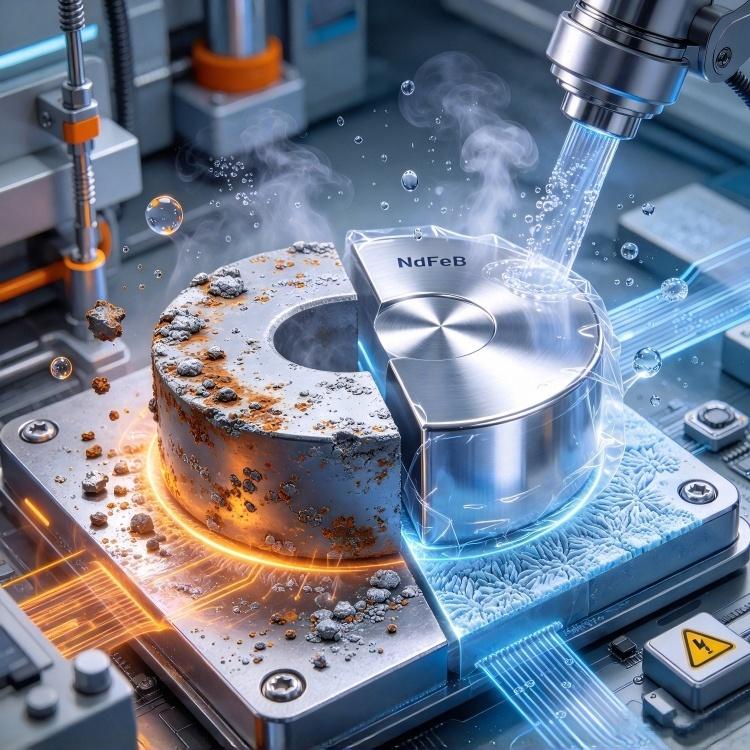
Neodymium magnets are made of a rare-earth alloy that is highly susceptible to oxidation. Without protection, moisture and oxygen attack the magnet’s surface, causing rust and flaking. This isn’t just cosmetic—corrosion eats into the magnet, reducing its effective volume and, consequently, its magnetic strength.
In high-humidity environments or applications involving sweat, water, or saline exposure, unprotected magnets can degrade rapidly. That’s why nearly all permanent magnets used in consumer or industrial products are coated. Common coatings include nickel, zinc, epoxy, and gold plating—each offering different trade-offs between cost, durability, and corrosion resistance.
Protective Coatings: Nickel, Epoxy, and Gold Plating
The simplest and most effective way to protect a magnet from environmental damage is to coat it. Each coating type has its strengths:
| Coating Type | Best For | Key Advantage |
|---|---|---|
| Nickel | General-purpose use | Durable, shiny, good corrosion resistance |
| Epoxy | High-moisture environments | Thick barrier against water and humidity |
| Gold | High-end electronics | Excellent conductivity and oxidation resistance |
For outdoor sensors, marine equipment, and consumer electronics exposed to sweat or humidity, epoxy coating is often preferred because it provides a thicker barrier against moisture than standard nickel plating. This protection translates into measurable longevity gains: in one field study, epoxy‑coated magnets lasted over 30% longer than uncoated alternatives under similar humid conditions, reducing replacement frequency from every few months to every few years.
Proper Storage Techniques to Avoid Field Interference
How you store a magnet matters just as much as how you use it. Here are a few simple but effective practices:
-
Do store magnets in a cool, dry place to prevent condensation and heat exposure.
-
Do keep magnets away from other metal objects to avoid accidental magnetization or field distortion.
-
Don’t place magnets near sensitive electronics, as the magnetic field can interfere with their operation.
-
Do use non-metallic storage containers to avoid unintended magnetic interference.
These guidelines apply whether you’re storing a single prototype magnet or managing thousands of pieces in a warehouse.
Ideal Working Conditions for Long-Lasting Magnets
Consistency is key. Magnets perform best in stable environments where temperature and magnetic fields are kept within specified ranges. Frequent temperature cycling—going from hot to cold and back again—can accelerate aging and cause cumulative irreversible loss.
A study conducted in a manufacturing setting showed that maintaining stable environmental conditions extended magnet lifespan by up to 50% compared to environments with frequent temperature fluctuations. For industries like food processing, automotive, and electronics, this means fewer replacements, less downtime, and better overall efficiency.
Re-magnetizing a Magnet Using a Stronger External Field
If a magnet has lost strength due to mild demagnetization, it may be possible to restore it by exposing it to a stronger external magnetic field. This process realigns the magnetic domains, recovering a significant portion of the original magnetic force.
Re-magnetization is commonly used in industries like automotive manufacturing and motor repair, where maintaining magnetic integrity is essential. However, the success rate depends heavily on the extent of degradation—and it won’t work at all if the magnet has suffered physical damage or been heated beyond its Curie temperature.
Limitations of Restoring Neodymium and Ferrite Magnets
Neodymium magnets and ferrite magnets behave differently when it comes to restoration:
-
Neodymium: High energy product, but vulnerable to heat. Once exposed beyond its maximum operating temperature, it suffers irreversible losses that no amount of re-magnetization can fix.
-
Ferrite: More heat-resistant, but has lower intrinsic magnetic strength. Restoration can recover some performance, but the ceiling is lower.
On average, re-magnetization methods may recover 70–80% of a magnet’s original strength—depending on the type, size, and level of degradation. Full restoration to 100% is rarely achievable due to intrinsic material constraints.
When to Replace a Magnet Instead of Trying to Restore It
Re-magnetization isn’t always the right answer. Here’s when you should consider replacement instead:
-
The magnet has visible physical damage—cracks, chips, or significant corrosion.
-
The magnet has been exposed to temperatures above its maximum operating rating.
-
Restoration attempts have failed, or the recovered strength still falls below operational requirements.
-
The cost of restoration exceeds the cost of a new magnet.
In high-reliability applications—like aerospace, medical devices, or automotive safety systems—replacing a degraded magnet is often the safer, more cost-effective choice in the long run.
At DAWA Magnet, we’ve spent 35 years working with neodymium magnets and understanding exactly what causes them to fail. Unlike many suppliers that outsource critical steps—sintering, coating, or grinding—we control every stage of manufacturing in-house, from powder preparation to final inspection.
This vertical integration means:
-
Tighter magnetic consistency – Every batch delivers the same flux, the same snap, the same performance.
-
Better dimensional accuracy – We grind to micron-level tolerances, so your magnets fit perfectly every time.
-
Superior coating reliability – Our multi-layer nickel-copper-nickel plating passes rigorous salt-spray and humidity tests, protecting against sweat, moisture, and corrosion.
-
Faster customization – Need a specific shape, magnetization direction, or temperature grade? We can deliver, because we control the entire production chain.
35 years, one focus: making neodymium magnets right. From sintering to final coating, we keep the risks inside our own factory—so you don’t have to worry about them.
What is the Curie temperature of a neodymium magnet?
The Curie temperature is the point at which a magnet loses all magnetic properties. For neodymium magnets, this ranges from approximately 310°C to 400°C, depending on the grade.
Can heat permanently damage a magnet?
Yes. Exceeding the magnet’s maximum operating temperature—which is much lower than the Curie temperature—can cause irreversible loss of magnetic strength. Cooling will not restore it.
How do protective coatings help magnets last longer?
Coatings like nickel, epoxy, and gold plating act as barriers against moisture, oxygen, and corrosive elements. They prevent rust and oxidation, which are major causes of magnet degradation.
Can a weakened magnet be re-magnetized?
In some cases, yes. Applying a stronger external magnetic field can realign the magnetic domains and recover 70–80% of the original strength. However, this does not work for magnets with physical damage or heat-induced irreversible loss.
How can I tell if my magnet needs replacement?
Signs include visible cracks or corrosion, a noticeable drop in holding force, inconsistent performance, or failed restoration attempts. If the magnet no longer meets your operational requirements, replacement is the better choice.
What makes DAWA Magnet’s products different?
We control every manufacturing step in-house—sintering, grinding, coating, and inspection—giving us tighter control over quality, consistency, and delivery. With 35 years of experience and a track record as one of China’s first TWS magnet specialists, we deliver magnets you can rely on.
For more information, technical specifications, or to request samples, visit the DAWA Magnet website or contact our sales team directly.
Dawa Jiahao, facilitate innovation and mass production