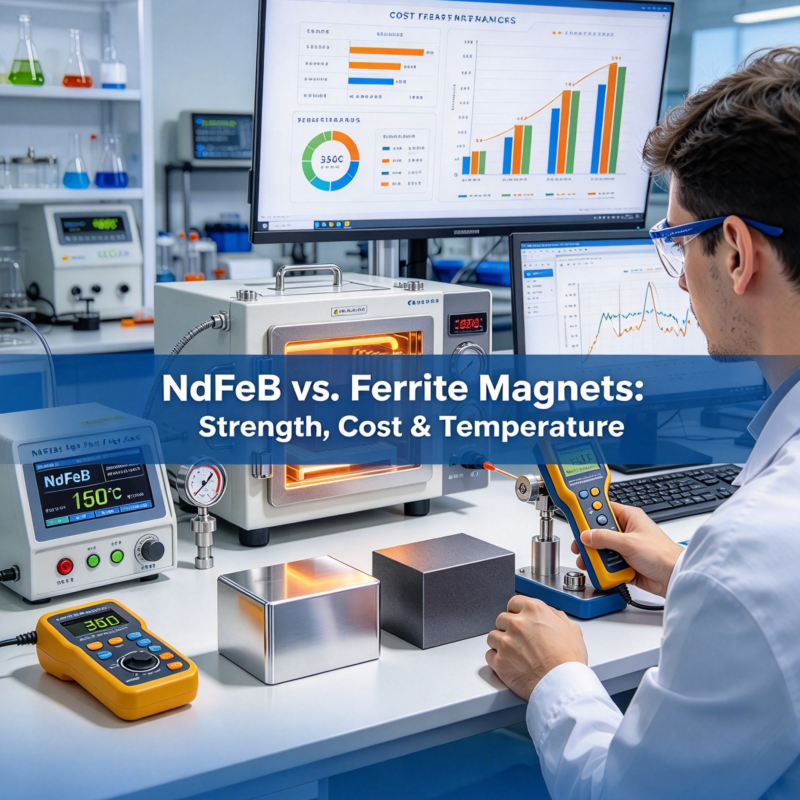
What Makes Neodymium Magnets So Strong? A Complete Guide for Everyday Use
Introduction: The World’s Strongest Permanent Magnet
If you’ve ever held two small neodymium magnets and felt them snap together with surprising force, you know there’s something special about these little silver discs. They’re the strongest type of commercially available permanent magnets—and they’re everywhere. Inside your smartphone’s vibration motor, holding your wireless earbuds in their charging case, keeping your cabinet doors closed, even powering the electric motors in hybrid and electric vehicles.
But what exactly makes them so strong? And why does a tiny magnet smaller than a coin sometimes outperform a much larger ceramic magnet?
This guide breaks down the science behind neodymium magnets in plain language, explores the different grades available, and shows you how to choose the right one for your everyday needs—whether you’re an engineer, a DIY enthusiast, or just someone curious about how these little powerhouses work.
The Nd₂Fe₁₄B Crystal Structure
At the heart of every neodymium magnet is a specific compound: Nd₂Fe₁₄B—two atoms of neodymium, fourteen of iron, and one of boron. This isn’t a random mixture; it’s a carefully engineered crystal structure that creates the perfect conditions for extreme magnetism.
Think of it like a crowded dance floor. In most materials, the dancers (atoms) are moving in all directions, so there’s no organized movement. In a neodymium magnet, the crystal structure forces the atoms to line up in a very specific way, all facing the same direction.
Magnetocrystalline Anisotropy: The Quantum Advantage
Here’s where it gets interesting. The immense strength of neodymium magnets comes from a quantum effect called magnetocrystalline anisotropy. In simple terms, the neodymium atoms have a strong preference—a very strong preference—to align their magnetic moments along a particular axis of the crystal.
Why does this matter? Because this preference means the magnet “wants” to stay magnetized in that direction. It resists being demagnetized. This resistance, combined with the iron’s naturally strong magnetism, creates a permanent magnet that packs an incredible amount of magnetic force into a very small volume.
Magnetic Domains: The Organized Army
Inside a magnet, atoms group together in regions called magnetic domains. Within each domain, all the atomic magnetic moments are aligned. In a demagnetized material, these domains point in random directions, cancelling each other out. In a magnetized neodymium magnet, the domains are all aligned in the same direction, creating a unified, powerful magnetic field.
The high magnetocrystalline anisotropy of Nd₂Fe₁₄B locks these domains in place, making them extremely difficult to disrupt. That’s why neodymium magnets don’t easily lose their strength—they’re designed to stay magnetized.
Understanding magnet strength isn’t just about how much weight it can hold. Here are the three key numbers that define a neodymium magnet’s performance:
Remanence (Br): The Magnetic “Footprint”
Remanence is the magnetic field strength left behind after the magnetizing field is removed. It’s measured in Tesla (T) or Gauss (G). Higher remanence means a stronger magnetic field at the surface. For comparison:
| Material | Typical Remanence |
|---|---|
| Ceramic (Ferrite) Magnet | ~0.4 T |
| Alnico Magnet | ~1.2 T |
| N35 Neodymium | ~1.17 T |
| N52 Neodymium | ~1.42–1.47 T |
A higher Br means the magnet can exert more force at the same distance.
Coercivity (Hc): Resistance to Demagnetization
Coercivity measures how much external magnetic field is needed to demagnetize the material. Intrinsic Coercivity (Hcj) is the field required to reduce the magnet’s internal magnetization to zero. Higher coercivity means the magnet can withstand stronger opposing fields without losing its strength—critical for applications like motors where strong opposing fields are present.
Maximum Energy Product (BH)max: The Overall Score
This is the single number that tells you how “powerful” a magnet is overall. It combines remanence and coercivity into one metric, measured in Mega-Gauss-Oersteds (MGOe). Neodymium magnets have the highest (BH)max of any commercial permanent magnet material, with top grades exceeding 50 MGOe.
| Magnet Material | Typical (BH)max |
|---|---|
| Ceramic (Ferrite) | ~3–4 MGOe |
| Alnico | ~5–10 MGOe |
| Samarium Cobalt | ~20–30 MGOe |
| Neodymium (N35) | ~35 MGOe |
| Neodymium (N52) | ~49.5–52 MGOe |
Put simply: neodymium magnets can be 6–10 times stronger than ceramic magnets of the same size.
Understanding Neodymium Magnet Grades: N35 vs N42 vs N52
All neodymium magnets are labeled with an “N” rating—N35, N42, N52, and so on. The number represents the maximum energy product in MGOe. A higher number means a stronger magnet for the same size.
The Grade Comparison
| Grade | Remanence (Br) | Energy Product (BH)max | Relative Strength |
|---|---|---|---|
| N35 | ~1.17 T | ~35 MGOe | Baseline |
| N42 | ~1.28–1.32 T | ~42 MGOe | ~20% stronger than N35 |
| N45 | ~1.32–1.38 T | ~45 MGOe | ~28% stronger than N35 |
| N50 | ~1.40–1.45 T | ~50 MGOe | ~43% stronger than N35 |
| N52 | ~1.42–1.47 T | ~49.5–52 MGOe | ~48% stronger than N35 |
Which Grade Should You Choose?
-
N35–N38: Good for general-purpose applications where cost matters more than maximum strength.
-
N42–N45: The sweet spot for most everyday and industrial uses—strong enough for demanding applications without the premium price tag of higher grades.
-
N50–N52: The strongest commercially available grades. Best when you need maximum force in the smallest possible space. However, higher grades typically have lower maximum operating temperatures, so they’re not always the best choice for high-heat environments.
A higher N-rating doesn’t always mean a better magnet for your application. N52 magnets are stronger but generally more brittle and have lower temperature resistance than lower grades. Always consider your specific operating conditions.
Neodymium magnets have quietly become essential components in countless everyday products. Here’s where they show up:
Consumer Electronics
Your smartphone’s speaker, vibration motor, and camera autofocus mechanism all rely on tiny neodymium magnets. The same goes for tablets, laptops, and wireless earbuds. The magnets in TWS earbuds serve two purposes: driving the speaker to produce sound and holding the earbuds securely in their charging case.
Home and DIY
Around the house, neodymium magnets are used for cabinet door closures, drawer latches, hanging pictures, and fixing furniture. They’re also found in magnetic jewelry clasps, handbag closures, and even high-end packaging.
Automotive and Industrial
Electric vehicle motors rely heavily on neodymium magnets for their high torque-to-weight ratio. They’re also used in wind turbines, industrial sensors, medical devices, and countless other applications where compact, powerful magnets are needed.
Industrial Automation
In modern industrial automation, neodymium magnets are essential components that directly impact performance, precision, and reliability. Here are three of the most critical applications:
Servo Motors
Servo motors are the workhorses of precision motion control. They’re found in CNC machines, robotic arms, packaging equipment, and automated assembly lines. Inside a servo motor, neodymium magnets are mounted on the rotor to create a powerful, stable magnetic field that interacts with the stator windings. The high energy product of neodymium allows servo motors to deliver high torque output in a compact form factor, with rapid acceleration and deceleration. The magnets also maintain consistent performance across a wide speed range, which is essential for applications requiring precise positioning and speed control.
Robotics
From articulated robotic arms to collaborative robots (cobots) and autonomous mobile robots (AMRs), neodymium magnets are everywhere in robotics. They’re used in:
-
Joint actuators: Providing high torque density for compact, powerful robot joints.
-
Linear actuators: Enabling precise linear motion for pick-and-place operations.
-
Magnetic grippers and end effectors: Allowing robots to handle ferromagnetic workpieces without mechanical clamping, reducing cycle times.
-
Sensors and encoders: Hall-effect sensors and magnetic encoders rely on neodymium magnets for precise position feedback, enabling closed-loop control.
The ability of neodymium magnets to deliver strong, consistent magnetic fields in small volumes makes them ideal for the space-constrained designs of modern robots.
Linear Motors
Linear motors are increasingly used in high-precision manufacturing, semiconductor fabrication, and automated inspection systems. Unlike traditional rotary motors that require mechanical conversion (e.g., ballscrews) to produce linear motion, linear motors generate direct linear motion through electromagnetic interaction.
Neodymium magnets are arranged along the motor’s stator (the “track”), while coils move along the track to produce thrust. The high magnetic flux density of neodymium allows linear motors to achieve:
-
High acceleration and speed – Critical for pick-and-place machines and high-speed sorting systems.
-
Sub‑micron positioning accuracy – Essential for semiconductor wafer handling and precision assembly.
-
Low maintenance – Fewer moving parts means less wear and lower maintenance costs compared to mechanical drive systems.
As factories move toward fully automated, “lights-out” production, the demand for high-performance neodymium magnets in linear motors continues to grow.
Why are neodymium magnets so brittle?
Neodymium magnets are sintered—made by pressing metal powder into shape and heating it. This process creates a very strong magnetic material but also makes it brittle, similar to ceramic. Dropping one or letting two snap together can cause chips or cracks. Handle them with care.
Can neodymium magnets lose their strength?
Yes, but slowly. The main causes of strength loss are:
-
Heat: Exceeding the magnet’s maximum operating temperature causes irreversible demagnetization.
-
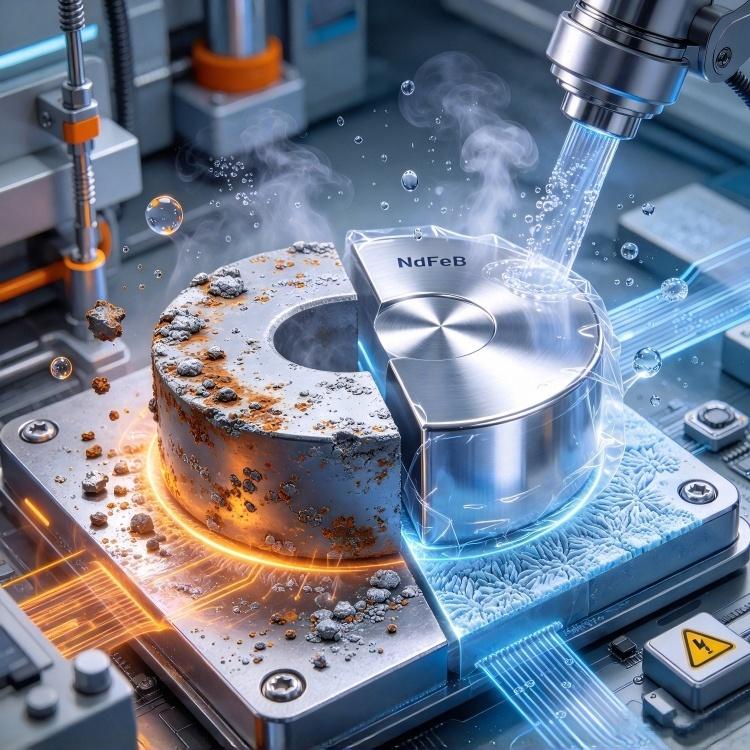
Corrosion: Without proper coating (nickel, epoxy, or gold plating), moisture can cause oxidation and flaking.
-
Physical damage: Cracks and chips disrupt the magnetic domains.
Are neodymium magnets dangerous?
Small neodymium magnets can be extremely dangerous if swallowed—especially multiple magnets, which can attract through intestinal walls. They can also interfere with pacemakers and other medical devices. Always keep them away from children and handle with care.
How can I tell if a magnet is neodymium?
Neodymium magnets are typically silver or gold-colored (due to nickel or gold plating), very strong for their size, and often heavier than they look. If a small magnet holds significantly more weight than a larger ceramic magnet, it’s almost certainly neodymium.
At DAWA Magnet, we’ve spent 35 years working with neodymium magnets and understanding exactly what causes them to fail. Unlike many suppliers that outsource critical steps—sintering, coating, or grinding—we control every stage of manufacturing in-house, from powder preparation to final inspection.
This vertical integration means:
-
Tighter magnetic consistency – Every batch delivers the same flux, the same snap, the same performance.
-
Better dimensional accuracy – We grind to micron-level tolerances, so your magnets fit perfectly every time.
-
Superior coating reliability – Our multi-layer nickel-copper-nickel plating passes rigorous salt-spray and humidity tests, protecting against sweat, moisture, and corrosion.
-
Faster customization – Need a specific shape, magnetization direction, or temperature grade? We can deliver, because we control the entire production chain.
35 years, one focus: making neodymium magnets right. From sintering to final coating, we keep the risks inside our own factory—so you don’t have to worry about them.
What makes neodymium magnets stronger than other magnets?
Their crystal structure (Nd₂Fe₁₄B) creates high magnetocrystalline anisotropy, which forces magnetic domains to align strongly in one direction. This, combined with iron’s naturally strong magnetism, produces the highest energy product of any commercial permanent magnet.
What does the “N” in N42 or N52 stand for?
“N” stands for neodymium. The number that follows (e.g., 42, 52) represents the maximum energy product in MGOe. Higher numbers mean stronger magnets.
Is a higher grade always better?
Not necessarily. Higher grades like N52 are stronger but typically more expensive, more brittle, and have lower maximum operating temperatures. Choose the grade that matches your application’s requirements for strength, temperature, and cost.
Can I use neodymium magnets outdoors?
Yes, but only if they’re properly coated. Uncoated neodymium magnets will corrode when exposed to moisture. Nickel, epoxy, and gold plating provide protection against humidity and oxidation.
How do I store neodymium magnets safely?
Store them in a cool, dry place, away from other metal objects and electronic devices. Keep them separated with non-magnetic spacers to prevent sudden snapping, which can cause chipping or injury. Always keep them out of children’s reach.
Does DAWA Magnet offer custom neodymium magnets?
Yes. We can customize magnets to your specific shape, size, magnetization direction, and performance grade. Contact our team with your requirements for a quick quote.
For more information, technical specifications, or to request samples, visit the DAWA Magnet website or contact our sales team directly.
Dawa Jiahao, facilitate innovation and mass production