If you’ve ever used a pair of true wireless stereo (TWS) earbuds, you’ve probably noticed that satisfying “click” when they snap into the charging case. You’ve also experienced the sound coming out of those tiny drivers. Both experiences rely on one unsung hero: magnets.
But here’s the thing—most people don’t realize that a single TWS earbud actually contains two completely different types of magnets serving two entirely different purposes. One makes sound. The other keeps your earbuds charged and secure.
Let’s break down exactly why magnets are indispensable in TWS earbuds, how they work, and why the quality of those magnets can make or break your product.
Inside every TWS earbud is a miniature speaker driver—usually a dynamic driver measuring just 5–8mm in diameter. Despite its tiny size, it needs to produce clear audio with decent bass and volume. How does it do that?
The principle is surprisingly simple:
-
A voice coil sits inside a magnetic field created by a permanent magnet.
-
When an audio signal (electrical current) passes through the voice coil, it generates its own electromagnetic field.
-
This new field interacts with the permanent magnet’s field, creating a mechanical force that pushes the voice coil back and forth.
-
The voice coil is attached to a diaphragm (the thin membrane you see in the driver). As the coil moves, the diaphragm moves with it, pushing air to create sound waves.
In short: electricity + magnet = motion = sound.
The stronger and more precisely controlled the magnetic field, the better the driver’s efficiency, transient response, and overall audio quality.
1. This is where it gets interesting. A TWS earbud doesn’t just have one magnet—it has two, and they serve completely different functions.
| Magnet Type | Location | Function |
|---|---|---|
| Speaker Magnet | Inside the driver unit | Creates the magnetic field that drives the voice coil and diaphragm to produce sound |
| Charging/Retention Magnet | In the earbud housing and/or charging case | Magnetically attracts the earbud to the charging case, ensuring secure alignment and reliable charging contact |
The Speaker Magnet
This is the magnet inside the driver. It’s a permanent magnet (almost always neodymium) that provides a stable, continuous magnetic field. The voice coil sits inside this field, and when current flows through the coil, the interaction creates the mechanical motion that produces sound.
In a typical TWS dynamic driver, the magnet is a small ring or disc positioned behind the voice coil. Its job is to provide a strong, symmetrical magnetic field across the entire range of the voice coil’s movement.
The Charging/Retention Magnet
This magnet is entirely separate from the speaker system. It’s positioned in the earbud housing (and often paired with another magnet in the charging case) to create a magnetic latch.
When you bring the earbud near the charging case, this magnet pulls it into the exact right position, aligning the charging pins perfectly. It also holds the earbud securely so it doesn’t fall out if the case gets jostled in your bag.
Some designs also use this magnetic connection to trigger power management: when the earbud snaps into the case, it automatically turns off and starts charging; when you remove it, it wakes up and reconnects to your device.
If you look inside almost any TWS earbud on the market—from premium brands to budget options—you’ll find neodymium-iron-boron (NdFeB) magnets. There’s a reason for that.
Unmatched Magnetic Strength in a Tiny Package
NdFeB magnets have the highest energy product of any commercial magnet material. They can generate a powerful magnetic field in a volume that would be impossible with ferrite or alnico magnets.
For TWS earbuds, this is critical. The driver cavity in a typical earbud is often less than 2 cubic centimeters. Within that space, you need a magnet strong enough to drive the diaphragm with enough force to produce decent volume and bass response.
A single NdFeB magnet weighing less than 0.5 grams can power a micro-speaker driver that produces over 80 dB SPL. Ferrite magnets simply can’t deliver that kind of performance at that size.
Better Audio Performance
NdFeB magnets don’t just save space—they sound better too. The stronger magnetic field allows for:
-
Tighter, more controlled bass
-
Better transient response (faster attack and decay)
-
Clearer mids and highs
-
Higher overall efficiency (more sound per watt of power)
The Practical Reality
For earbud manufacturers, the choice is straightforward: NdFeB is the only magnet material that can deliver the required acoustic performance within the physical constraints of a TWS design. It’s not a luxury—it’s a necessity.
Not all NdFeB magnets are created equal. When manufacturers cut corners on magnet quality, the problems show up quickly—and they’re often the kinds of issues that drive customers crazy.
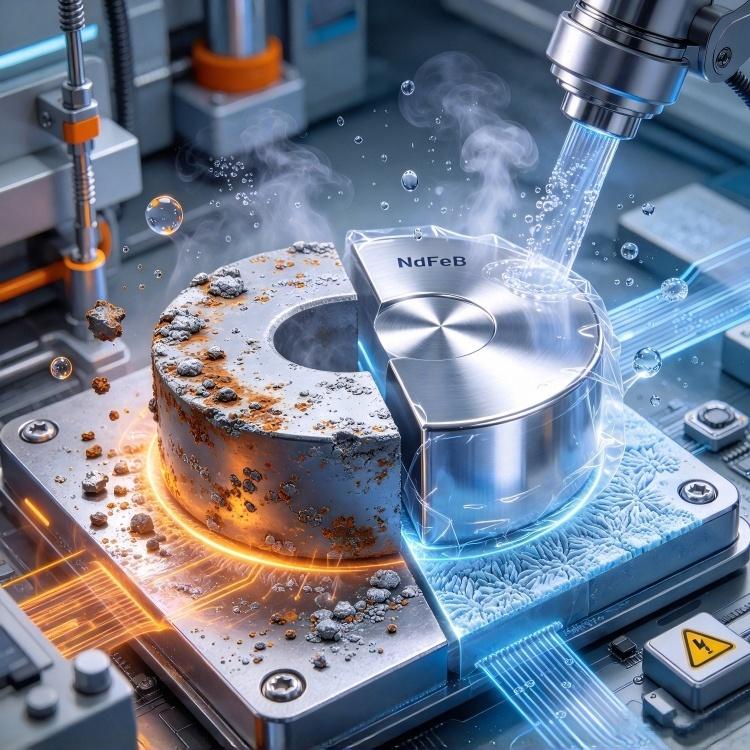
1. Corrosion and “White Fuzz”
NdFeB magnets are highly susceptible to oxidation. Without proper coating, they can corrode when exposed to moisture—and earbuds are constantly exposed to sweat, humidity, and skin oils.
A common sign of corrosion is a white, fuzzy residue on the magnet surface, often described as “white fuzz” or “efflorescence”. This is actually severe oxidation of the sintered NdFeB material.
Once corrosion starts, it can:
-
Degrade magnetic performance
-
Cause charging contacts to fail
-
Lead to intermittent charging or complete failure to charge
2. Charging Contact Failure
The charging magnets also serve as part of the electrical path. When the magnet surface corrodes, or when dirt and grease accumulate on the contact points, the electrical connection becomes unreliable.
This is one of the most common complaints in TWS earbud reviews: “My earbuds won’t charge unless I wiggle them in the case.”
3. Demagnetization from Heat
NdFeB magnets have a relatively low maximum operating temperature compared to other magnet materials. If the earbud gets too hot—from prolonged use, fast charging, or exposure to sunlight—the magnet can partially demagnetize.
The result? Weaker bass, lower volume, and irreversible performance degradation.
4. Inconsistent Magnetic Force
Poor manufacturing tolerances can result in magnets that are too weak or too strong. Too weak, and the earbud won’t stay securely in the case. Too strong, and users struggle to pull the earbud out.
Both scenarios create a poor user experience and increase return rates.
At DAWA Magnet, we bring something different to the table. Unlike suppliers that outsource sintering or coating—handing off critical steps to third parties and introducing quality variability—DAWA controls every key manufacturing process in-house, from powder preparation to final inspection.
This vertical integration isn’t just a talking point; it delivers tangible benefits:
-
Tighter magnetic consistency – Because we control the entire process chain, lot-to-lot variation in magnetic flux is minimized. Every batch performs identically on your assembly line.
-
Dimensional accuracy – We grind and cut our magnets to micron-level tolerances, ensuring they fit perfectly in the cramped spaces of TWS drivers and charging cases.
-
Reliable delivery schedules – With no external dependencies for critical operations, we can plan production and meet deadlines with far greater certainty.
We’ve been in the neodymium magnet business for 35 years, and we were among the first manufacturers in China to develop TWS-specific magnet solutions—back when true wireless audio was still an emerging category. This early involvement has given us extensive experience supporting TWS manufacturers through prototype validation, mass production, and quality consistency.
Our process covers the full spectrum:
-
Raw material formulation – We tailor the alloy composition for each application.
-
Sintering – Performed in our own furnaces under strict atmosphere control.
-
Precision cutting and grinding – Achieving the exact dimensions required.
-
Multi-layer coating – A robust nickel-copper-nickel system that passes salt-spray and humidity tests, essential for sweat-resistant earbuds.
-
Magnetizing and testing – Fully magnetized and inspected for flux uniformity before shipment.
Because we don’t outsource, we don’t pass quality risks downstream. When you source from DAWA, you’re getting a magnet that has been supervised at every stage by our own engineers—from the first sintering furnace to the final QC check.
What happens if the charging magnet corrodes?
Corrosion can interrupt the electrical connection, causing charging failures, intermittent contact, or complete inability to charge.
Why do almost all TWS earbuds use neodymium magnets?
NdFeB magnets offer the highest magnetic energy density, allowing powerful audio performance in the extremely limited space inside a TWS earbud.
Can a TWS magnet lose its strength over time?
Yes—especially if exposed to high temperatures or if the coating fails and corrosion sets in. Quality manufacturing and proper coating are essential for long-term reliability.
What makes DAWA Magnet’s TWS magnets different from others?
Unlike many suppliers that outsource sintering or coating, DAWA controls every manufacturing step in-house—from powder preparation to final inspection. This gives us tighter control over magnetic consistency, dimensional precision, and delivery schedules, backed by 35 years of NdFeB experience and a track record as one of the first TWS magnet specialists in China.
How can I tell if my earbuds have poor-quality magnets?
Look for white residue on the charging contacts, weak or inconsistent snap into the case, charging issues, or declining audio quality over time.
Dawa Jiahao, facilitate innovation and mass production